Best Ground Cover to Replace Grass
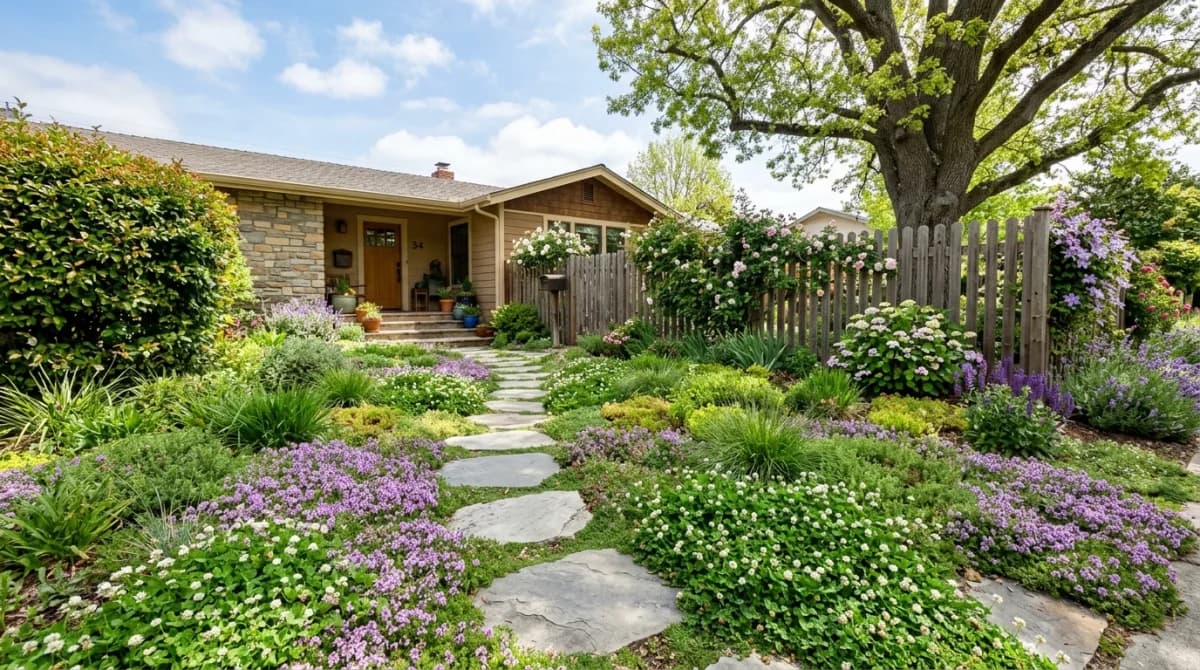
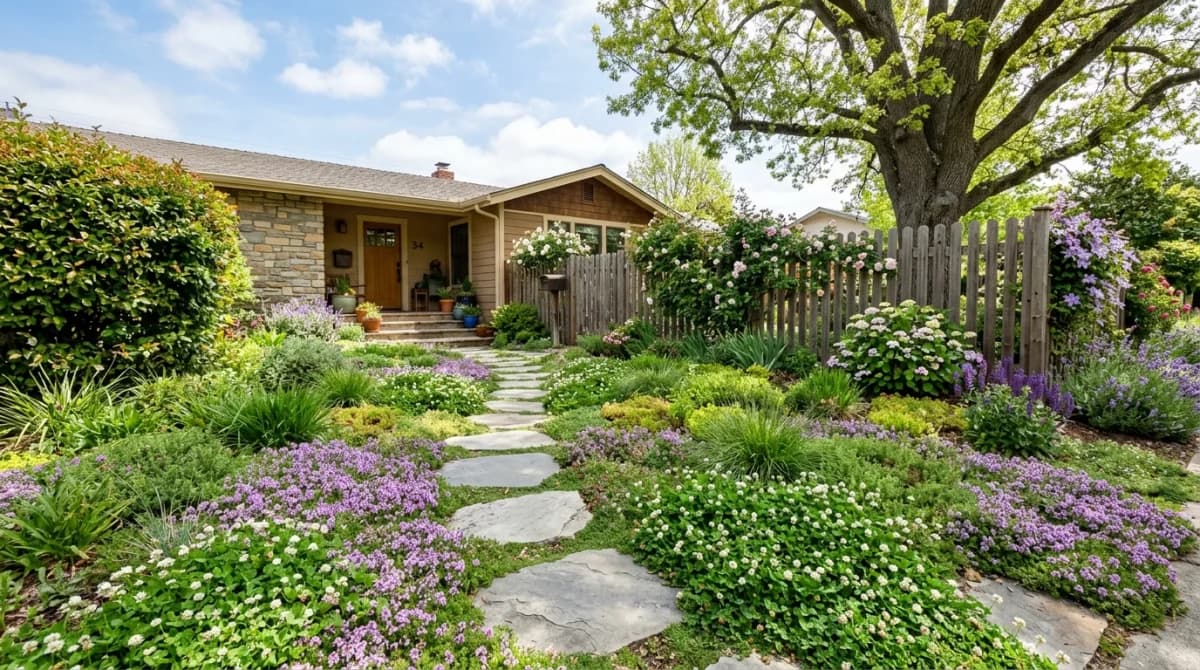
The average American spends 70 hours a year mowing their lawn. Add watering, fertilizing, aerating, and overseeding, and turf grass starts to look less like a garden feature and more like a part-time job. Ground cover plants offer a way out. They stay low, spread on their own, and once established, need almost nothing from you — no mowing, little watering, and zero fertilizer bags hauled from the garage.
Spring and early autumn are both good times to start. The soil is warm, seasonal rain does most of the watering, and plants get a full stretch of growing season to knit together before hard weather.
Quick Answer
The best ground cover to replace grass depends on foot traffic. For areas you walk on, use creeping thyme, brass buttons or dwarf mondo grass. For sunny areas you rarely walk on, use white clover, sedum or creeping phlox. For shade, use Pennsylvania sedge, sweet woodruff or wild ginger.
If you want the closest thing to a lawn you can still cross, white clover or Pennsylvania sedge are the two that come nearest, and clover is the cheapest by a wide margin because you sow it from seed.
Comparison Table
| Ground cover | Zones | Light | Foot traffic | Height | Spread rate | Notes |
|---|---|---|---|---|---|---|
| White clover (Trifolium repens) | 3–10 | Sun to part shade | Good | 10–15cm | Fast | Sow from seed, fixes nitrogen, cheapest option |
| Creeping thyme (Thymus serpyllum) | 4–9 | Full sun | Good | 5–8cm | Slow | Needs sharp drainage, fragrant, flowers for bees |
| Sedum (Sedum spurium, S. acre) | 3–9 | Full sun | Light only | 5–15cm | Moderate | Drought-proof, hates wet feet |
| Creeping phlox (Phlox subulata) | 3–9 | Full sun | None | 10–15cm | Moderate | Spectacular spring flowers, plain afterwards |
| Pennsylvania sedge (Carex pensylvanica) | 3–8 | Part to full shade | Light | 20–30cm | Slow | Native, the closest thing to a shade lawn |
| Sweet woodruff (Galium odoratum) | 4–8 | Shade | None | 15–20cm | Fast | Vigorous in moist shade, can overrun neighbours |
| Wild ginger (Asarum canadense) | 3–8 | Full shade | None | 15cm | Slow | Native, glossy, handles deep dry shade poorly |
| Brass buttons (Leptinella squalida) | 4–10 | Sun to part shade | Excellent | 2–5cm | Moderate | Genuinely walkable, fern-like texture |
| Dwarf mondo grass (Ophiopogon japonicus ‘Nanus’) | 6–11 | Part shade | Good | 5–10cm | Very slow | Evergreen, tidy, expensive to cover area |
| Miniature stonecrop (Sedum requieni) | 6–9 | Sun to part shade | Light | 1–2cm | Slow | For between pavers rather than open ground |
| Creeping Jenny (Lysimachia nummularia) | 3–9 | Part shade | Light | 5cm | Very fast | Invasive in parts of North America, check first |
Two of these will run. Creeping Jenny is listed as invasive in several US states and escapes readily into wetlands, so check your state list before planting it. Sweet woodruff spreads hard in moist shade and will swallow smaller neighbours. Both are fine in a contained bed and a problem next to a wild area.
Why Replace Lawn With Ground Cover
Before digging into specific plants, it helps to understand what you gain by making the switch.
Less maintenance. Most ground covers need mowing once a year at most — some never. Compare that with weekly mowing from April to October.
Less water. Turf grass typically needs one to one and a half inches of water per week during summer. Many ground covers survive on rainfall alone once their roots are established.
More habitat. A clover lawn feeds pollinators. A creeping thyme path releases fragrance when stepped on. Even a simple mat of sedge hosts beneficial insects that a monoculture lawn cannot.
Better aesthetics in tough spots. Steep slopes, dry shade under trees, narrow strips between pavement — these are places where grass struggles and ground covers thrive.
The Best Ground Covers for Sun
If the area you want to convert gets six or more hours of direct sun, these are your strongest options.
Creeping Thyme (Thymus serpyllum)
Creeping thyme forms a dense, aromatic mat two to four inches tall that erupts in tiny pink or purple flowers in early summer. It handles foot traffic well, thrives in poor soil, and is drought-tolerant once established. Plant plugs six to eight inches apart in spring and expect full coverage by the second season. Zones 4–9.
White Clover (Trifolium repens)
Clover is having a moment, and for good reason. It fixes nitrogen in the soil (so it feeds itself), stays green through moderate drought, and produces white flowers that honeybees love. You can seed it directly into existing lawn — just mow short, scratch the surface, and broadcast seed at two to four ounces per thousand square feet. It handles regular foot traffic and stays under six inches tall. Zones 3–10.
Creeping Phlox (Phlox subulata)
For a dramatic spring display, nothing beats creeping phlox. It blankets slopes and edges with sheets of pink, purple, or white flowers in April and May, then settles into a neat evergreen mat for the rest of the year. It prefers well-drained soil and does not tolerate heavy foot traffic, making it best for slopes and borders rather than paths. Zones 3–9.
Sedum (Sedum spurium, S. acre)
Low-growing sedums are nearly indestructible. They tolerate poor, rocky, or sandy soil where grass refuses to grow, store water in their succulent leaves, and spread steadily by trailing stems. Dragon’s Blood sedum adds burgundy foliage and pink flowers in summer. Plant plugs four to six inches apart. Zones 3–9.
The Best Ground Covers for Shade
Shady areas under trees are where lawns tend to thin out first. These plants actually prefer it.
Creeping Jenny (Lysimachia nummularia)
The golden-leaved cultivar ‘Aurea’ lights up dark corners with chartreuse foliage that carpets the ground in a dense, two-inch-tall mat. It tolerates moist soil and part to full shade, spreading quickly by rooting stems. Be aware that it is vigorous — contain it with edging where you do not want it to wander. Zones 3–9.
Sweet Woodruff (Galium odoratum)
Sweet woodruff is a woodland classic. Its whorled leaves form a tidy carpet six to eight inches tall, topped with delicate white star-shaped flowers in May. It smells like freshly cut hay when dried. It thrives in dry shade once established, making it perfect under mature deciduous trees. Zones 4–8.
Pennsylvania Sedge (Carex pensylvanica)
If you want the look of a lawn without the mowing, native sedge is your answer. Pennsylvania sedge grows eight to twelve inches tall in graceful, fine-textured clumps that blend together over time. It tolerates dry shade, deer browse it less than grass, and it needs mowing only once in early spring if you want a tidier look. Zones 3–8.
Wild Ginger (Asarum canadense)
For a bold, textural ground cover in deep shade, wild ginger delivers. Its large, heart-shaped leaves overlap to create a dense canopy six to eight inches tall that suppresses weeds effectively. It spreads slowly by rhizomes and tolerates even heavy clay soil. Zones 3–7.
Ground Covers That Handle Foot Traffic
If the area you are replacing is a path, play space, or high-traffic zone, you need plants that can take being stepped on.
Brass Buttons (Leptinella squalida)
This New Zealand native forms a tight, fern-textured mat just one inch tall. It stays flat under foot traffic, tolerates part shade to full sun, and spreads quickly in moist soil. The bronze-green foliage is attractive year-round. Zones 4–9.
Miniature Stonecrop (Sedum requieni)
At just half an inch tall, this is one of the lowest ground covers available. It fills cracks between stepping stones and pavers beautifully, producing tiny pink flowers in summer. It needs well-drained soil and full sun to part shade. Zones 6–9.
Dwarf Mondo Grass (Ophiopogon japonicus ‘Nanus’)
For a tidy, dark green ground cover between pavers or along paths, dwarf mondo grass is hard to beat. It grows two to four inches tall in neat clumps that slowly merge into a solid mat. It tolerates shade, is evergreen in mild climates, and never needs mowing. Zones 6–11.
How to Make the Switch
Replacing lawn with ground cover is straightforward, but doing it in stages keeps the project manageable and lets you learn what works in your specific conditions.
Start With One Problem Area
Do not try to convert your entire yard at once. Pick one area where the lawn already struggles — the shady spot under the oak tree, the dry strip along the driveway, or the slope you hate mowing. Convert that section first, learn from the experience, and expand from there.
Prepare the Ground
Kill or remove existing grass in the target area. The most reliable method is sheet mulching: lay two to three layers of corrugated cardboard over the grass, wet it thoroughly, and cover with three to four inches of mulch. Wait four to six weeks (or do this in fall for spring planting). The grass underneath will die without chemicals.
For faster results, you can cut the sod out with a flat spade, but this is labor-intensive for large areas.
Plant Densely
Ground cover success depends on closing the canopy quickly. Weeds fill any gap you leave. Space plants at the closer end of the recommended range and plan to mulch between them for the first season. For most spreading ground covers, plugs or small pots spaced six to eight inches apart will fill in within one to two growing seasons.
Water the First Season
Even drought-tolerant ground covers need consistent moisture while their roots establish. Water deeply once or twice a week for the first growing season. After that, most species can handle themselves.
Be Patient With Year Two
The first year, ground covers put energy into roots. The second year, they spread aggressively. By the third year, you will wonder why you ever bothered with a lawn. This timeline is consistent — trust the process.
Designing With Ground Cover
Ground covers work best when treated as a design element rather than just a lawn replacement. Mix textures by pairing fine-leaved sedge with bold-leaved wild ginger. Use flowering ground covers like creeping phlox to create seasonal focal points. Edge ground cover areas with stone, steel, or brick to create a clean boundary that reads as intentional rather than neglected.
If you are planning a larger redesign that combines ground covers with beds, paths and planting areas, an AI garden design from a photo lets you see the proportions before you start digging, which makes committing to turf removal considerably easier.
What It Costs
Clover is the outlier, because you sow it from seed. Everything else is bought as plants or plugs, and the cost scales with how fast it spreads.
| Approach | Cost per m² | Time to full cover |
|---|---|---|
| Clover from seed | $0.50–$2 | One season |
| Plugs at 4 per m², fast spreader | $12–$25 | 2 seasons |
| Plugs at 9 per m², moderate spreader | $25–$50 | 2 seasons |
| Potted plants at 9–16 per m², slow spreader | $60–$150 | 1–2 seasons |
Slow spreaders such as dwarf mondo grass and wild ginger are expensive to cover ground with, because you have to buy nearly full coverage up front. Fast spreaders let you plant sparsely and wait.
Frequently Asked Questions
The Long Game
Replacing lawn with ground cover is one of the rare garden projects where maintenance falls every year instead of rising. The plants thicken, weeds decline, and the hours behind a mower disappear.
Start with one section, pick for the traffic that area actually gets, and clear perennial weeds before you plant. By the following year you will be choosing which patch of lawn goes next.