Low-Maintenance Garden Design That Still Looks Great
The reason most gardens are high-maintenance is not bad luck or wrong plants. It’s bad design. Every hedge that needs trimming four times a year, every annual bed that needs replanting each spring, every patch of lawn squeezed into an awkward shape that takes twenty minutes to mow: these are design decisions, not inevitabilities.
A well-designed low-maintenance garden can be genuinely beautiful. Not a sparse, boring landscape with three boxwoods and a strip of mulch, but a lush, layered garden that takes care of itself most of the time. The trick is making the right decisions upfront about plants, layout, and materials so the garden works with natural processes instead of constantly fighting them.
Before you commit to a lower-maintenance layout, preview it with AI garden design so you can see whether larger drifts, reduced lawn, and simpler plant palettes still feel rich in your own space.
Here is how to design a garden that gives you most of the beauty for a fraction of the work.
Why Most Gardens Are High-Maintenance
Before fixing the problem, it helps to understand what causes it.
Too much lawn. Lawns are the most labor-intensive element in any landscape. Mowing, edging, fertilizing, watering, aerating, and overseeding all demand weekly attention from spring through fall. The more lawn you have, the more work you have.
Annuals instead of perennials. Annual flower beds look great but require complete replanting every year. They need constant deadheading, regular fertilizing, and daily watering in containers. Perennials do the same job and come back on their own.
Wrong plant, wrong place. A shade-loving plant in full sun spends its life stressed, which means it’s constantly fighting pests, diseases, and environmental damage. A sun-lover in shade gets leggy and sparse, never looking right. Plants in the wrong conditions need constant intervention to survive.
Formal shapes. Clipped hedges, topiary, and geometric beds require regular shaping to look intentional. A hedge that’s meant to be a tight rectangle needs trimming every few weeks. A hedge left to grow naturally needs pruning once a year.
Too many different plants. A garden with one of everything looks busy, has no visual rhythm, and requires learning the specific care needs of dozens of different species. Simplifying the plant palette reduces both visual complexity and maintenance.
The Design Principles
Reduce Lawn Area
Every square foot of lawn you convert to planted beds, ground cover, gravel, or patio reduces your weekly maintenance. You don’t have to eliminate lawn entirely; just reduce it to the amount you actually use and enjoy.
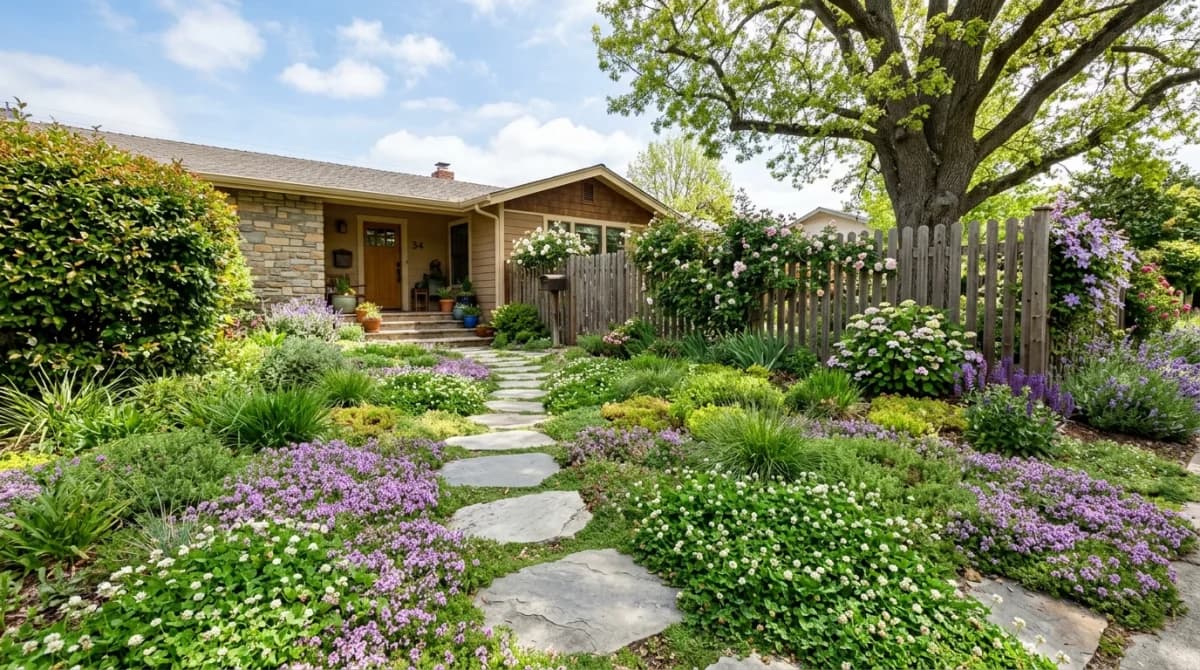
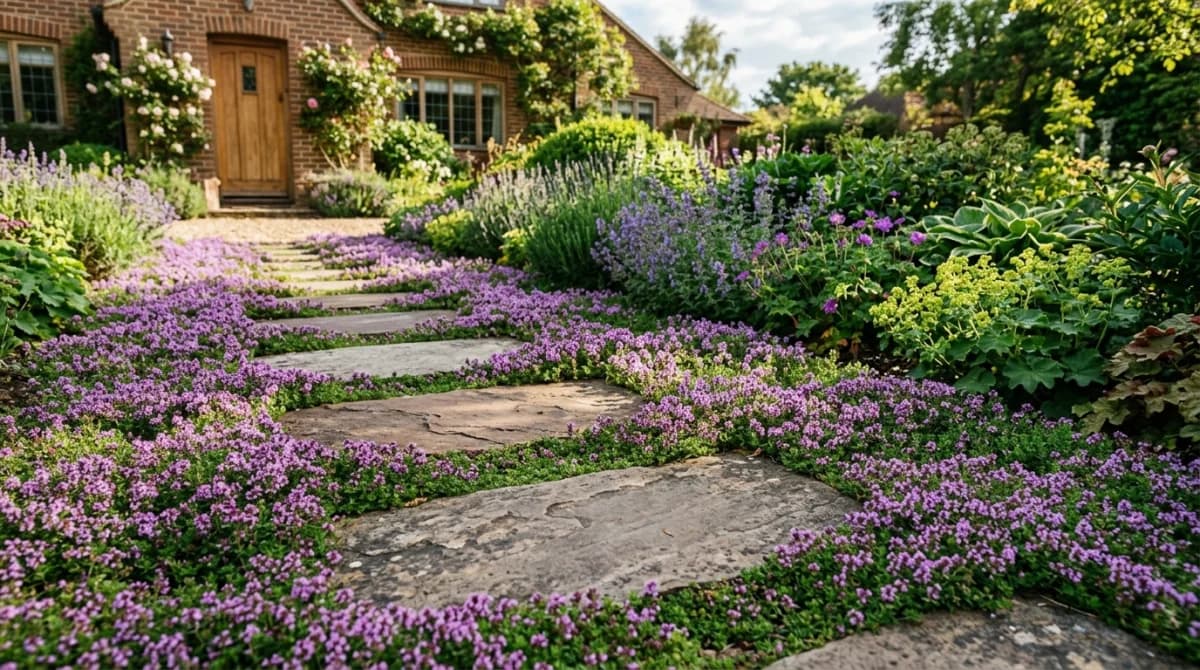
Replace lawn in shady areas (where it grows poorly and requires extra inputs) with shade-tolerant ground covers like pachysandra, vinca, or native sedges. Replace lawn on slopes (where it’s hard to mow) with low-growing shrubs or ground covers. Replace narrow lawn strips between beds and paths with mulch or stepping stones.
A smaller lawn that’s easy to mow in one pass is dramatically less work than a large, complex-shaped lawn with edges to trim.
Choose the Right Plants
Low-maintenance plants share these characteristics:
- Adapted to your climate and soil. Native plants are the ultimate low-maintenance choice because they evolved in your conditions. They need no supplemental watering once established, no fertilizer, and no pest control.
- Long-lived perennials. Plants that return for years are less work than those you replant annually.
- Disease and pest resistant. Choose varieties known for resistance rather than ones that need regular spraying.
- Don’t need staking. Plants that flop without support are work. Choose compact or self-supporting cultivars.
- Bloom for a long time without deadheading. Self-cleaning flowers like catmint, salvia, and geranium (cranesbill) drop spent blooms on their own.
Plant in Masses
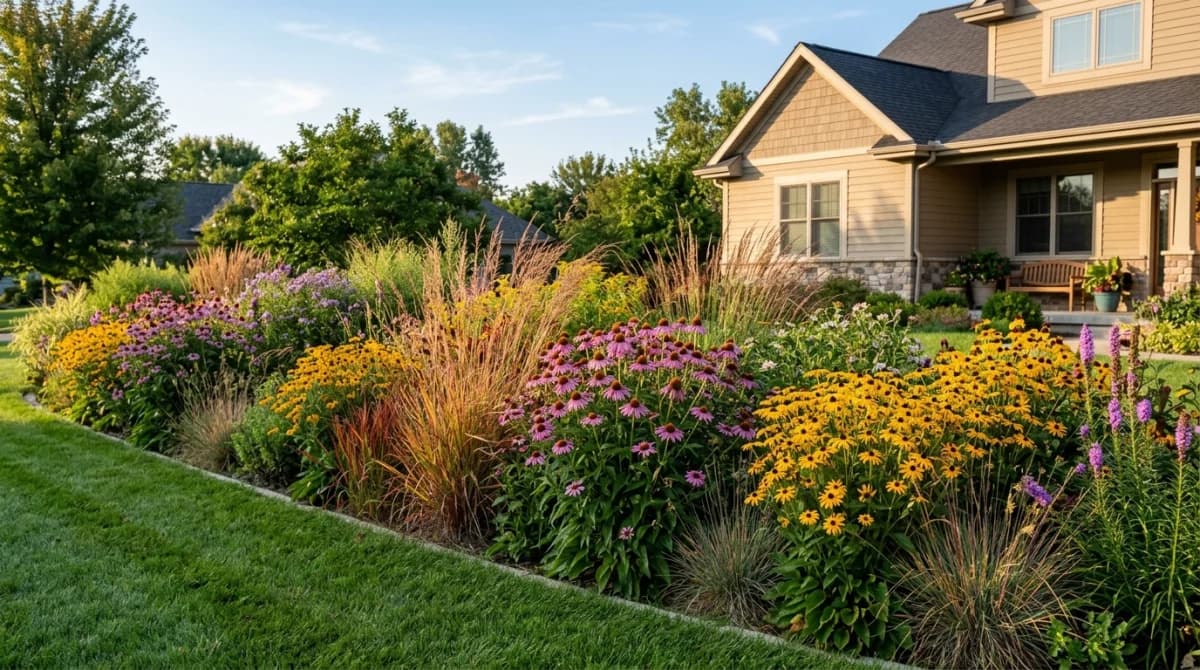
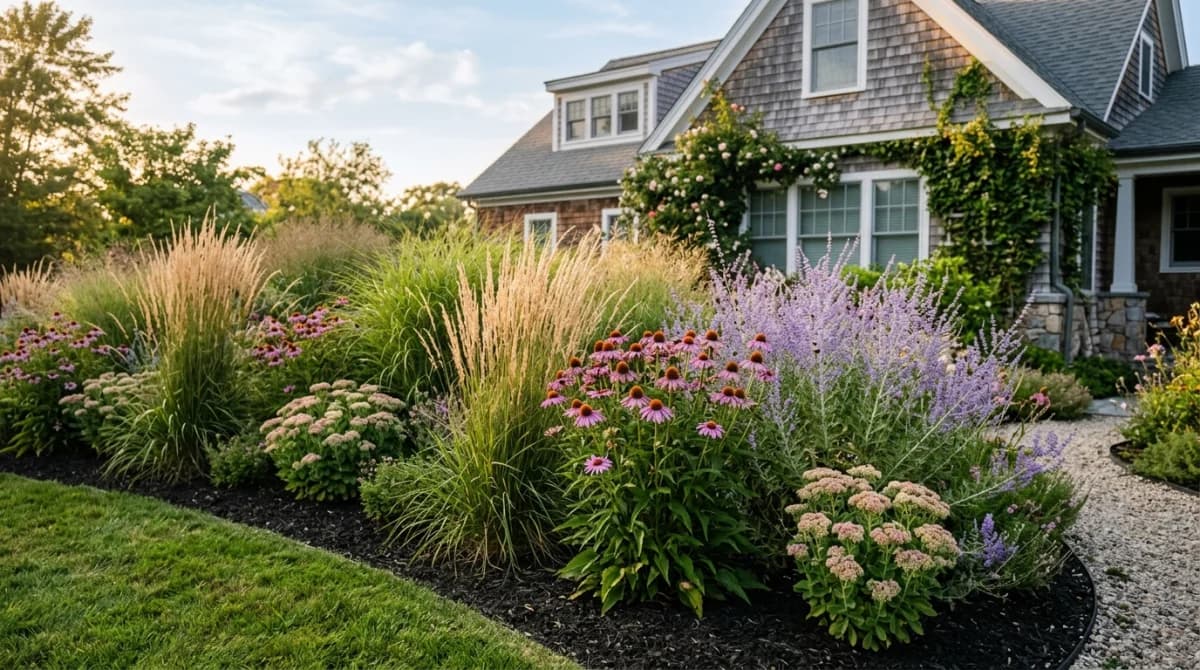
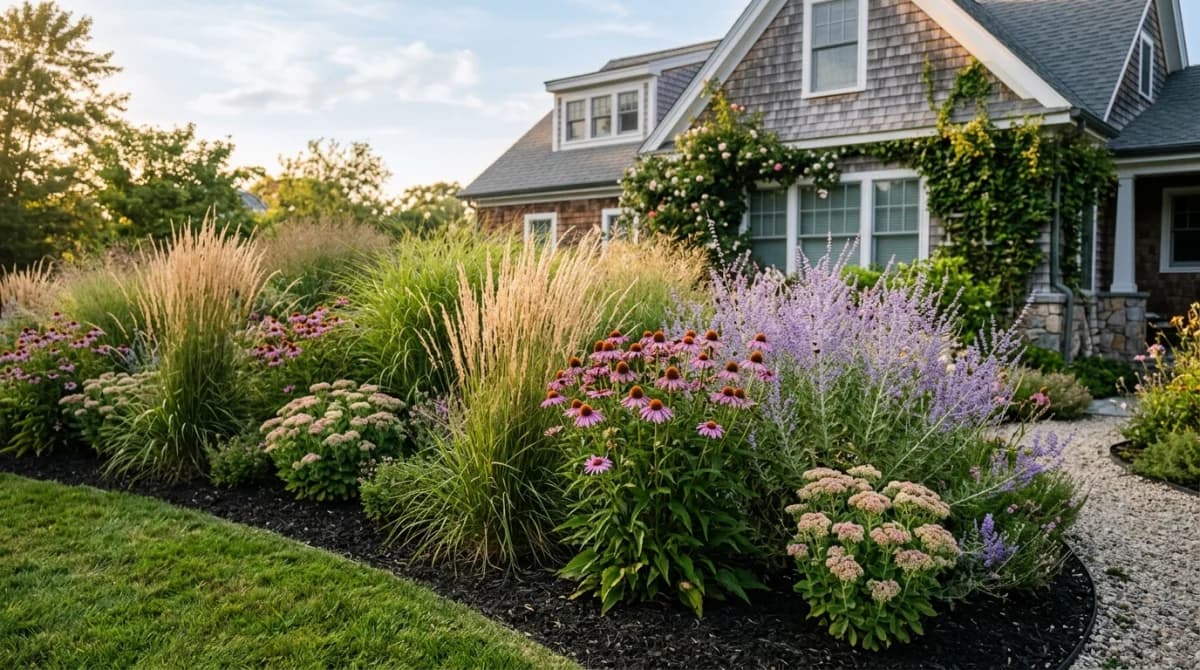
Instead of one of everything, plant groups of three, five, or seven of the same plant. Mass planting creates a cohesive look that’s more impactful than a scattered mix, and it simplifies care because you’re treating a group of identical plants instead of managing dozens of individual needs.
A border with five species planted in repeating drifts looks more designed and is easier to maintain than a border with twenty-five different species each represented once.
Use Hardscape Strategically
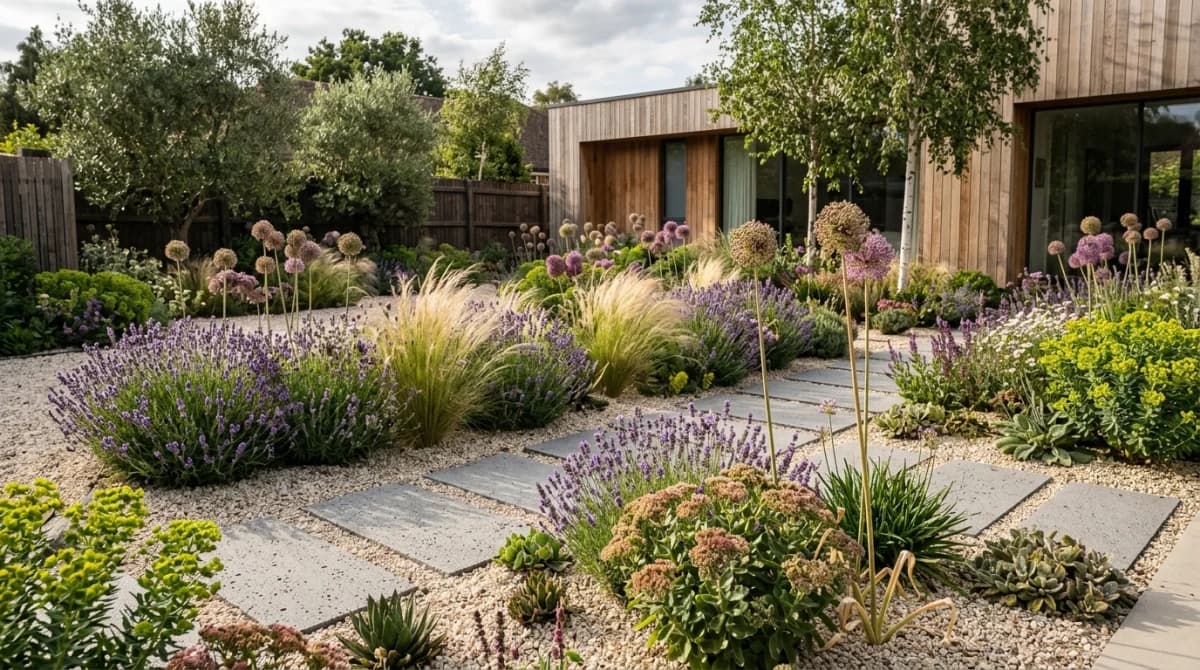
Gravel paths, stone patios, and well-placed walls don’t need mowing, watering, or pruning. They reduce the amount of garden that needs active care while adding structure and usability.
A gravel garden (a planting style that uses gravel as mulch with drought-tolerant plants growing through it) can be spectacularly beautiful and needs almost zero maintenance after the first year. No weeding, no watering, no mulch replacement.
The Low-Maintenance Plant List
Perennials That Earn Their Space
- Catmint (Nepeta): Blooms lavender-blue for months. Cut back by half after the first flush for a complete rebloom. Drought-tolerant, deer-resistant.
- Daylilies (Hemerocallis): Tough as nails, available in every color, bloom for weeks. Reblooming varieties extend the show.
- Sedum (Stonecrop): Succulent foliage, fall flowers, winter interest from dried seed heads. Thrives in poor, dry soil.
- Russian sage (Perovskia): Silvery foliage, lavender-blue flowers from July through October. Completely drought-tolerant once established.
- Hosta: The shade garden workhorse. Plant once, divide every few years. Virtually no care required except slug management in wet climates.
Shrubs That Don’t Need Pruning
- Dwarf fothergilla: Compact, spring flowers, spectacular fall color. Naturally stays 3 to 4 feet.
- Spirea ‘Little Princess’: Low mound of pink flowers in summer. Naturally 2 to 3 feet, no shaping needed.
- Arborvitae (compact varieties): Evergreen, naturally columnar or globular. Choose varieties that mature at the size you want.
- Hydrangea paniculata (compact cultivars): ‘Little Lime’ and ‘Bobo’ stay 3 to 5 feet without pruning.
Ground Covers Instead of Lawn
- Creeping thyme: Fragrant, flowers in summer, tolerates foot traffic, needs no mowing.
- Sedum (ground-hugging types): Drought-proof, evergreen, no care at all.
- Native sedges (Carex): Look like ornamental grass, need one annual mow-down, tolerate shade.
- White clover: Fixes nitrogen, stays low, soft underfoot, feeds pollinators.
The Maintenance Calendar
A well-designed low-maintenance garden needs roughly 12 to 15 hours of work per year, concentrated in a few seasonal bursts:
Early Spring (2–3 hours)
- Cut back ornamental grasses and perennials left standing for winter interest
- Pull any weeds that germinated over winter
- Apply a thin top-dressing of compost to beds (optional but beneficial)
- Divide any overcrowded perennials
Late Spring (2–3 hours)
- Mulch beds with 2 to 3 inches of bark or shredded leaves
- Set drip irrigation timers for the season
- One pass of weeding (mulch prevents most weeds)
Summer (1–2 hours total)
- Cut back catmint and other reblooming perennials after first flush
- Check irrigation is working
- Light weeding if needed (usually minimal in mulched beds)
Fall (2–3 hours)
- Leave most perennial seed heads standing for winter interest and bird food
- Move any tender plants indoors
- Clean up only truly messy or diseased material
- Shut down irrigation
That’s it.
The rest of the year, you walk through the garden and enjoy it.
Automated Irrigation
The single best investment for a low-maintenance garden is a drip irrigation system on a timer. It eliminates daily watering decisions, keeps plants consistently healthy, and lets you leave for vacation without worrying about coming home to a dead garden.
A basic battery-powered timer on a faucet, connected to soaker hoses or drip lines through your beds, costs under $50 and takes an afternoon to install. Many smart irrigation controllers adjust watering based on weather, so you don’t even need to change seasonal settings manually.
Designing Your Low-Maintenance Garden
The best time to reduce maintenance is before you plant. Planning the layout, choosing the right plants for each spot, and minimizing high-maintenance features at the design stage is infinitely easier than ripping things out and starting over.
Tools like Gardenly let you experiment with different layouts, test plant combinations, and visualize what your garden will look like before you commit. This is especially valuable for low-maintenance design because the whole point is getting it right the first time so you don’t have to redo it.
A low-maintenance garden is not a lazy garden. It’s a smart garden. One where every element earns its place, every plant is in the right spot, and the design works with nature instead of against it. The result is more beauty with less effort, which is the best kind of gardening there is.