Direct Sow These Summer Annuals in May for Months of Cheap, Easy Color
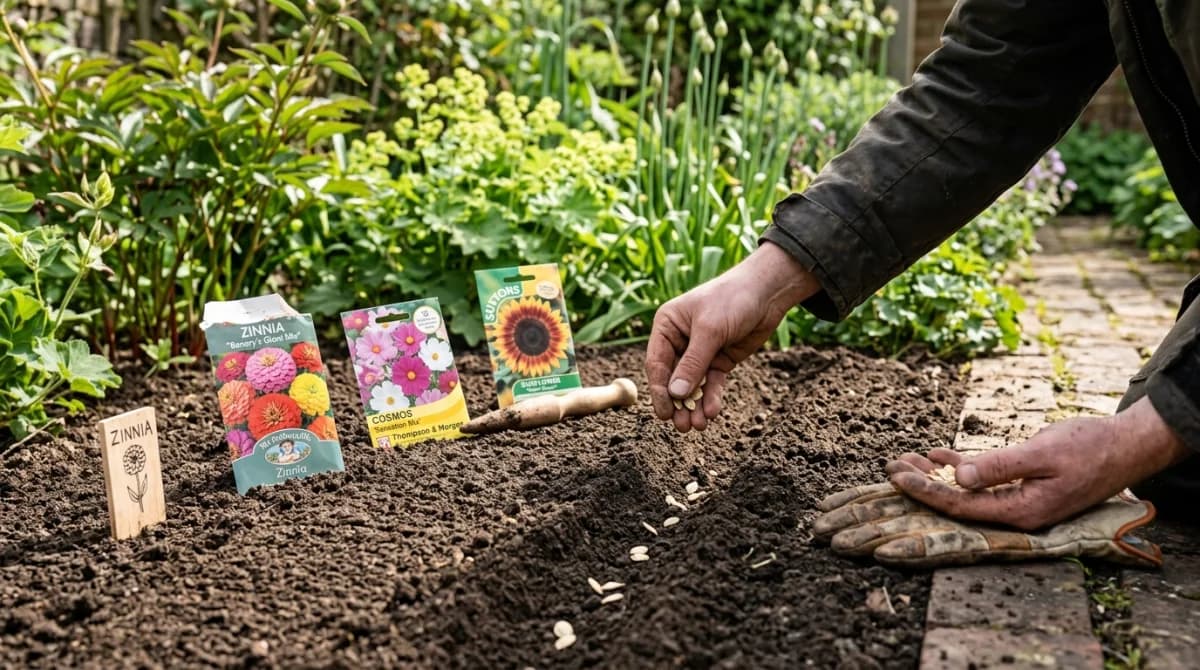
The most underrated job in early May is also one of the easiest. While the rest of the garden is being staked, mulched, and fussed over, a handful of summer annuals can be sown straight into the ground and left almost entirely alone. Six weeks later, those same seeds turn into a wall of color that runs from late June until the first frost knocks them down in October.
Direct sowing skips the whole indoor-seed-starting circus. There are no grow lights, no leggy seedlings reaching for a sunny window, no hardening-off shuttle in and out of the garage. The seeds go in the ground when the soil is warm, the plants grow up where they will live, and the roots never get disturbed. For the right species, the result is sturdier, faster-flowering, and far less work than anything started indoors.
The catch is timing. Direct sowing too early, into cold wet soil, is one of the most common reasons gardeners decide they “can’t grow annuals from seed.” The seeds rot, the survivors grow slowly, and the bed looks bare for weeks while indoor-started plants from the garden center race ahead. The fix is simple: wait until the soil itself is warm, sow generously, and pick species that genuinely want to be sown directly.
When the Soil Is Actually Ready
Air temperature is a poor guide. A warm afternoon in late April with daffodils still going does not mean the soil has caught up. The reliable signal is soil temperature at planting depth — about an inch down — staying above 60°F for several days running. A cheap soil thermometer pushed into the bed at midmorning will tell you in seconds.
For most of zones 5 through 7, that threshold lands somewhere in the first two weeks of May. South-facing beds against a wall warm earlier; low-lying clay beds and shaded borders can lag by a week or two. If you sow into 55°F soil, the seeds sit and sulk. If you sow into 65°F soil, most of these annuals are up in five to seven days.
The other test is the lawn. If grass has been actively growing and needing mowing for a couple of weeks, the soil is past its winter stupor. A quick rake of the bed should turn up worms within a few seconds — another good sign that biology has restarted.
Five Annuals That Genuinely Want to Be Direct Sown
A long list of seed packets will say “may be sown direct,” but only a handful actually thrive that way. The rest do better with an indoor head start. The five below are the ones that will outperform transplants if you give them warm soil and a bit of patience.
Zinnias
Zinnias are the workhorse cut flower of summer, and they hate root disturbance. A zinnia transplanted from a six-pack will stall for a week or more before resuming growth. A zinnia direct-sown into warm soil will catch up and pass it within three weeks.
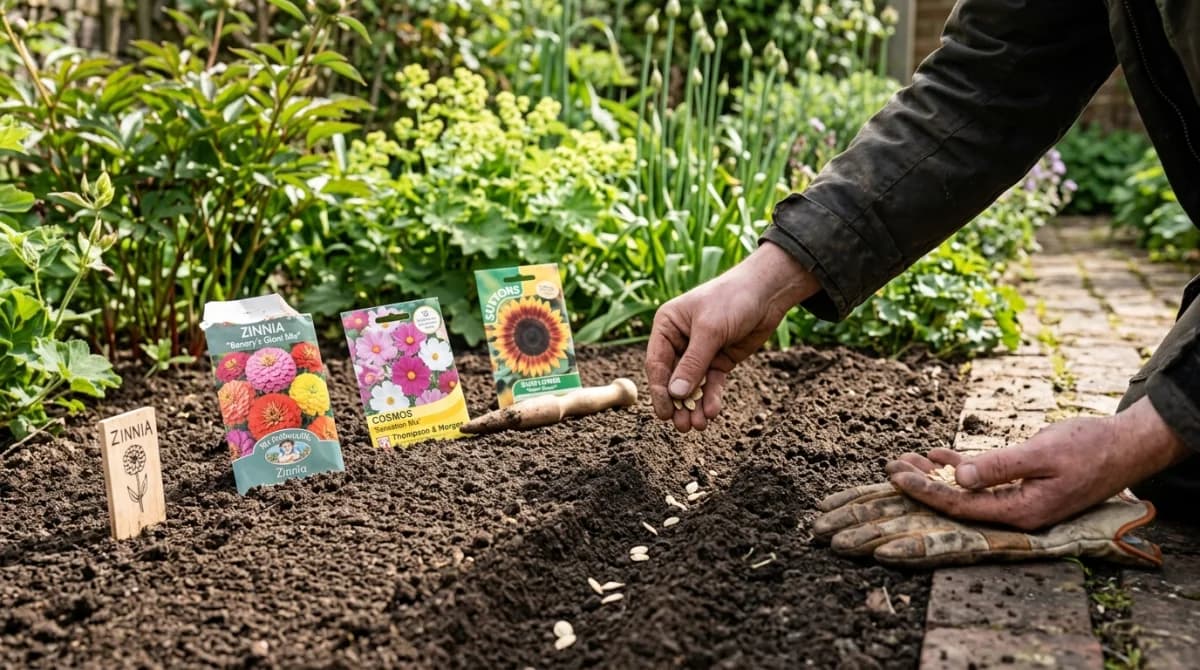
Sow about half an inch deep, three or four seeds together, with clusters spaced eight to twelve inches apart. Once the seedlings have two true leaves, thin to the strongest one per cluster. Resist the urge to skip the thinning — overcrowded zinnias produce smaller flowers and are far more prone to powdery mildew in August.
The ‘Benary’s Giant’ series gives the best stems for cutting; ‘Profusion’ and ‘Zahara’ types stay shorter and bushier and shrug off mildew better in humid summers. For a quick-results bed, mix both — Benary’s for vases, Profusion for the front of the border.
Cosmos
Cosmos are even tougher than zinnias and bloom on lean soil. In fact, a too-rich, freshly composted bed is the main reason cosmos grow into six-foot leafy giants with three flowers each. They evolved on dry hillsides, and they want that kind of treatment.
Sow quarter-inch deep, scattering seeds thinly along a row or in a drift. Thin to about a foot apart once seedlings are three inches tall. The ‘Sensation’ series is the classic tall cosmos for the back of a border; ‘Sonata’ stays under three feet for mid-border use; ‘Apricot Lemonade’ and ‘Xanthos’ bring softer color than the standard pink-and-white mix.
A row of cosmos along a fence, sown the first week of May, will be in flower by the last week of June and will keep going through October if you deadhead every week or two.
Sunflowers
Sunflowers want the same warm soil and even more sun. Sow direct an inch deep, three or four inches apart, then thin to the spacing the variety calls for — eighteen inches for branching cut-flower types like ‘ProCut’ or ‘Soraya’, three to four feet for the giant single-stem ‘Mammoth’ types.
The biggest mistake with sunflowers is sowing only once. A single planting gives a single big bloom flush that fades in two weeks. Succession-sow a fresh row every two weeks from early May through late June, and the garden has sunflowers in bloom continuously into October. A small notebook by the back door with the dates on it makes the difference between “I forgot” and a steady supply of stems for the kitchen table.
For pollinators, choose pollen-bearing varieties — the pollen-free hybrids bred for the cut-flower trade are useless to bees. ‘Lemon Queen’, ‘Italian White’, and most of the open-pollinated heirlooms are excellent for both bouquets and bees.
Marigolds
Marigolds are not glamorous, but a row of them along the edge of a vegetable bed solves a long list of small problems. They flower within six weeks of sowing, they bloom non-stop until frost, and the foliage seems to confuse some flying pests by sheer scent. Whether marigolds genuinely repel anything is debatable; what is not debatable is that they keep blooming when everything else is wilting in August.
Sow seeds quarter-inch deep, six inches apart, then thin to about a foot. French marigolds (Tagetes patula) like ‘Durango’ and ‘Bonanza’ are the compact bedding type. African marigolds (T. erecta), like ‘Crackerjack’, grow to three feet and make surprisingly good cut flowers if you can get past the sharp scent.
For an edible-garden edge, sow signet marigolds (T. tenuifolia), like ‘Lemon Gem’ or ‘Tangerine Gem’. The flowers are smaller but the foliage is delicate and citrus-scented, and the flowers are a real edible — bright, peppery, and lovely scattered across a salad.
Nasturtiums
Nasturtiums are the original lazy-gardener flower. The seeds are huge, easy to handle, and germinate reliably. They climb or trail without staking. They flower in poor soil where nothing else will. They are also entirely edible, leaves and flowers both, with a mustardy bite that is excellent in salads or open sandwiches.
Sow nasturtium seeds an inch deep, six inches apart. Soak them in water overnight first if you want to speed things up — the seed coat is thick. Trailing varieties like ‘Empress of India’ and ‘Jewel Mix’ will tumble down a wall or container edge. Climbing varieties like ‘Spitfire’ and ‘Tall Trailing Mix’ will scramble up six feet of pea netting if you give them something to grab.
One word of warning: nasturtiums in rich, well-watered soil produce huge quantities of leaves and almost no flowers. If the bed has been recently composted, push the seeds toward the leaner edges. The hungriest, sandiest, most-neglected corner is where they do their best work.
How to Actually Sow Them
The mechanics are simple, but a few details make the difference between a uniform stand and a patchy one.
- Rake the bed smooth and break up clods. Seeds need contact with soil. A lump of clay against a zinnia seed will keep it from germinating.
- Water the bed thoroughly the day before sowing. Sowing into wet soil and then watering on top tends to wash seeds around. Pre-wetting the bed gives even moisture without disturbance.
- Sow in drifts, not lines. Single straight rows of annuals look like a vegetable garden. A drift three or four plants wide reads as a planting.
- Cover seeds to roughly twice their thickness. Tiny seeds like cosmos get a barely-there dusting of soil. Big seeds like nasturtiums and sunflowers go an inch deep.
- Tamp the soil firmly with the back of a rake. Seeds need contact with the soil; a loose surface dries out fast and seeds shift.
- Mist with a fine spray or use a watering can with a rose. A blast from a hose nozzle will excavate everything you just planted.
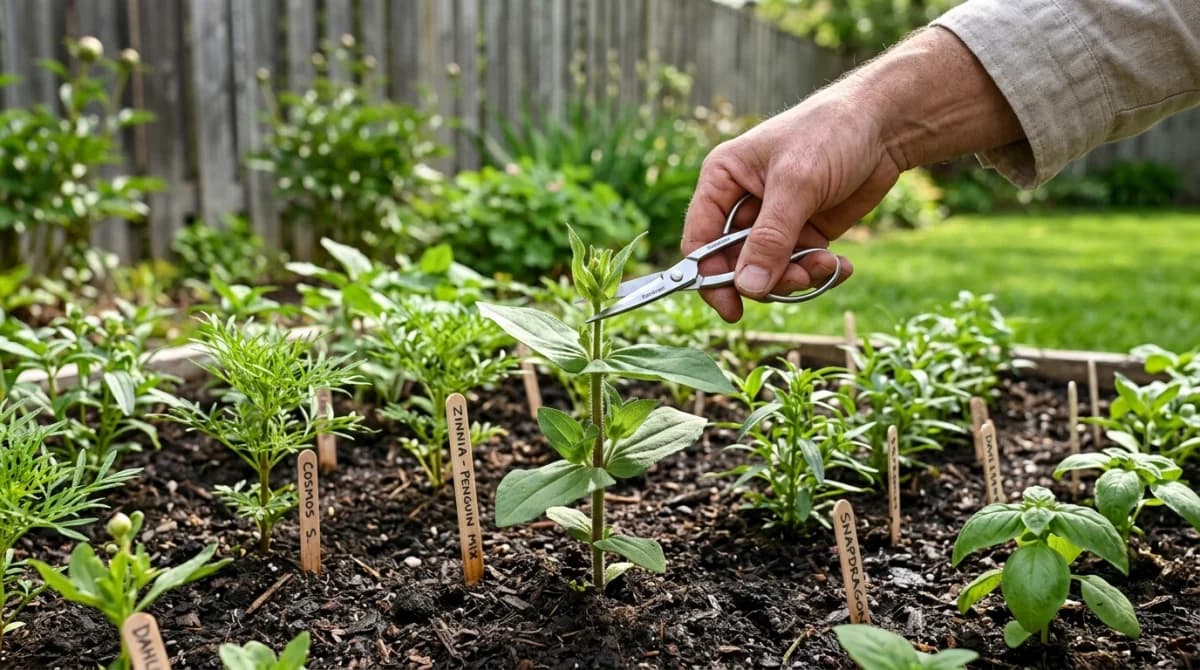
- Mark what you sowed. A label, a stick, anything. Two weeks later, when something starts coming up, you want to know whether it is the cosmos or a weed.
Keep Them Going Until Frost
The work is not quite over after germination. Three small habits keep these annuals in flower until October instead of fading in August.
Thin ruthlessly. Crowded annuals produce smaller flowers, fall over more, and mildew faster. The plants you pull out are not wasted — they were the cost of letting the survivors thrive.
Pinch the growing tip when seedlings are six inches tall. This applies especially to zinnias, cosmos, and branching sunflowers. A single cut just above a leaf node forces two side branches, and each side branch makes its own flowers. The plants flower a week later but produce two to three times as many stems.
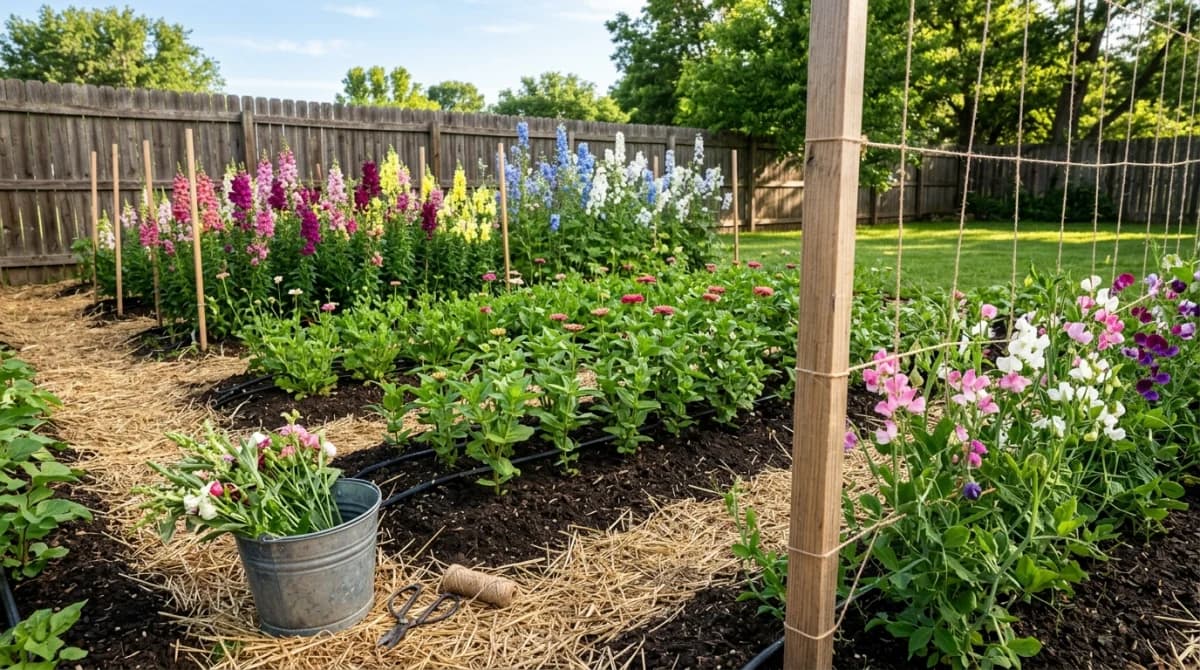
Deadhead or cut flowers regularly. Annuals are programmed to set seed and die. Every flower you cut for the kitchen table — or every spent bloom you snip off — is a signal to the plant to keep producing. A weekly walk with snips will double the bloom season.
By July, a five-dollar packet of zinnia seeds sown the first week of May will be producing more stems than any cut-flower bouquet from the supermarket, and the bed will keep going long after the early perennials have finished. If you are working out where these drifts of annuals fit alongside permanent plantings, Gardenly can help you sketch a border and see how heights and colors will read together at peak bloom.
A bed of direct-sown annuals is one of the few corners of the garden that does most of the work itself. The hard part is doing nothing in late April and trusting that mid-May is soon enough.
Sources
- Royal Horticultural Society — Annuals from Seed
- University of Minnesota Extension — Annual Flowers
- Cornell Cooperative Extension — Growing Cut Flowers
- Oregon State University Extension — Direct-Seeding Flowers