Plant Up a Hanging Basket This Weekend That Will Still Look Good in October
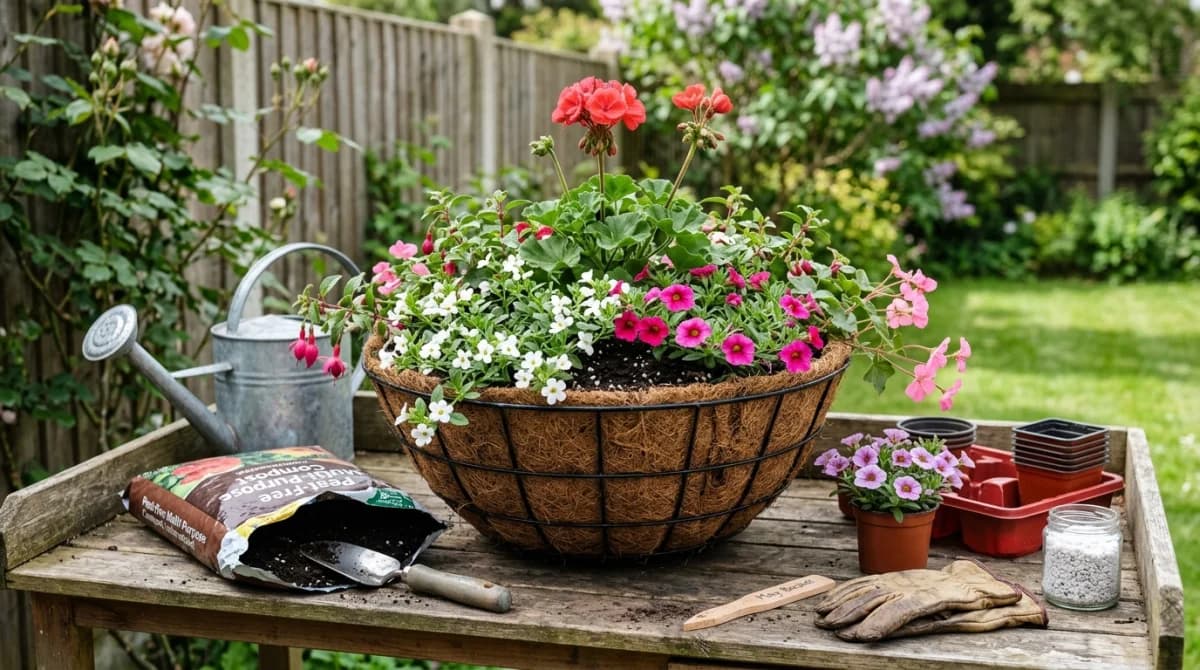
The hanging baskets that show up at supermarkets the weekend before Mother’s Day are the floral equivalent of a fast-food meal. They look fantastic at the till, last about eight weeks, and then turn into a brown skeleton hanging off the porch by mid-July. The reason is not the plants — it is the basket itself. A pre-planted basket has roughly four hundred millilitres of compost stuffed full of a dozen small plug plants, no slow-release fertiliser, and a coir liner so thin the soil dries out twice a day in the heat. Watered twice and skipped on a hot Sunday, it never recovers.
A basket built at home this weekend is a different object. With a slightly oversized container, a proper soil mix, a small amount of slow-release feed mixed in at planting, and three or four good plants instead of twelve crowded ones, the same basket carries colour from late May right through to the first frost. The work takes about forty minutes. Materials run roughly $40–60 depending on what you already have, against $35–60 for the supermarket version that dies in eight weeks. May is also the only month of the year when every plant on the list is in stock at the local nursery in flat-pack sizes that fit four to a basket.
Pick the Basket Itself, Carefully
The single decision that determines how often you have to water is the size and material of the basket. A 35–40 cm (14–16 inch) basket holds about three times the soil volume of the 25 cm version that comes pre-planted, and dries out roughly half as fast. In a sunny spot, that is the difference between watering once a day and twice a day in August.
Three formats work, in roughly this order of practicality:
- Solid plastic or fibre-clay bowls with a built-in saucer are by far the easiest to keep alive. They lose less water through the sides, the saucer catches overflow and gives the plants a small reservoir for hot afternoons, and the wider the bowl the better the proportions look full-grown. Look for ones at least 35 cm across.
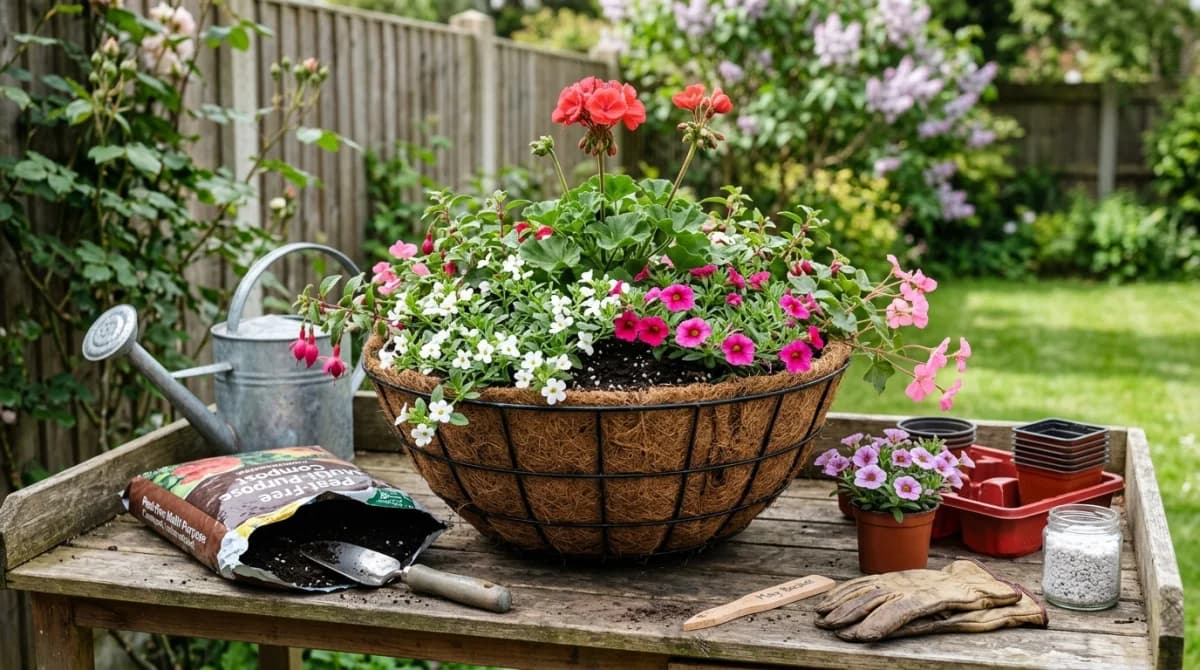
- Wire baskets with a thick coir or wool liner are the prettiest and the traditional English option. They allow side-planting, which is the trick that makes a basket look round and full from every angle. The trade-off is that they dry out faster and absolutely need a daily watering routine in summer. Use a wool liner if you can find one — it holds twice the water of coir.
- Self-watering hanging baskets with a hidden reservoir are an honest answer to the watering problem if the basket is hung somewhere awkward — a high pergola beam, a balcony railing you cannot easily reach. They look slightly less natural but extend the watering interval to two or three days.
Skip moss-lined baskets entirely. Sphagnum moss harvested from the wild is an environmental problem, and the substitutes labelled “moss” are usually shredded coir of poor quality.
The Soil Mix That Makes the Difference
A basket is a stress environment. The soil heats up faster than ground soil, dries out faster, and loses nutrients through the bottom every time you water. A bag of generic multi-purpose compost is not enough.
The mix that holds up best for a full season is roughly two parts good peat-free multi-purpose compost, one part soil-based loam (John Innes No. 2 in the UK, a bag of any “potting soil with topsoil” elsewhere), and a generous handful of perlite for drainage. The loam adds weight and a small mineral nutrient buffer that pure compost lacks; the perlite stops the mix going dense and airless after a month of watering.
Mix in two things at the start, dry, before any plants go in:
- A controlled-release fertiliser like Osmocote 5–6 month or any equivalent encapsulated NPK fertiliser, at the rate on the label (usually a small handful per basket). This is the single biggest reason home-built baskets out-bloom shop-bought ones — the prills release a small steady amount of feed every time the basket is watered for the next twenty weeks.
- A water-retaining gel at half the rate the packet recommends. Half rate, not full rate. Full rate makes the soil glug water and rot roots in cool weather; half rate adds a useful buffer for the hottest days without going slimy.
Do not bother with feeding rules involving liquid feed every Tuesday. With slow-release prills mixed in, a basket holds itself together until at least August. From August onward, switch to a weekly liquid tomato feed at half strength to push it through to October.
Thriller, Filler, Spiller — and Why It Actually Works
The classic container formula is one tall plant in the middle (the thriller), two or three medium-height plants around it (the fillers), and trailing plants around the rim (the spillers). It exists because it works on hanging baskets in particular: the basket is seen mostly from below and from the sides, never from above, and the formula gives every angle something flowering.
For a 35–40 cm basket, the right plant count is one thriller, three fillers, and three spillers — seven plants, not the twelve a supermarket basket comes with. Crowded baskets bloom hard for six weeks, then the plants run out of root space and stop. Seven well-chosen plants at the right spacing keep going for five months.
A few proven combinations for May planting:
Hot-coloured, sun-baked spot (south-facing porch, full sun all afternoon). Thriller: a single upright pelargonium in deep red (‘Caliente Fire’ or any zonal red). Fillers: three calibrachoa (“million bells”) in coral or orange — the tougher of the two main basket annuals and the longest-blooming. Spillers: three red or pink trailing verbena. The whole basket looks like a tropical cocktail by July and shrugs off heat.
Cool, soft, English-cottage look (east or west-facing, half day of sun). Thriller: a small-flowered fuchsia ‘Marinka’ or ‘Lady Boothby’ standard. Fillers: three white bacopa (Sutera cordata) — the most underrated basket plant, blooms non-stop. Spillers: three trailing lobelia ‘Lobelia richardsonii’ (it does not get the mid-summer collapse the older trailing lobelias do) or three ivy-leaved geraniums.
Shade or part shade (north-facing porch, dappled tree light). Thriller: a large coleus in a deep colour (‘Black Dragon’, ‘Wizard Pineapple’). Fillers: three impatiens (‘Beacon’ series is mildew-resistant and reliable now) or three Begonia ‘Dragon Wing’. Spillers: three trailing ivy or three lysimachia ‘Aurea’ for golden trailing foliage. This combination flowers steadily but is mostly a foliage basket — and foliage baskets are the longest-lived of the three styles, often still looking good in early November.
Pollinator basket (sunny, near the kitchen window). Thriller: a single tall white nicotiana (‘Nicki White’ is a good basket-sized cultivar). Fillers: three calibrachoa in purple or pink, and a small clump of trailing rosemary in one corner. Spillers: three nasturtiums (the trailing types like ‘Empress of India’) — edible flowers, peppery leaves for salads, and bumblebee magnets.
The plants on every list above are at every garden centre this weekend in 9 cm pots — the right size to plant straight into a basket without checking root development.
Planting Day
Forty minutes of work, in this order.
- Soak every plant in its small pot in a bucket of water for ten minutes before planting. A dry root ball does not take up water again easily once it is in the basket.
- Half-fill the basket with the soil mix. Mix in slow-release fertiliser and water-retaining gel at this point and stir through the soil with your hand.
- Gently squeeze each plant out of its plastic pot. If the roots are tightly circled at the bottom, tease them apart with your fingers — circling roots stay circled and never properly colonise the new soil.
- Set the thriller in the centre, then arrange the three fillers in a triangle around it, and the three spillers right at the rim, angled slightly outward. Leave about 4–5 cm between root balls. The basket will look thinly planted at this stage. It is supposed to.
- Top up with soil to about 2 cm below the rim — leaving a watering “well” so water does not pour over the edge.
- Water slowly until water runs clearly from the bottom. This first watering is the most important one of the season — it settles the soil into every gap.
- Hang the basket in its final spot. Do not move it around hunting for the perfect angle once the plants have rooted in; basket plants set their leaf orientation in the first week and resent being rotated more than once.
The Watering Routine That Actually Keeps It Alive
A 35 cm basket in full sun in July, with a healthy plant load, drinks roughly one to two litres of water a day. The single most common reason home baskets fail is a watering routine built around “every other day” rather than around how the basket actually feels.
The reliable test is to lift the basket. Once you have watered a basket properly to runoff, lift it once with your hand under it and remember the weight. Saturated, it is heavy. Two days later when it feels significantly lighter, it needs water — not because of the calendar, but because half the water reservoir is gone. In a heatwave, this can be every morning. In a cool damp week in June, it can be every fourth day.
Water in the morning if at all possible. Evening watering is fine in a heatwave but invites mildew on the leaves of nicotiana, geranium, and impatiens in cooler weather.
Two more rules that quietly determine whether the basket makes it to October:
- Deadhead pelargoniums, calibrachoa, and verbena once a week. Snap off the dead flower stems with finger and thumb. Five minutes of work; it doubles the second-flush bloom.
- From August onward, give a weekly liquid tomato feed at half the bottle’s rate. Slow-release prills are largely exhausted by twelve weeks, and the difference between a basket that dies in August and a basket that flowers into October is almost always the late-summer feeding.
If you want to see how a planted basket would actually look at mature size against your particular porch, fence, or pergola — and whether the colour combination works against the wall colour behind it — Gardenly lets you place containers and beds on a photo of your real space and previews them in full bloom. Particularly useful for hanging baskets, where the relationship between the colour of the flowers and the wall, brick, or siding three feet behind them makes more difference than people expect.
Why This Weekend in Particular
Frost danger is over in most of zones 5 and warmer, the soil mix is warm enough for the plants to root in within ten days rather than three weeks, and the nurseries are still fully stocked with the 9 cm cell-pack annuals that disappear by the end of May. Plant this weekend and the basket is rooted, fed, and starting its first heavy bloom by the time school finishes for the year. Plant in early June and the same basket is two weeks behind for the rest of the summer.
A home-built basket also makes a serviceable Mother’s Day gift if Sunday is the morning you remember. A 35 cm basket, half-planted on Saturday afternoon and finished off on Sunday morning over coffee, is a more thoughtful object than a supermarket basket and roughly the same money.
Sources
- Royal Horticultural Society — Hanging Baskets
- University of Illinois Extension — Successful Container Gardens
- Cornell Cooperative Extension — Container Vegetables and Flowers
- Missouri Botanical Garden — Annuals for Containers