Move Your Houseplants Outside for Summer Without Wrecking Them
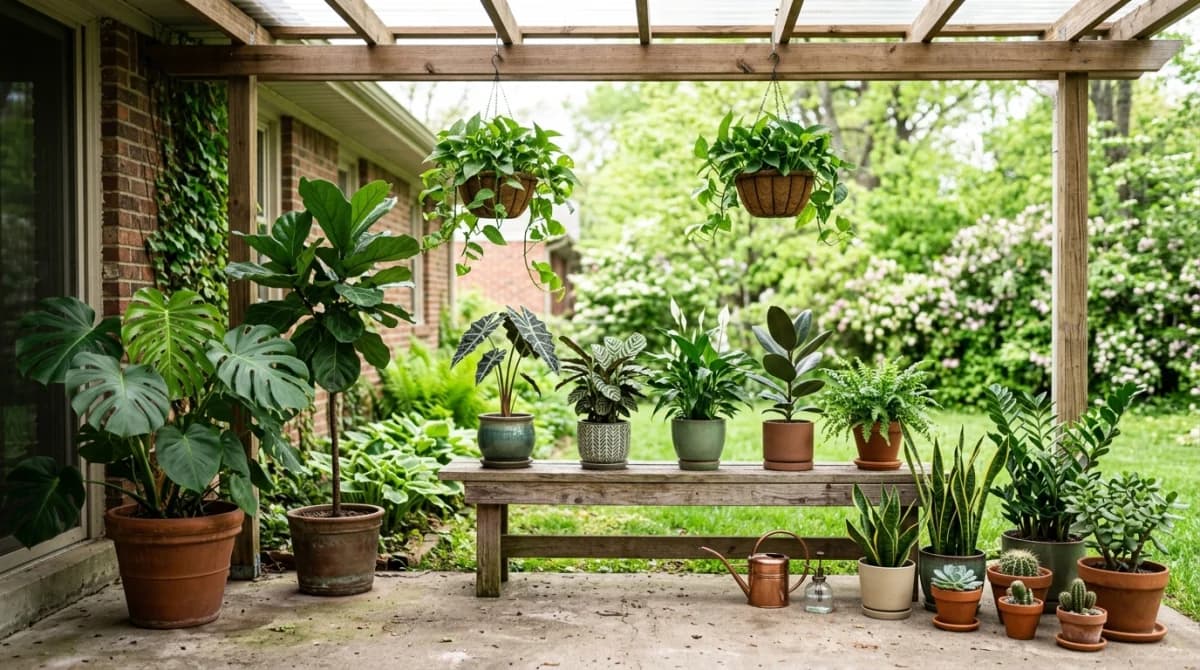
A monstera that put out two leaves all winter will put out six or seven in a single summer if you move it outside. The same is true of fiddle-leaf figs, pothos, philodendrons, hoyas, and almost every other tropical that spent the cold months stuck in a centrally heated room. Outdoor humidity, real airflow, and an order of magnitude more light turn most houseplants into different plants. The catch is that the move is also where most houseplants get wrecked. A pot left in direct sun for one afternoon comes back with bleached, papery patches that never recover. A windy day knocks a top-heavy fiddle-leaf onto its side and snaps the trunk. A pot that goes back inside in September brings spider mites, fungus gnats, and three kinds of scale with it.
Early May, in most temperate climates, is the right window to start. The trick is to do it in stages and to plan the return trip before the holiday weekend, not after it.
Wait Until Nights Stop Dipping Below 10 °C (50 °F)
The single most common mistake is moving tropicals outside during the first warm week, then losing them to a clear cold night two days later. Most common houseplants — monstera, philodendron, anthurium, calathea, dieffenbachia, ficus, alocasia, hoya, peperomia — sulk visibly below about 12 °C and start losing leaves below 10 °C. A single night at 5 °C can permanently mark a calathea or an alocasia.
Watch the ten-day forecast, not the daytime high. The rule of thumb is the same one you use for tomatoes and basil: when overnight lows are reliably above 10 °C (50 °F) for at least seven nights running, you can move the tropicals out. Cold-tolerant houseplants — jade, most succulents, snake plants, ZZ plants, ponytail palms — can go a few degrees colder, but there is no real benefit to rushing them.
If the forecast turns on you after the move, the rescue is simple: pull the most tender ones (calatheas, alocasias, anthuriums, fittonias) back inside or into a garage for the cold nights. The hardier crowd can stay out under a sheet.
Almost Every Houseplant Wants Shade Outdoors
The second most common mistake is putting the plant where you think a houseplant belongs — on a sunny patio table, on the front step, on the deck rail in full afternoon sun. Indoor “bright light” is roughly equivalent to outdoor deep shade. A monstera that lived happily two feet from a south window has been growing in something like 1500 to 3000 lux. Direct outdoor sun, even in May, is 50,000 to 100,000 lux. Moving it from the window to the patio is like taking a houseplant out of a closet and putting it under a stadium spotlight.
The result is sunburn — pale, bleached, eventually crispy patches on the upper leaves. Sunburn does not heal. The damaged tissue stays damaged, and a badly burned plant has to grow new leaves to look right again.
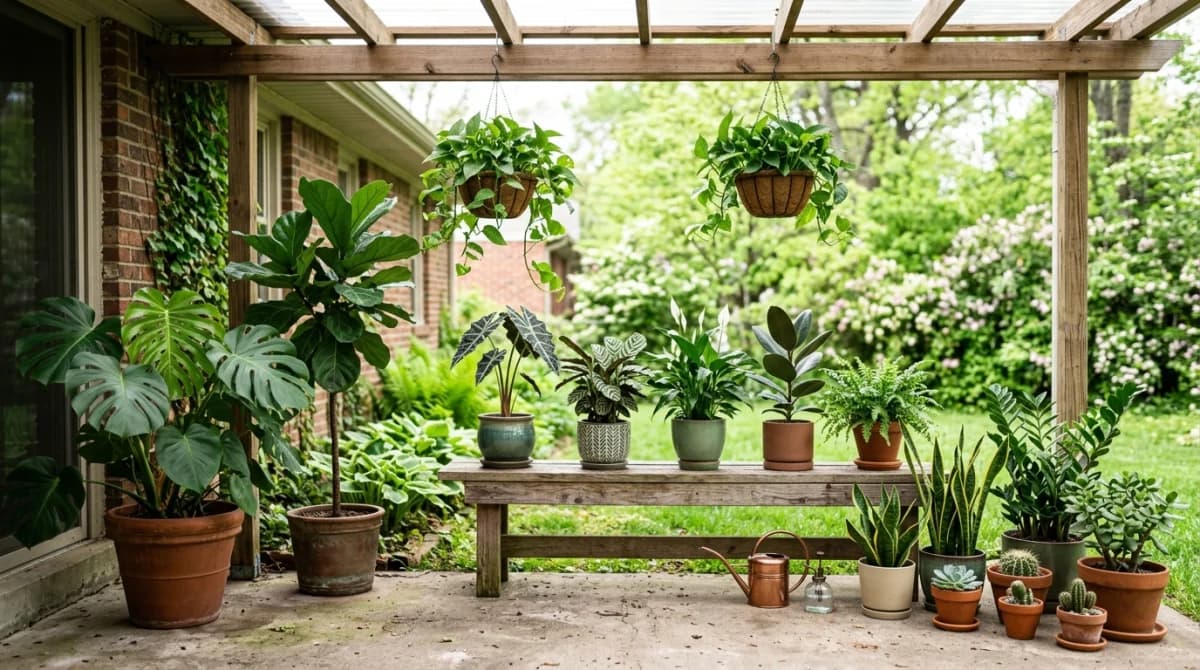
A safer mental model: almost every glossy-leaved tropical wants outdoor bright shade for the summer. That means under a tree canopy, on the north or east side of the house, under a pergola, on a covered porch, or behind taller plants. A few hours of early-morning sun is fine. Direct midday or afternoon sun, in May or any other month, will damage almost everything except cacti, succulents, citrus, plumeria, and a few other true sun lovers.
The way to find out is to spend five minutes walking around the garden in the middle of a sunny afternoon and noting where the shade actually falls. The shadiest place at noon in May is also going to be the shadiest place at noon in July, when the consequences of getting it wrong are worse.
Harden Off Like You Would a Tomato Seedling
Even moving a plant from the brightest window to the deepest shade outdoors is a bigger jump than it sounds. Outdoor light is brighter, indoor air is calmer, and the plant has to rebuild leaf surface chemistry before it can cope.
The same hardening-off routine that works for vegetable seedlings works here. Set the plants out in a sheltered, fully shaded spot — under a porch, against the north wall — for two hours the first day. Add an hour or two each day for a week to ten days, increasing exposure to wind and ambient light without ever letting them sit in direct sun. By the end of the second week, they can stay out full time. After that, if they are going to a brighter spot, move them gradually — a foot or two of brighter shade per day, never a sudden jump.
The plants that need this most are the soft, glossy-leaved ones: fiddle-leaf fig, monstera, alocasia, calathea, peace lily, anthurium, large-leaved philodendrons. The ones that need it least are succulents, snake plants, and ZZ plants — but even those benefit from a few days of acclimation rather than going from bedroom to patio in a single afternoon.
Repot Now, Not in August
If a plant is rootbound — circling roots, pushing up out of the pot, drying out within a day of watering — May is the right month to repot it, before it goes outside or in the first week or two after it does. A houseplant that goes outside into a too-small pot will hit a wall mid-summer just when it should be growing fastest. A repot in May gives the roots all summer to fill the new pot.
Two notes that save trouble later. First, go up only one pot size — from a six-inch to an eight-inch, not from a six-inch to a twelve-inch. Excess unrooted soil stays soggy, and soggy soil outdoors is even more of a problem than soggy soil indoors, because the plant gets rained on. Second, switch to a chunkier mix than the standard peat-heavy houseplant blend if you can. A 50/50 mix of houseplant potting mix and orchid bark, or potting mix with extra perlite and bark, drains faster — which matters when the plant is sitting outside through a thunderstorm.
Watering Changes Completely Outside
The watering schedule that kept everyone alive on the windowsill is the wrong schedule outside. Outdoor air moves. Sun heats pots through the wall. Wind dries leaves. A pot that needed watering once a week indoors might need watering every two or three days on a covered porch in June, and once a day if it ends up sitting in a warm corner.
The reliable rule is to water by feel and by weight, not by date. Push a finger an inch into the soil before reaching for the watering can. If it comes out with damp soil clinging to it, the plant does not need water yet. Lift the pot — a fully watered pot is noticeably heavier than a dry one, and after a week of this you can tell which is which without thinking.
Rain is a bonus, not a guarantee. A heavy downpour can leave a pot under an eave completely dry. Glossy-leaved tropicals like monsteras shed water down to the floor without much soaking the rootball. Always check before assuming nature did the job.
The Pest Conversation Has to Happen Now
The other reason to harden off in stages is that it gives the resident insects a chance to find your plants gradually instead of all at once. Outside, plants stop being sterile windowsill objects and start being ecosystems. That is mostly good — predator insects show up, pollination happens on flowering houseplants, and the constant moving air makes life difficult for spider mites and scale.
It is also where the autumn problem starts. Anything that is on the plants outside in September is going to come back inside in September. A clean inspection in early June and again in late July catches most of it before it becomes a winter infestation.
What to look for: fine webbing on the underside of leaves and along stems (spider mites — most likely on alocasia, calathea, ivy, and citrus); small brown or tan bumps on stems and leaf undersides that do not move (scale — common on ficus, citrus, hoya, jade); white cottony fluff in leaf joints (mealybugs — anything tropical); small flies rising from the soil when the pot is jostled (fungus gnats — overwatered everything).
Treatments depend on what shows up — insecticidal soap and horticultural oil handle most soft-bodied pests, systemic granules deal with persistent scale, and yellow sticky traps plus letting the soil dry between waterings handle fungus gnats. The point is to catch things in June, not in October when the plant is already coming back inside.
If you are working out where the houseplants and tender container plants actually fit into the larger summer garden — and where there is enough shade, shelter, and mid-summer interest to host them well — Gardenly can help you sketch the layout of porches, patios, and shaded corners alongside the rest of the planting before everything has to move.
Plan the Return Trip in September
The last piece is the one that catches almost everyone. A plant that has spent the summer outdoors, in higher light, higher humidity, and active growth, comes back inside in September to lower light, lower humidity, drier air, and central heating. The shock causes a wave of leaf drop on fiddle-leaf figs, ficus, and most large-leaved tropicals — sometimes alarming, but usually recoverable.
Two things make the return trip easier. First, reverse the hardening-off process. Two weeks before the move, start bringing the plants in for the night and back out during the day. By the end of the period, they have already adjusted to indoor humidity and air movement before they are stuck inside permanently. Second, treat preventatively for pests a week before the move. A thorough hose-down of the foliage and a soil drench with a mild insecticidal solution catches most hitchhikers before they make it back to the living room.
September feels like a long way away on May 4. It is not, especially compared to the difference a real outdoor summer makes to the size, color, and overall vigor of houseplants that have spent six months in dry indoor air. The plants that come back in this fall will look almost nothing like the plants going out this week.
Sources
- Missouri Botanical Garden — Houseplants Outdoors in Summer
- University of Maryland Extension — Moving Houseplants Outdoors
- North Carolina State Extension — Indoor Plants Outdoors
- Royal Horticultural Society — Houseplants: Summer Care