Design a Moon Garden in May for Evenings That Light Themselves
Most home gardens are designed for the middle of a sunny Saturday — the time of week the gardener walks out with a coffee and looks at the borders. The hours people actually use the garden are the opposite end of the day. Dinner outside on a Tuesday in late May. A glass of wine on the patio after the kids are in bed. The slow forty-five minutes between sunset and full dark when most of the year’s bedding plants disappear into a flat green wall and the only color left is whatever happens to be white.
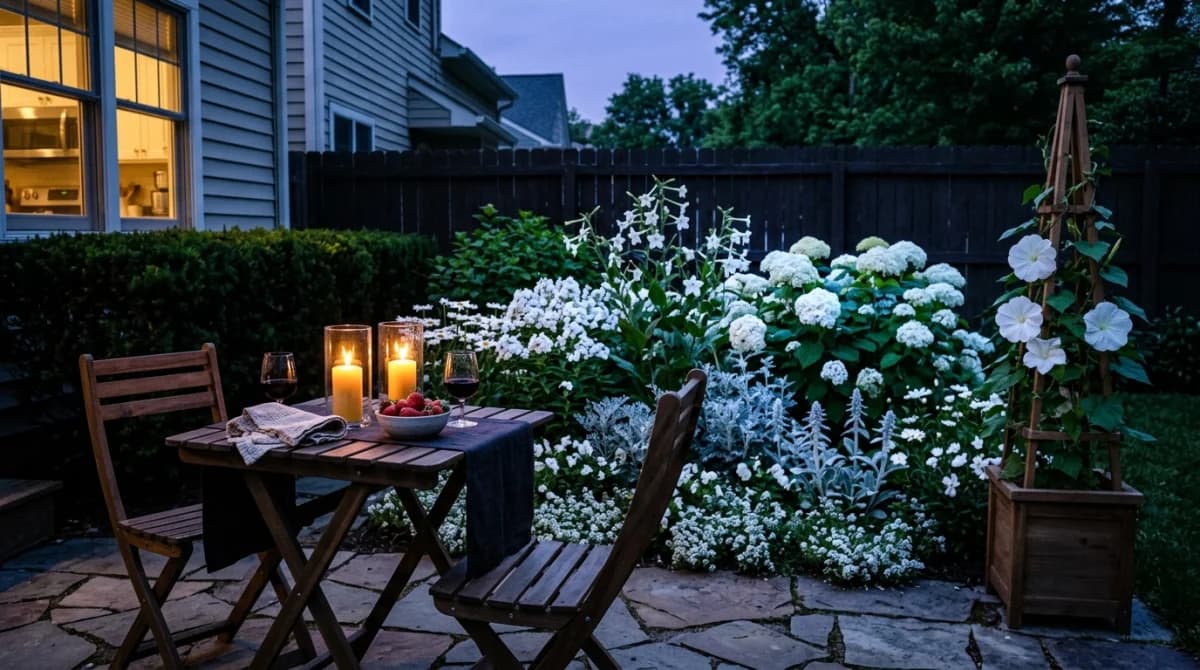
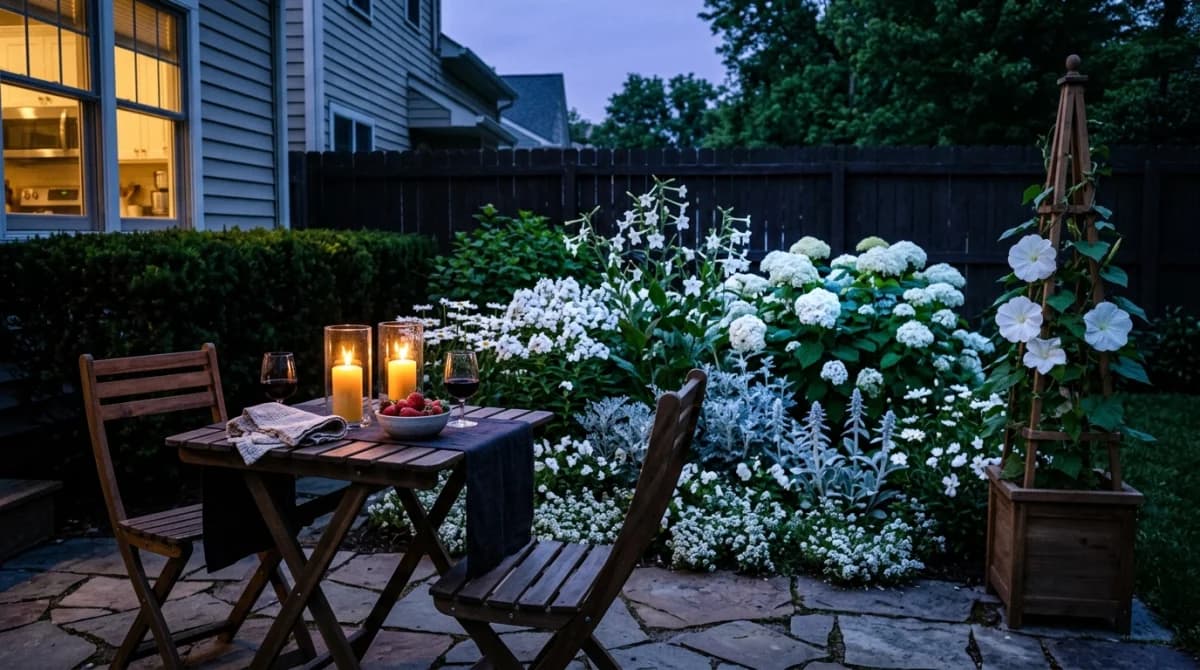
A moon garden is a deliberate design for those hours. It is a bed or a border planted almost entirely with white flowers, pale silver or variegated foliage, and a few night-blooming plants that release scent only after dark. By daylight it reads as a calm, slightly elegant white-and-silver border. After sunset, it does something more useful — it stays visible. Everything else in the garden flattens into shadow, and the moon garden glows as if backlit. If there is a back patio, a side path you walk in the dark, or a window you sit by after dinner, planting one in May is the single highest-return design move available this month. The plants you want are at the nursery now, the soil is workable, and most of these species hit their stride from June onward.
Why It Works
The eye loses color receptors in low light long before it loses contrast receptors. Reds, blues, and purples fade to a uniform dark gray within minutes of sunset. White, by contrast, holds a brightness almost equal to noon. A scarlet salvia disappears at dusk. A white phlox at the back of the same bed looks lit from inside. Silver and gray foliage — artemisia, lamb’s ear, dusty miller — does the same trick because those leaves reflect what little light is left from the sky and from any nearby house lights. Variegated foliage, especially with a strong white margin, behaves almost identically.
A handful of night-flowering plants then layer scent on top of the visual effect. Tobacco flower, evening primrose, moonflower, night-scented stock, and angel’s trumpet keep their flowers folded all day and open them at dusk, releasing strong perfume to attract moths. A patio planted with even one of these is unmistakably different at 9 p.m. than it is at 9 a.m.
The Plant Palette
The point is not to plant only white flowers — that produces a stiff, formal effect copied from Sissinghurst and rarely flattering at smaller home scale. The mix that holds up best in a residential bed has four layers.
Spring and early-summer flowering shrubs. A small to medium-sized white-flowered shrub anchors the bed and gives it presence even in winter. Reliable choices include white hydrangeas — particularly ‘Annabelle’ and ‘Limelight’ — viburnum ‘Mariesii’, a single white lilac for one big week of evening scent in May, and the smaller philadelphus cultivars like ‘Belle Étoile’ for a late-May to June flush of orange-blossom-scented flowers that double their volume after sunset.
Mid-border perennials. This is where most of the long-season visual work happens. White echinacea (the original ‘White Swan’ is still hard to beat), Shasta daisy, white Phlox paniculata ‘David’, white Japanese anemones for late summer and fall, white agapanthus in mild climates, and white astilbe for shadier corners. White peonies — ‘Festiva Maxima’ is the classic — cover the late-May to June gap and their faint sweet scent carries on still evenings. Add a few clumps of artemisia ‘Powis Castle’ or ‘Silver Mound’ between the flowering perennials to build the silver layer; the foliage holds its color from May to hard frost.
Front-of-border and edging. Lamb’s ear (Stachys byzantina ‘Big Ears’ is the best non-flowering form), white sweet alyssum, white lobularia, and the silvery-blue foliage of dianthus ‘Mrs. Sinkins’ — which also gives a white, very clove-scented flower — work along the front edge. White creeping phlox in spring, white violas, and a generous run of white candytuft (Iberis sempervirens) for the front of the border in April and May. Variegated euonymus or a low cushion of variegated thyme at the corners reads almost as bright as a flower from across the patio.
Annuals and night-bloomers for the patio side. This is the layer that does the heavy lifting after dark. Plant directly into the bed or into a few large pots set on the patio side of the border:
- White nicotiana — Nicotiana sylvestris (tall, statuesque, drooping flowers) and N. alata ‘Grandiflora’ (shorter, very strongly scented). Flowers open at dusk and pour out perfume that carries fifteen feet.
- Moonflower (Ipomoea alba) — a fast-climbing vine for an obelisk or mailbox post. Saucer-sized white flowers unfurl visibly in the half hour around sunset, hold all night, fade by 9 a.m.
- Night-scented stock (Matthiola longipetala) — small, plain by day, almost unrecognizable as the same plant after dark when the flowers open and release the strongest sweet scent of any annual you can sow from a packet.
- Evening primrose (Oenothera biennis and O. caespitosa) — yellow rather than white, but with the same dusk-opening behavior and a soft glow against silver foliage.
- Datura and brugmansia (angel’s trumpet) — large, dramatic, deeply scented. Toxic, so a poor choice in gardens with small children or curious dogs, but unmatched in a planter at the corner of an adult patio.
- White cosmos ‘Purity’ and ‘Sonata White’ for a cloud of small white daisies from July to October. Plant them now from cell packs or sow seed direct.
How to Lay It Out
A moon garden does not need to be large. A border ten feet long by four feet deep along the side of a patio, or a half-circle bed wrapped around a single seating area, is enough to change how the space feels at night. The single most important design move is to put the bed where you will see it after dark — the line of sight from the kitchen window, the stretch of fence behind the patio table, the low wall along the back deck. If the bed is placed for the daytime view from the lawn, it will not get used.
Three principles tighten the design.
Plant generously in single-color drifts, not as a polka dot of one of everything. Three nicotiana together read from across the garden. One nicotiana surrounded by salvias and zinnias disappears.
Repeat at least one silver foliage plant every six to eight feet. This is what stitches the bed together at dusk. A single clump of artemisia in the middle is not enough; a recurring rhythm of artemisia, lamb’s ear, and silver-leaved sage along the bed gives the eye landmarks once color drops out.
Site the most strongly scented plants closest to where you actually sit. A nicotiana ten feet away is pleasant. The same plant three feet from the table is a definite presence. A potted brugmansia at the corner of the patio is the difference between a nice border and a garden you do not want to leave.
Lighting, Background, and Containment
A moon garden does not need garden lighting to work, and most people who add lights to one ruin the effect. The flowers and silver foliage rely on residual sky-light and the reflected light from the house. If there is a path light or a string of bulbs over the patio, keep them warm and dim. Cool, bright LEDs flatten everything the bed is designed to do.
The background behind the bed matters. A dark fence, a hedge of yew or boxwood, a brick wall — anything that reads dark at night — makes the white flowers stand out more. A pale fence or white siding behind the bed can wash out the effect; in that case, plant taller dark-leaved shrubs (a viburnum, a black elderberry like Sambucus ‘Black Lace’) at the very back of the border to give the white flowers something to glow against.
Two of these plants are also vigorous enough to take over the bed if not contained. Mints and white-flowered varieties of evening primrose can run; plant in pots sunk into the soil if you want the flowers without the spread. Moonflowers and morning glories are annual in most zones and will not return, but they self-seed mildly and can be pulled in spring.
Setting It Up This Week
Most of the perennials and shrubs above are at garden centers now in two- and three-gallon pots. The annuals — nicotiana, white cosmos, moonflower — are either available as plug trays or are easy to sow from seed direct into warm May soil. A reasonable starter list for a four-by-ten-foot bed: one white hydrangea or philadelphus at the back, three white phlox, three Shasta daisies, three artemisia, two lamb’s ear, six white cosmos, six nicotiana, an obelisk with a moonflower vine, and a generous front edging of white sweet alyssum. Total nursery cost is usually well under $200 and the bed is full by the end of June.
If you are working out where exactly to put it — the line from the kitchen window, the angle from the patio chair, how big the bed needs to be to read from twenty feet away — Gardenly lets you sketch the bed in place against a photo of your actual patio and see how the planting looks at mature size before any of it goes in. Particularly useful for moon gardens, where the layout is genuinely about sight lines from one or two specific seats rather than about the daytime view from the lawn.
Why It’s Worth Doing in May
The plants are at their freshest and most available right now. The soil is warm enough to plant out everything on the list, and the bed is established before the first hot weeks of June, when the perennials need to put on their root growth. Most of these species — nicotiana, cosmos, phlox, hydrangea, anemone — are also at their longest bloom window from June through October, so a bed planted the second weekend of May pays off across the entire summer-evening season. By late June, the bed has filled in and the patio it borders has quietly become the most-used room in the house.
Sources
- Royal Horticultural Society — White Garden Planting Ideas
- Missouri Botanical Garden — Plants for Evening Gardens
- North Carolina State Extension — Moon Gardens: Plants That Glow at Night
- University of Vermont Extension — Night Blooming Plants for the Garden