Pinch Your Annuals Now for Twice the Flowers This Summer
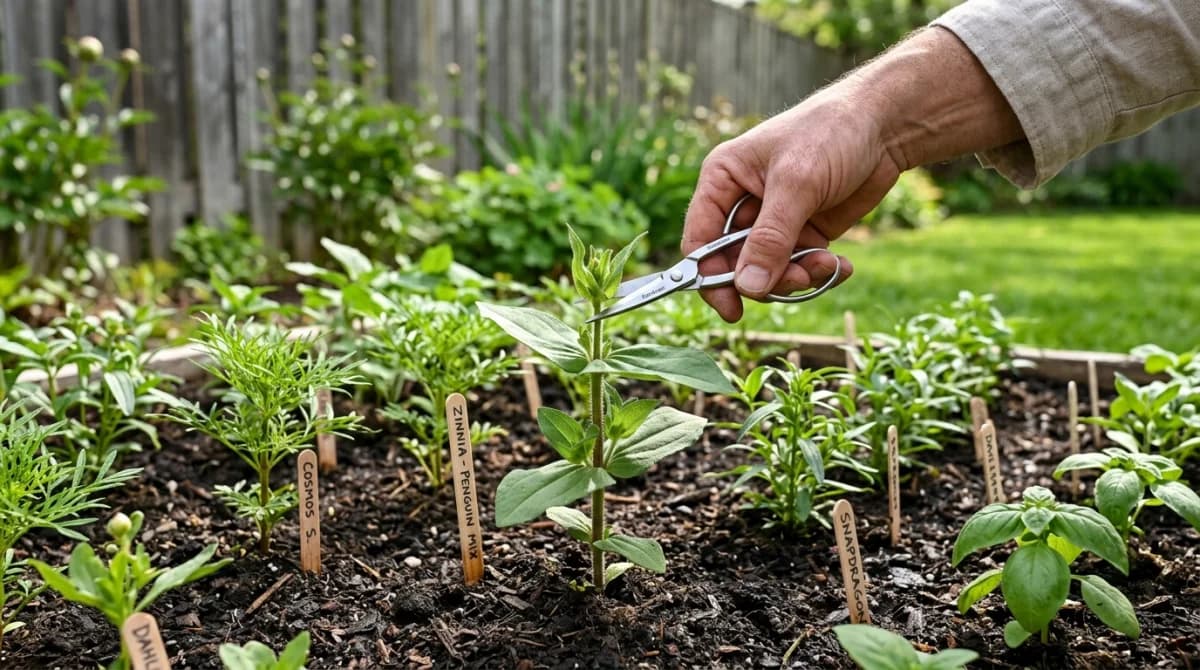
Most gardeners plant a tray of zinnias, cosmos, snapdragons, or dahlias in early May, water them in, and then leave them entirely alone until they flower. The plants do flower — eventually — on tall, leggy single stems with one bloom on top. By August they have flopped over each other in a tangle and the bouquet you imagined cutting from the bed never quite materializes. The plants did exactly what they were genetically inclined to do, which was put all their energy into one apical stem and bloom.
A pair of scissors and ten minutes in early May fixes this. Pinching — cutting the topmost growing tip off a young plant before it has any flower buds — turns one stem into four, four into sixteen, and a plant that would have given you eight blooms into one that gives you forty. It is the single highest-leverage thing you can do to the cutting garden between now and July, and the right window to do it on most annuals is right now.
What Pinching Actually Is
Plants are wired to grow upward from the very top of the main stem. The growing tip releases a hormone (auxin) that suppresses all the side shoots tucked into the leaf axils below it. As long as the tip is intact, those side shoots stay dormant. Cut the tip off, and the suppression lifts. Within a week, the next two leaf axils below the cut wake up and start growing. Each of those becomes a new flowering stem, and each of those, if pinched again, becomes two more.
The transformation, on a healthy zinnia or cosmos, is dramatic. A pinched plant ends up shorter, bushier, sturdier in wind, and carrying four to eight times as many flower stems as an unpinched one. Cut flower growers know this. Most home gardeners have never tried it because the first cut feels like sabotage — you are cutting healthy, vigorous growth off a plant you just paid for and planted. Do it once, see the result, and you will never plant a zinnia again without reaching for the scissors.
Which Plants Want to Be Pinched
Almost every soft-stemmed summer annual and tender perennial benefits. The list of strong responders is long and includes most of what people grow for cutting and for color:
- Zinnias — possibly the single most rewarding plant to pinch. An unpinched zinnia gives you one or two main blooms and a thicket of small late laterals. A pinched zinnia gives you long, straight, identical-length cut stems all summer.
- Cosmos — pinching turns a six-foot floppy giant into a four-foot bushy plant covered in flowers from waist height upward. Especially worth doing on tall varieties like ‘Versailles’ and ‘Sensation’.
- Snapdragons — pinch when they are six to eight inches tall and you get five to seven flowering spikes per plant instead of one tall central one.
- Dahlias — once they have three or four pairs of true leaves, pinch out the central growing point above the third or fourth pair. Pinching dahlias reliably doubles or triples bloom count and gives you stems long enough to actually use as cut flowers.
- Basil — the pinch is the same operation as the first harvest. Take the top off above the second or third pair of leaves and a single basil plant becomes a small bush. Skipping the pinch is why most basil bolts to flower by the Fourth of July.
- Sweet peas — pinch when seedlings are about four inches tall, just above the second or third pair of true leaves. Encourages strong basal shoots, which carry the longest, best stems for cutting.
- Celosia, ageratum, salvia, marigolds, calendula, statice, scabiosa, China asters — all respond well to a single early pinch.
A few plants prefer to be left alone. Plants with one main flower spike per stem — sunflowers, single-stem celosia varieties, larkspur, stock — should not be pinched. The whole point of those plants is that one strong central stem. Other plants that are happy unpinched: nasturtiums (already branchy), alyssum (too small), lobelia (too tedious), and most poppies (too brittle). When in doubt, leave the slow-to-grow and the spike-formers alone, and pinch everything that wants to be a bush.
How to Pinch
The mechanics are simple but the timing matters.
Wait until the plant has at least three or four sets of true leaves above the seed leaves. Pinching a two-leaf seedling shocks it. Pinching a six-leaf plant gets you a vigorous response within a week. Most direct-sown annuals reach this stage about three to four weeks after germination; transplants from the garden center are usually already there when you bring them home.
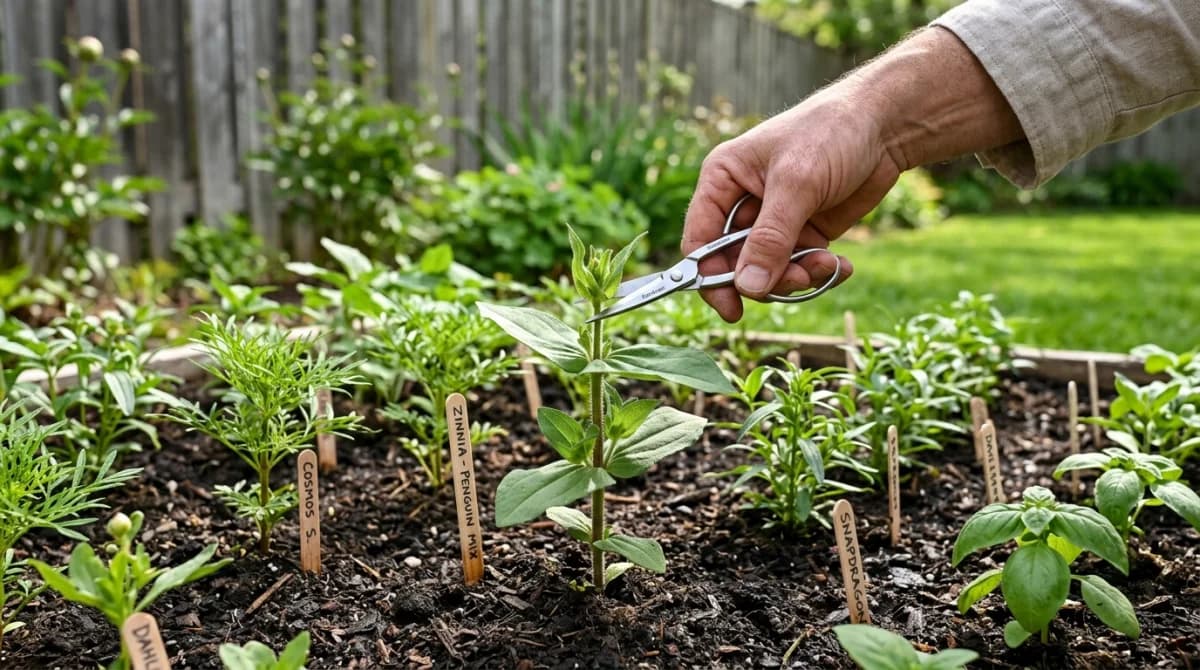
Find the topmost growing point. It is the small cluster of new, tightly furled leaves at the very tip of the main stem, sitting above the most recently expanded pair of leaves.
Pinch or snip just above a leaf node. Use clean scissors, fingernails, or pruning snips and cut about a quarter of an inch above the topmost pair of fully expanded leaves. You are removing the small tuft of new growth at the top — usually less than an inch of stem and a few baby leaves. You are not cutting back into mature foliage. The cut should leave the plant looking like the top has just been gently flattened, with two healthy leaves now defining its new ceiling.
Step back. Wait a week. Within five to ten days, the two leaf axils just below the cut will start producing new shoots. After two weeks the plant will look noticeably bushier than its unpinched neighbors. After a month, the structure that defines the rest of the season is set.
Optional: pinch a second time. On vigorous plants like zinnias, snapdragons, and cosmos, you can pinch each of the new lateral shoots once they have several pairs of leaves of their own. Each becomes two, and the plant ends up with eight or more flowering stems instead of four. Most home gardeners get the bulk of the benefit from a single pinch, though.
Common Mistakes
The first one is hesitating. The plant looks fine, the pinch feels destructive, and you talk yourself out of it. Three weeks later it is in bud and pinching is no longer the right call. The window is roughly when the plant is between five and ten inches tall, has not yet started forming flower buds, and is growing actively. Once you can see flower buds forming at the tip, the pinch is over — at that point you let the bud open and start picking flowers instead.
The second mistake is over-pinching. One pinch on the main stem, plus optionally one on each new lateral, is enough. Pinching a plant every week the way you might prune a hedge stresses it and delays bloom too far into the season. Two pinches per stem, total, is the maximum on most annuals.
The third mistake is pinching frost-tender plants too early in the year. Pinching dahlias, basil, or zinnias still feels productive in the moment, but if the plants are in the ground before the frost-free date and a cold night sets them back, the pinch on top of the cold check can put them weeks behind. Pinch only when the plant is actively growing in warm weather.
What Pinching Looks Like in the Garden
A pinched cutting bed in mid-May looks slightly defeated — short, blunt-topped plants spaced evenly on bare soil. By the first week of June it looks normal. By late June it looks unmistakably better than the unpinched bed next door: bushier, denser, more leaves, and just starting to set flower buds at the ends of every lateral shoot. By mid-July, an unpinched zinnia plant has produced two or three open blooms; a pinched one has fifteen, all on long straight stems suitable for cutting. The same difference, in slightly different shapes, applies to cosmos, snapdragons, dahlias, and basil.
The other practical benefit shows up in storms. A four-foot pinched cosmos is rarely flattened by a thunderstorm. An unpinched six-foot one almost always is. A bushy pinched dahlia stands without staking; a single-stem dahlia needs a heavy stake by July. Pinching is, indirectly, the cheapest staking system there is.
If you are mapping out a cutting garden or a flower border this spring and trying to work out where to put the zinnias, cosmos, dahlias, and snapdragons so they actually look good together, Gardenly lets you sketch the bed layout and see how the planting fits the space before any of it goes in the ground — useful when the difference between a great cutting bed and a so-so one is partly the pinch and partly where you put the plants in the first place.
Do It This Week
The plants in the garden center right now are at exactly the right stage for their first pinch. The plants you direct-sowed in late April will get there in another week or two. Walk the bed every few days with a pair of small scissors in your pocket and pinch each plant as it crosses the four-true-leaves threshold. Ten minutes of work in May, distributed across two weeks of evening walks through the garden, becomes the difference between a thin scattering of August blooms and a cutting garden you can actually fill a vase from twice a week from July to first frost.
Sources
- Floret Flowers — Pinching Annuals for More Blooms
- Cornell Cooperative Extension — Annual Flower Care: Pinching and Deadheading
- Royal Horticultural Society — Pinching Out
- North Carolina State Extension — Cutting Garden Basics