Thin Your Carrots This Week — Quietly, in the Evening, to Beat Carrot Fly
There is a job in the carrot bed in late May that almost every gardening book describes correctly and almost every gardener still gets wrong, because the books explain the how and skip the part that actually matters — the when of day. Thinning carrots is not a difficult task. A child can do the physical part. But the moment your fingers close on a carrot seedling and pull it from the soil, you bruise its foliage and release a sharp, sweet, unmistakable scent of carrot into the air, and that scent is the single most powerful summons in the spring vegetable garden. Carrot fly can detect it from a remarkable distance, and a row thinned carelessly at the wrong time of day is a row that has just sent up a flare. Get the timing right and thinning is harmless. Get it wrong and you have hand-delivered an invitation to the one pest that can quietly ruin the entire crop.
Carrots (Daucus carota) are almost always sown direct, because they resent root disturbance and a transplanted carrot forks and stunts. Sown direct, they come up far too thickly — even careful sowers end up with seedlings shoulder to shoulder — and a crowded row simply cannot produce decent roots. The plants compete, the roots stay thin and tangled, and the bed yields a mat of green tops over a disappointing scrabble of pencil-thin carrots. Thinning is not optional. It is the difference between a real harvest and a green failure. The whole skill lies in doing a necessary job without paying the pest’s toll for it.
Why Late May Is the Moment
Carrots sown in March and April reach the right stage for their first thinning in the third and fourth weeks of May. By now the seedlings have pushed past the first pair of strappy seed leaves and have two or three true leaves — the familiar fine, ferny carrot foliage — and stand somewhere around two to three inches tall. That is exactly the size to thin. The seedlings are large enough to grip individually and to tell apart from one another, and small enough that pulling one does only minimal disturbance to its neighbours’ roots.
Wait much longer and the seedlings’ roots knit together below the surface, so that removing one drags and tears the roots of the two beside it — the very disturbance carrots cannot tolerate. The plants you leave behind are then checked just as they should be powering away. Thinning on time, in the last fortnight of May, means the keepers barely notice their neighbours have gone and carry straight on growing into the space you have opened for them.
There is a pest reason for the timing too. The first generation of carrot fly is on the wing across much of the temperate world from mid-May onward. The adult is a small, slim, shiny black fly that flies low — rarely more than a foot or two above the soil — searching by scent for carrot, parsnip, parsley and celery foliage on which to lay its eggs. The eggs hatch into small creamy maggots that burrow down to the root and tunnel through it, leaving the rusty brown scars and channels that make a carrot inedible. Thinning in late May happens right inside the first flight, which is exactly why how you thin matters as much as whether you thin.
Thin in the Evening, on a Still Day
This is the detail the books leave out, and it is the one that decides the crop. Carrot fly are day-flying insects. They are most active in warm, bright, breezy conditions and they all but stop flying in the cool, still air of late evening. So you thin then.
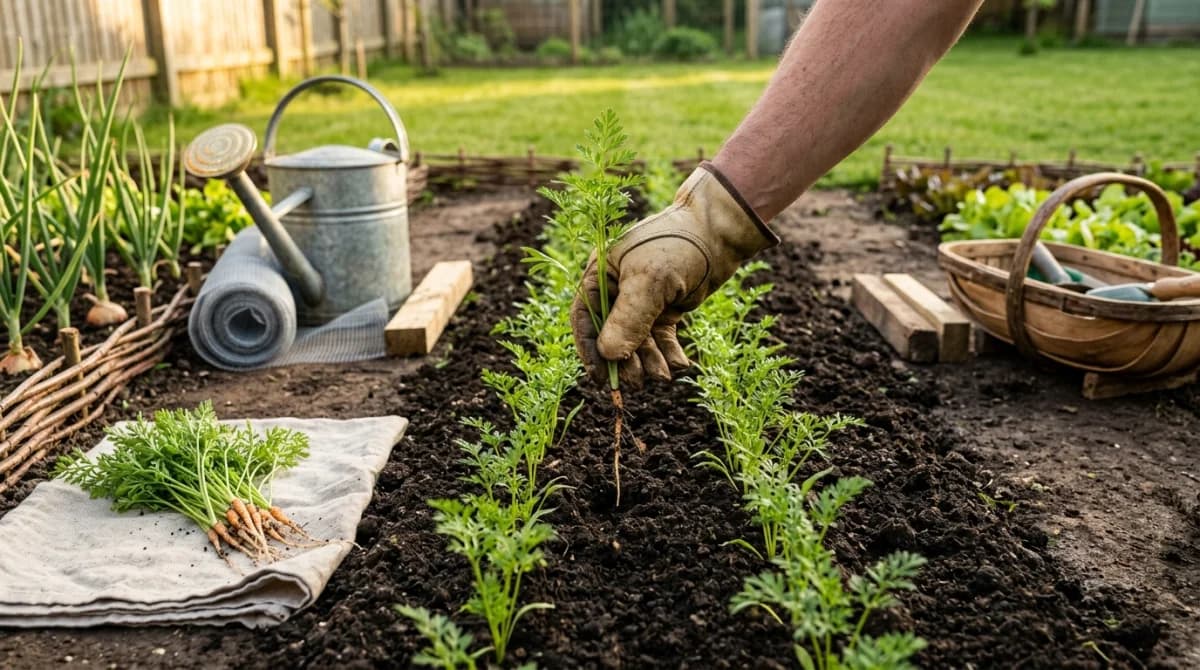
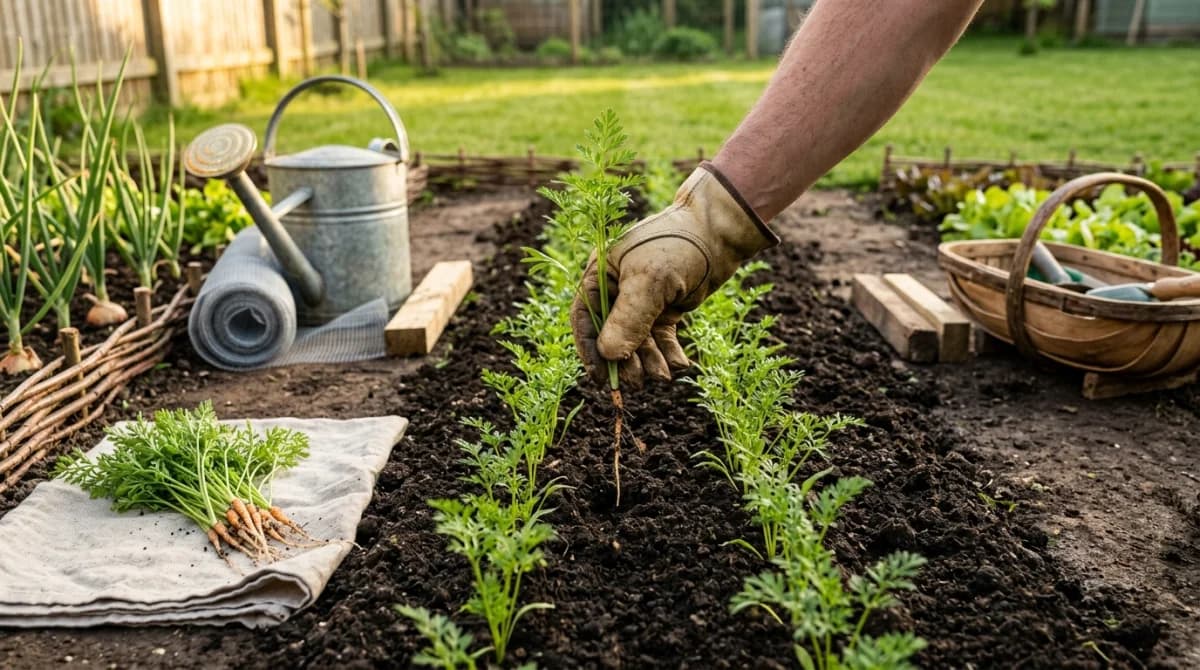
Pick a calm evening, after the heat has gone off the day. Work quietly along the row, and as you go, take hold of each surplus seedling right at soil level and ease it straight up and out with a gentle, steady pull rather than a yank — a yank disturbs the keepers, a steady draw does not. If the soil is dry and the seedlings resist, water the row lightly first; a seedling lifts cleanly from damp soil and stubbornly from dry. Aim to leave one strong seedling roughly every inch for the first thinning. You do not need a ruler — the eye is fine — and you will thin again later for the final spacing.
As you remove each thinning, drop it straight onto a cloth, into a tub, or into a bucket — never onto the soil beside the row. A discarded thinning lying on the bed is a scent factory that will keep broadcasting carrot to every fly in the neighbourhood for hours. Every single thinning must leave the bed. When the row is done, carry the lot away and bury them deep in the compost heap or seal them in a bag. Then, while the carrot scent from the disturbed row is still hanging in the air, water the whole row gently with a fine rose. The water settles the soil firmly back around the keepers’ roots and, just as importantly, damps down and dilutes the carrot scent so that far less of it drifts off into the dusk. Quiet evening, steady pull, every thinning removed, water straight after — four small habits, and a job that used to summon the pest now barely whispers.
Backing It Up With a Barrier
Careful thinning sharply reduces the risk, but the surest protection is to keep the fly away from the row entirely, and late May — with the row freshly thinned and tidy — is the natural moment to put that protection in place.
The simplest and most reliable method is a physical barrier of fine insect-proof mesh or horticultural fleece laid over the row and tucked down firmly all around the edges, with no gaps at the corners. Carrot fly are weak, low fliers and will not find a way through a well-sealed cover. Lay it loosely so the carrots have room to grow up underneath, and weight the edges with stones, soil or timber. Lift it only to weed or thin again, and always replace it on a still evening.
The other classic defence works with the fly’s low flight path. Carrot fly cruise within a foot or two of the ground, so a vertical barrier of fine mesh or fleece about two feet high, run right around the carrot bed, simply stops them reaching it — they will not climb to clear it. It is less foolproof than a full cover but it leaves the bed open to tend. Companion planting is sometimes suggested, the theory being that strong-smelling alliums or aromatic herbs mask the carrot scent; the evidence for it is mixed and it is no substitute for a barrier, but a row of onions alongside the carrots does no harm and is a good use of the space regardless.
The Rest of the Late-May Carrot Job
While you are working down the row, two other small tasks belong in the same visit.
The first is weeding. A young carrot row is easily swamped — the seedlings are fine and slow, and any vigorous weed will out-grow and shade them within a week. Weed by hand, carefully, on the same still evening you thin, because hoeing close to carrots disturbs the soil and, again, releases scent. Slow and quiet beats fast and fragrant in the carrot bed.
The second is a note for your sowing diary. If you want carrots right through the year, late May is the time to sow a fresh short row of a maincrop variety for autumn and winter pulling, and to keep sowing a little every three or four weeks through the summer. Successional sowing is what turns carrots from a single glut into a steady supply, and a five-minute sowing now, while you are already at the bed, saves a gap later. Sow thinly if you can — every seed you do not sow is a thinning you will not have to pull, and every thinning you do not pull is a little less scent on the evening air.
Why the Crop Is Worth the Care
A home-grown carrot, pulled and eaten the same day, is one of those vegetables that genuinely tastes of something the shop version has lost. The crop asks for very little — no staking, no feeding, no fussing — and the entire reputation of carrots as “tricky” rests almost wholly on this one pest and this one job. A gardener who thins on a still evening, clears every thinning, waters the row and slips a cover over the top has effectively solved carrots for the season. Everything after that is just waiting and weeding.
If you are still working out where the carrot bed should sit — which corner stays breezy and bright, where a low fleece barrier will not shade a taller crop behind it, how to rotate the roots through next season so they follow a bed the legumes have just fed — Gardenly can render your plot in full mid-summer growth from a photo of the space, so you can see the layout standing up before you commit a single seed to the ground. Useful for a kitchen garden where the difference between a clean crop and a maggoty one can come down to something as simple as which row caught the evening breeze.
Sources
- Royal Horticultural Society — Carrots: Growing Guide
- Royal Horticultural Society — Carrot Fly
- University of Minnesota Extension — Growing Carrots in Home Gardens
- Garden Organic — Carrot Growing Guide