Earth Up Your Potatoes This Week to Boost Yield and Stop the Greening
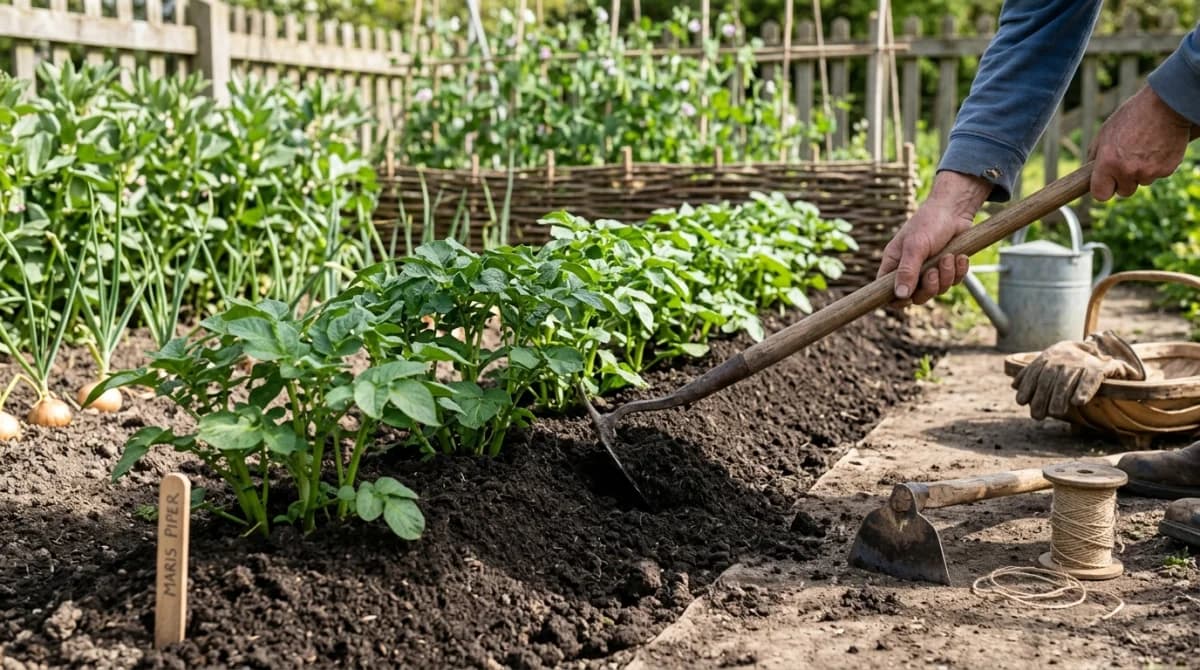
A potato row in the second week of May is a study in deceptive simplicity. The shoots are eight to ten inches tall, vivid green, healthy looking, and the gardener walking past on a Sunday morning has every reason to think the bed is doing fine on its own. It is not. Of every potato variety in domestic cultivation, the tuber-forming part of the plant — the section of underground stem where the new potatoes actually swell — sits in a narrow band immediately above the seed tuber and extends upward as the plant grows. Without intervention, that band stays small, the plant produces a modest cluster of tubers near the seed, and the upper stem grows on for foliage rather than yield. Earth the plant up at the right moment and the tuber-forming zone extends upward by six or eight inches, the plant sets two or three times the tubers, and the yield per row doubles. Skip it and the harvest is half what the bed could have given, with the additional indignity that a portion of the modest crop will be green and inedible.
The second week of May is the textbook moment to do the first earthing up across most of the temperate zones where potatoes were planted in late March or early April. The shoots have reached the eight-to-ten-inch height that marks the start of the active tuber-setting phase. The soil has warmed enough that mounding does not chill the plant. The risk of a hard late frost has dropped to the point where a partly buried plant is no worse off than an exposed one. And the foliage is still flexible enough to lift and mound around without snapping at the base. A week earlier and the shoots are too short to bury usefully; two weeks later and the plant has invested in upright growth that does not respond as well to being covered. The window is real but narrow.
Why Earthing Up Actually Works
The simplest way to think about a potato plant is as an inverted production schedule. The seed tuber is the starting point, but the new tubers — the ones the gardener cares about — form on short underground stems called stolons that radiate sideways and slightly upward from the buried part of the main stem. Crucially, those stolons can only form along the length of stem that sits below soil level. Whatever length of stem is exposed to light grows leaves; whatever length is dark and underground has the option to set tubers.
When you earth up a potato, you are not simply covering the plant for protection. You are converting six or eight inches of would-be leaf stem into tuber-bearing underground stem. The plant responds within days by initiating new stolons from the newly buried section, and each of those stolons can set one or more tubers over the following six weeks. A single earthing up of six inches, well-timed, increases the tuber-forming zone by roughly the same length. Two earthings up, spaced three weeks apart, can extend it to twelve or fourteen inches — and the yield difference is plainly visible at harvest, in early August for second earlies and September for maincrops.
The other reason — the one most gardeners hear first and the one that matters less to yield but matters considerably to dinner — is sunlight. Tubers exposed to light, including the indirect light that filters through a few millimetres of soil at the edge of a row, develop chlorophyll and produce solanine, a bitter glycoalkaloid that the plant uses as a defence against being eaten. Solanine concentrations in green potato tubers are high enough to cause stomach upset, and the green tissue is consistently bitter even before the alkaloid becomes a real problem. A well-earthed row buries the developing tubers under enough soil that no light reaches them, and the entire crop is white-fleshed and edible. A poorly earthed row produces a percentage of green tubers that have to be cut away or discarded. Among gardeners who report disappointing potato harvests, “half the crop was green” is the second most common complaint, after “the haulm collapsed before I could lift them.”
The Mechanics of the First Earthing Up
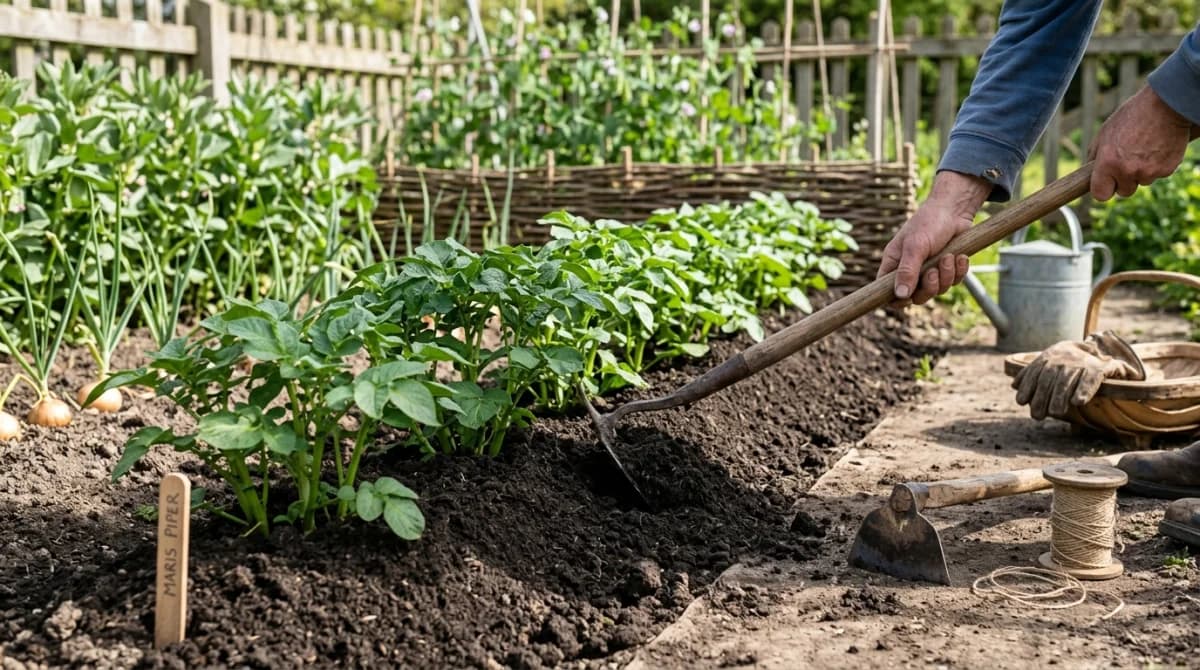
The technique is unambitious and unchanged in two centuries of vegetable gardening, which is a useful sign that it works. Wait for a dry morning — soil that crumbles rather than smears under a hoe — and choose a moment when the foliage is dry. Walk to one end of the row with a draw hoe, a Canterbury hoe, or, in a pinch, a flat-faced rake.
Stand astride the row and draw soil from the path on either side up against the base of the plants, forming a ridge about six inches high that comes about halfway up the standing shoots. Work down the row, pulling soil from both sides simultaneously so the ridge forms cleanly and the path on either side drops by an inch or two. The aim is to leave a row that looks, in profile, like a small mountain range: a ridge running the length of the bed with the upper third of the shoots visible above the soil.
If the bed is a no-dig or raised-bed system where the soil at the surface is too friable to draw into a ridge — or if there simply is not enough soil to spare on the path — substitute mature compost or a wheelbarrow of well-rotted manure barrowed in from elsewhere. The plant does not mind whether the covering material is the bed’s own soil, fresh compost, or even a thick straw mulch piled around the stems. What matters is that six or eight inches of stem are converted from above-ground to below-ground, in dark conditions, in one operation. Some experienced no-dig growers earth up with deep straw alone and report yields comparable to traditional soil mounding, with the bonus that the harvest pulls cleanly out of the loose mulch in August without forking.
Take care, when drawing soil up, not to snap the shoots at the base. The stems at this stage are brittle and the natural inclination of a draw hoe is to catch them at ground level. Use the hoe to deposit soil at the centre of the row first and then push it outward against the stems with the back of a glove, rather than scraping it directly against the foliage. A few broken shoots do not seriously harm the plant — it will throw replacements within a week — but a row of decapitated stems gives up two weeks of tuber-setting time at the worst possible moment.
Earth Up Again in Three Weeks
The first earthing up is the consequential one, but it is not the last one. Three weeks later — the first week of June in most years — the shoots will have grown another eight to ten inches above the new ridge. Repeat the operation: draw a second layer of soil up the ridge, raising it by another four or five inches, and burying the next section of stem.
A row that has been earthed up twice forms a tall, distinct ridge running the length of the bed, looking somewhat like a small earthworks. The visual change in the bed is dramatic, and the yield change at harvest is dramatic to match. Most domestic gardeners stop at one earthing up; the gardeners who routinely lift the heaviest crops earth up two or three times across May and June, raising the ridge progressively until the foliage closes over the top and prevents further work.
Three earthings up — the professional cut-flower-grower’s equivalent for potato production — is the standard in show-bench cultivation and in serious allotment beds. It is not necessary for a good crop, but it is the difference between a good crop and a remarkable one.
A Note on Frost Protection
A useful side benefit of mid-May earthing up is that it buries the lower half of the shoots and leaves only the upper foliage exposed. In zones where a late frost is still possible — anywhere through zone 6 in particular — this matters. A frost in the third week of May can blacken exposed potato foliage overnight, costing the plant up to two weeks of growth as it pushes replacement shoots from the buried part of the stem.
A row that has been earthed up six inches has only the upper four to six inches of shoot above the ridge. If a frost is forecast in the week following the first earthing up, draw the soil higher to bury the shoots entirely for the night, and rake the soil back down the following morning once the frost has lifted. The shoots underneath survive completely undamaged. This is a trick that pre-modern gardeners used routinely and that current frost-cloth methods have largely replaced, but the soil version is faster, free, and works in a row that is twenty yards long and impractical to fleece.
Mistakes That Cost Yield
Three patterns account for most underperforming potato rows in their first earthing up:
- Earthing up too early. A row earthed up when the shoots are only three or four inches tall ends up entirely buried, and the plant has to push the shoots up through six inches of fresh soil from a near-cold start. The setback can cost two weeks. Wait for at least eight inches of growth.
- Earthing up too little. A token mound of an inch or two does almost nothing; the buried section of stem is too short to set meaningful additional tubers. Aim for six inches of ridge above the original soil level, and make the operation count.
- Not earthing up at all. This is the most common single cause of green tubers and disappointing yield. A potato that has been planted and never earthed will produce a modest crop near the seed, a percentage of which is green and inedible. The intervention takes twenty minutes per ten-foot row and roughly doubles the harvest. There is no reasonable trade-off that justifies skipping it.
Get the first earthing up right in mid-May, repeat in early June, and the rest of the season is mostly watching the foliage and waiting. Potatoes are not a high-maintenance crop, but they are an unusually responsive one — a few minutes of correctly timed soil work returns more yield per minute spent than almost any other operation in the kitchen garden.
If you are uncertain how a row of potatoes will read in a bed that also has to look reasonable from the house — a long ridge of bare earth is not, after all, the prettiest feature in a small garden — Gardenly can preview the bed at full summer height, with the foliage closed over the ridge and the harvest hidden underneath, before you commit the space. Useful for deciding whether the potato row belongs at the back of the kitchen garden where the foliage adds height, or alongside the path where the ridge will be visible all season.
Sources
- Royal Horticultural Society — Potatoes: Growing Guide
- Cornell Cooperative Extension — Home Garden Potato Production
- Penn State Extension — Home Garden Potatoes
- University of Minnesota Extension — Growing Potatoes in Home Gardens