Best Small Flowering Trees for Small Gardens
A flowering tree is the highest-impact plant you can add to a small garden. For two or three weeks in spring the right tree turns an ordinary yard into something that stops people on the street. For the other eleven months it gives you structure, shade, and often good bark, fruit or autumn colour.
The challenge is choosing one that stays in scale. Plenty of flowering trees sold as “compact” or “dwarf” still reach 30 feet and spread 25 feet. In a modest backyard that is not a small tree, it is a future problem with a chainsaw at the end of it. The species below have predictable mature sizes.
Quick Answer
The best flowering trees that genuinely stay small are Japanese snowbell, kousa dogwood, eastern redbud, serviceberry and crabapple on a dwarf rootstock, all of which mature between 15 and 25 feet. For the smallest gardens, Japanese snowbell and crabapple cultivars such as ‘Sargent’ are the two that reliably stay under 20 feet with a modest spread.
Judge a tree by its mature spread, not its height. A 20-foot tree with a 25-foot canopy overwhelms a small garden, while a 25-foot tree with a 12-foot spread fits comfortably.
Size Comparison
| Tree | Zones | Mature height | Mature spread | Bloom | Min distance from house |
|---|---|---|---|---|---|
| Japanese snowbell (Styrax japonicus) | 5–8 | 20–30ft | 15–25ft | Late spring, white | 15ft |
| Kousa dogwood (Cornus kousa) | 5–8 | 15–25ft | 15–25ft | Late spring, white | 15ft |
| Eastern redbud (Cercis canadensis) | 4–9 | 20–30ft | 25–35ft | Early spring, pink | 20ft |
| Serviceberry (Amelanchier spp.) | 3–9 | 15–25ft | 15–20ft | Early spring, white | 15ft |
| Crabapple (Malus cultivars) | 4–8 | 10–25ft | 10–25ft | Mid spring, varies | 12–20ft |
| Japanese flowering cherry (Prunus serrulata) | 5–8 | 20–30ft | 20–30ft | Mid spring, pink | 20ft |
| Saucer magnolia (Magnolia × soulangeana) | 4–9 | 20–30ft | 20–30ft | Early spring, pink | 20ft |
Crabapple varies more than anything else on this list, from 10 feet to 25 depending on cultivar, so buy by named cultivar rather than by the label “crabapple”. ‘Sargent’ stays genuinely small, while many older cultivars do not.
What Makes a Tree Right for a Small Garden
Before looking at specific varieties, it helps to know what to evaluate.
Ultimate height and spread. A 15-foot tree sounds small, but a 15-foot spread eats an entire planting border. Look for trees with an upright or narrow vase shape if space is limited horizontally, or a wide-spreading form only if you have the room to match.
Root behavior. Aggressive roots crack pavement, heave garden beds, and invade drainage lines. The trees on this list have non-invasive root systems suited to garden use near paths and structures.
Multi-season interest. In a small garden, every plant earns its space in multiple seasons. The best small flowering trees deliver bloom, then interesting fruit, bark, or fall foliage.
Disease resistance. Nothing wastes space like a tree that spends summer defoliated from fungal disease. Variety selection matters as much as species.
The Best Flowering Trees for Small Gardens
Eastern Redbud (Cercis canadensis)
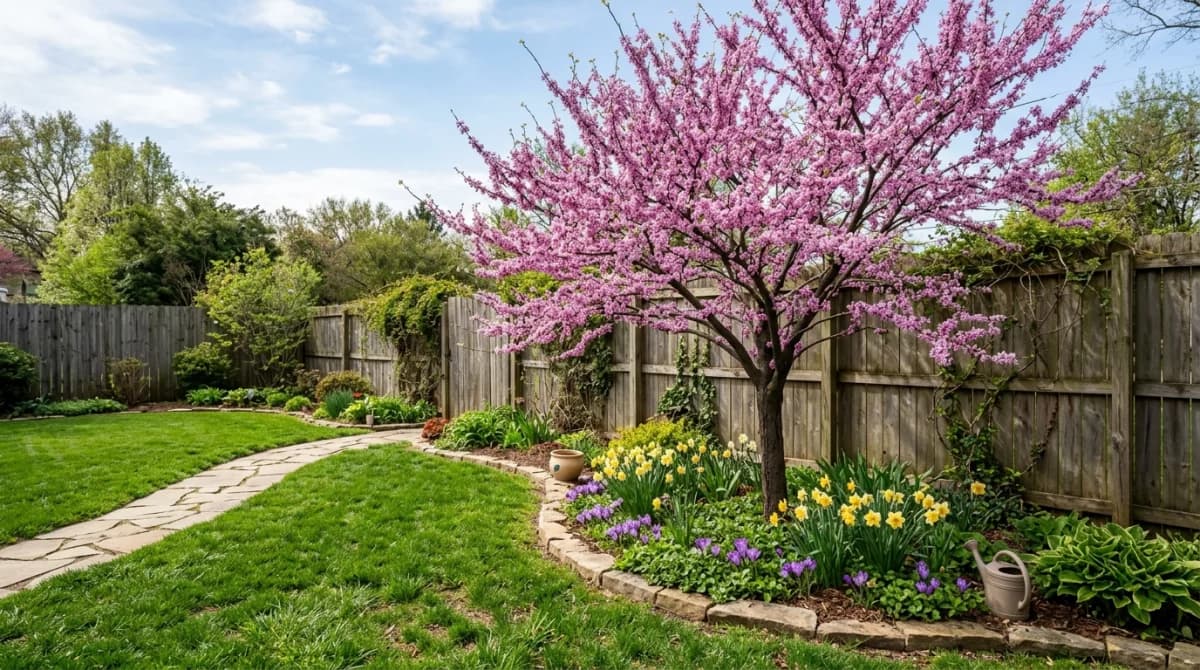
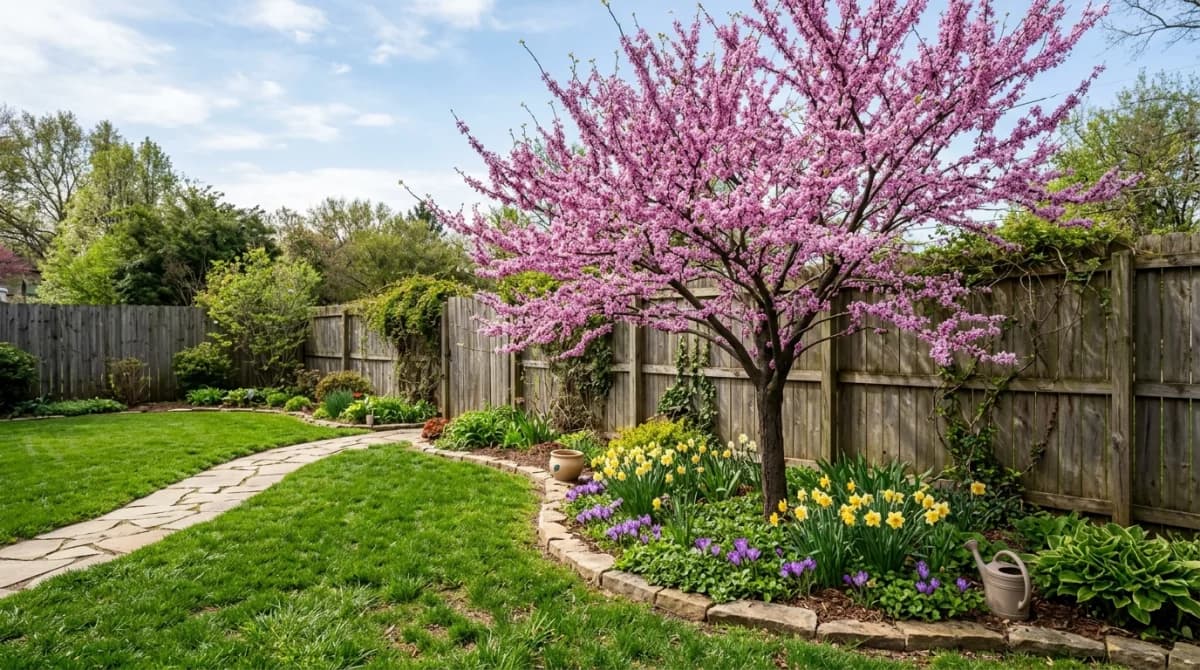
Redbud is possibly the most spectacular early-spring flowering tree you can grow. In March and April, before the leaves emerge, the bare branches are covered in clusters of vivid magenta-pink flowers right along the wood — not just at branch tips. It looks like the tree is glowing.
After bloom, large heart-shaped leaves unfold and hold through summer, turning yellow in fall. The branching structure is interesting enough to be a focal point even in winter.
Size: 20–30 feet tall, 25–35 feet wide — plant where you have room for the spread, or look for cultivars. ‘Forest Pansy’ has burgundy foliage but the same spread; ‘Merlot’ is more compact at 12–15 feet; ‘Ace of Hearts’ stays under 12 feet.
Growing notes: Full sun to part shade, tolerates clay and dry soils once established. Hardy in Zones 4–9.
Japanese Flowering Cherry (Prunus serrulata cultivars)
Few trees match the spring show of a Yoshino or Kwanzan cherry in full bloom. The flowers are so dense the branches disappear behind them. These are the trees behind Washington DC’s famous cherry blossom displays, and they perform just as reliably in home gardens.
Weeping Higan Cherry (Prunus subhirtella ‘Pendula’) reaches 20–25 feet tall with a graceful weeping form and blooms earlier than most — often in late February or early March — in warm spells. It fits vertical spaces well.
‘Okame’ is a hybrid cherry growing 20–25 feet tall and 15 feet wide with an upright oval shape. It blooms very early in a bright, clear pink and has good bronze-red fall color.
Prunus ‘Amanogawa’ is the most upright cherry available, growing like a narrow column 15–20 feet tall but only 6–8 feet wide. It suits tight gaps between structures, along narrow drives, or as a vertical accent.
Growing notes: Full sun, well-drained soil. Hardy in Zones 5–8 depending on cultivar. Avoid planting near vegetable gardens — cherry family roots host pests.
Serviceberry (Amelanchier species)
Serviceberry is a native North American tree that rarely gets the attention it deserves. It flowers in early spring in white or pale pink, before the leaves, then produces edible berries in June — sweet enough to eat fresh or make jam from, and beloved by birds. Fall foliage is orange to red.
Amelanchier canadensis (shadbush) grows 15–25 feet tall in a multi-stem clump form. Amelanchier × grandiflora ‘Autumn Brilliance’ is the most widely planted, reaching 15–25 feet with exceptional fall color. For very tight spaces, Amelanchier alnifolia ‘Regent’ grows as a shrub-like tree under 6 feet.
Growing notes: Adaptable to most soils, sun to part shade, drought-tolerant once established. Zones 3–9. One of the best trees for wildlife.
Crabapple (Malus cultivars)
Modern disease-resistant crabapple cultivars have transformed this group. Older varieties were plagued by apple scab, fire blight, and cedar-apple rust; the current generation stays clean all season and delivers both spring bloom and persistent ornamental fruit through winter.
Look for these characteristics when selecting a crabapple: disease-resistance rating of “good” or “excellent” on all three major diseases, persistent fruit that stays decorative into winter, and size that fits your space.
‘Prairifire’ — 15–20 feet, rounded form, deep magenta-red flowers and dark purple-red fruit. Outstanding disease resistance.
‘Sargent’ — Under 8 feet tall and 10–12 feet wide, dense spreading mound, white flowers, tiny persistent red fruit. Good for smaller spaces where you need width but not height.
‘Royal Raindrops’ — 15–20 feet, upright oval, deep pink-purple flowers, purple foliage through summer. Very showy.
‘Lollipop’ — Under 10 feet with a perfectly round, compact form. White flowers, yellow-green fruit. Easy to fit anywhere.
Growing notes: Full sun, adaptable soils. Zones 4–8. Always select named disease-resistant cultivars — species seedlings are far more disease-prone.
Kousa Dogwood (Cornus kousa)
Kousa dogwood blooms several weeks later than native flowering dogwood (C. florida), typically in late May and June, which makes it a bridge between spring and summer in the garden. The white or pink flower bracts are held upward-facing and star-like, covering the tree for three to four weeks.
After bloom, the tree produces raspberry-like ornamental fruit in late summer, attractive bark that exfoliates into a patchwork pattern as the tree matures, and reliable scarlet-red fall color.
Size: 15–30 feet tall, 15–30 feet wide, with a broadly horizontal branching habit. Smaller than flowering dogwood at most sites.
Growing notes: Prefers slightly acidic, well-drained soil. More tolerant of heat and drought than native dogwood, and resistant to dogwood anthracnose. Full sun to part shade. Zones 5–8.
Japanese Snowbell (Styrax japonicus)
Styrax is an underused gem. In late May to June, it covers itself in white, lightly fragrant, bell-shaped flowers that hang downward along the branches. The effect when viewed from below — looking up through a canopy of nodding white bells — is extraordinary.
It grows as a small, graceful tree with a broadly spreading crown and dark, attractive bark. It stays genuinely small.
Size: 20–30 feet tall, 20–30 feet wide, with horizontal layered branches.
Growing notes: Part shade to full sun, moist and well-drained acidic soil. Not drought-tolerant during establishment. Zones 5–8.
Saucer Magnolia (Magnolia × soulangeana)
The classic spring magnolia, with large pink-and-white goblet-shaped flowers that open before the leaves in March and April. When it blooms against a blue sky, few trees are more dramatic.
The drawback is vulnerability to late frosts — a single cold night after the buds open can turn all the flowers brown. In cold climates, plant on the north side of a structure to delay bloom slightly, reducing frost risk.
Size: 20–25 feet tall, 20–25 feet wide, multi-stemmed upright oval. ‘Jane’ and other “Little Girl” hybrids bloom later than saucer magnolia and stay under 15 feet.
Growing notes: Full sun, well-drained soil. Zones 4–9 for the species; some cultivars to Zone 3.
How to Choose the Right Tree for Your Space
Measure before you shop. Stand in the center of the spot where the tree will go and look in every direction. Note the distance to the house, fences, overhead wires, underground utilities, and neighboring trees. That radius becomes your constraint.
Match canopy shape to space. Narrow upright trees (Amanogawa cherry, pyramidal forms) suit spaces where horizontal spread is limited. Weeping forms create vertical drama without wide crowns. Spreading trees need room in all directions.
Consider sight lines. A flowering tree has its biggest impact when it can be seen from inside the house — from a kitchen window, a dining room, or a sitting area. Plant for your best view, not just to fill a bed.
Think about fall and winter. A tree that is spectacular for three weeks in spring but invisible for the rest of the year is a missed opportunity. Prioritize trees with at least two distinct seasons of interest.
One tree, placed well, beats three placed wrong. A single redbud centered in a garden bed that can accommodate its spread is more beautiful than three cramped crabapples. The scale relationship between tree and garden is as important as species choice.
If you are working out placement before committing, an AI garden design from a photo shows the tree in context with the rest of the garden, including how the canopy spread meets beds, paths and structures.
When and How to Plant
Autumn is the best planting window in most climates, with early spring a close second. Both give roots a stretch of mild weather to establish before summer heat or hard frost. Container-grown trees can go in through the growing season if you commit to watering them.
Dig the hole two to three times the width of the root ball and no deeper than the ball itself. Planting too deep is the single most common cause of young tree failure. The root flare, where the trunk widens at the base, should sit at or slightly above the soil surface once planted. Nursery stock is frequently potted too deep, so scrape back the surface compost to find the flare before you decide on hole depth.
Mulch two to three inches over the root zone and keep it clear of the trunk. Water deeply once a week through the first full season, and stake only if the site is windy, removing the stake after a year so the trunk builds strength.
Frequently Asked Questions
The Bottom Line
Buy for mature spread, not height, and buy by named cultivar rather than by species, especially with crabapples.
Plant it at the right depth, keep mulch off the trunk, water it weekly through the first season, then leave it alone. A flowering tree chosen well will outlast most of the other decisions you make in a garden.