All articles

How to Plant a Vegetable Bed That Looks Like a Border, Not a Vegetable Garden

Most home vegetable beds go in straight rows and look like a vegetable garden — useful, but not pretty. With a few changes in plant choice and layout, the same bed can read as an ornamental border that happens to feed you.

Niels Bosman7 min read
How to Plant a Vegetable Bed That Looks Like a Border, Not a Vegetable Garden

How to Plant a Vegetable Bed That Looks Like a Border, Not a Vegetable Garden

A May vegetable bed designed as an ornamental border, with rainbow chard, lacinato kale, purple basil, calendula, nasturtiums, and a tuteur of climbing beans, mixed into curved drifts in soft afternoon light

The reason most vegetable beds look like vegetable gardens has very little to do with the plants and almost everything to do with the layout. Long straight rows of one crop, evenly spaced, with bare soil between them — that arrangement reads as utility, not design. The same crops, planted in drifts of three or five, mixed with a few well-chosen flowers and structural plants, read as a border. The food you get out of it is identical. The view from the kitchen window is not.

May is the month this matters. Most of the soft summer crops — tomatoes, peppers, beans, basil, squash — are going in over the next two or three weeks. So are most of the cool-season hangers-on like chard, kale, and lettuce. Whatever layout you commit to now is the layout you live with through October. Spending an extra hour on the plan before anything goes in the ground is the difference between a bed you walk past and a bed you sit and look at.

What Makes a Border Look Like a Border

Before talking about which vegetables to use, it helps to name what an ornamental border actually does that a vegetable row does not. Three things, mostly.

It has structure that holds the eye even when nothing is flowering. A good border has a few permanent or semi-permanent shapes — a clipped boxwood, a clump of grass, a strong-leaved perennial — that give the bed a skeleton. Without that, the bed collapses into a flat carpet of small plants.

It repeats. The same plant, or the same color, shows up at three or four points along the bed. Repetition is what makes a planting feel composed instead of accidental. A single dramatic plant in the middle of a row of lettuce reads as a mistake. The same plant placed three times along the length of the bed reads as a design.

It works in drifts, not lines. Even in a formal potager, the planting itself is grouped — five lettuces in a teardrop shape, not five lettuces in a straight line. The eye follows curved groupings; it slides off straight rows.

All three of these are achievable with vegetables and herbs alone. You do not need to give up any growing space. You just need to plant the same plants in different shapes.

The Skeleton: Vegetables That Hold Their Shape

The first job is to pick a few crops that act as structure. These are the plants that look good even before they crop, hold their form for months, and give the bed something to organize itself around.

Lacinato kale (sometimes sold as ‘Tuscan’ or ‘Nero di Toscana’) has long, dark, almost black-green leaves with a heavily savoyed surface. A single plant looks like a small palm tree by July. Three of them spaced along a bed, each surrounded by softer planting, anchors the whole composition. ‘Redbor’ is the red-purple equivalent and reads even more strongly against green neighbors.

Rainbow chard does the same job at a slightly smaller scale. The ‘Bright Lights’ or ‘Five Color Silverbeet’ mixes give you stems in pink, yellow, orange, red, and white from a single packet. Plant in clumps of three, not single plants in a row, and the color reads from twenty feet away.

Globe artichokes are the most ornamental vegetable most people never plant. The silver, deeply cut foliage looks like a giant cardoon all summer, and if a bud opens it produces a thistle flower the size of a fist. One plant per bed is plenty; it will end the season at four feet across.

Bronze fennel is technically a herb, not a vegetable, but it acts like a structural plant. The lacy bronze foliage rises to four or five feet, catches the light, and gives the bed vertical interest the way a thalictrum or a tall grass would in a flower border. Swallowtail caterpillars adore it, which is a feature, not a bug.

A bed with three or four of these scattered along its length already looks intentional, before anything else has been planted.

The Color: Vegetables That Are Already Ornamental

Once the skeleton is in, the rest of the bed can be productive crops chosen at least partly for how they look. Almost every vegetable has a cultivar that is more ornamental than the standard one.

For lettuce, skip the green butterheads and plant ‘Merlot’, ‘Red Sails’, or ‘Australian Yellow’ in mixed drifts. A patch of ‘Speckled Trout Back’ next to a patch of dark red ‘Merlot’ looks like a deliberate planting; a row of green ‘Buttercrunch’ looks like a salad bar.

For basil, use ‘Purple Ruffles’ or ‘Amethyst’ alongside the standard green. A drift of dark-purple basil next to lime-green ‘Genovese’ is one of the cheapest color contrasts in the garden, and the flavor is identical.

For beans, climbing varieties on a tuteur or a length of pea netting give you the vertical element a flower border gets from a clematis. ‘Scarlet Emperor’ has bright red flowers; ‘Painted Lady’ has bicolor red-and-white blooms. Both are runner beans that flower for two months before producing pods.

For peppers, ‘Black Pearl’ (an ornamental edible) has near-black foliage and small purple-to-red fruit. ‘Aurora’ and ‘NuMex Twilight’ produce fruits that ripen through purple, yellow, orange, and red on the same plant. Used as small drifts at the front of the bed, they look like coleus that happens to be edible.

For tomatoes, the cherry types like ‘Sungold’, ‘Black Cherry’, and ‘Sunrise Bumblebee’ look like a tumbling small-fruited shrub all summer when caged or staked properly. The big slicers will always look agricultural; the small-fruited ones look like a planting.

The Glue: A Few Flowers Mixed Through

A bed that is one hundred percent vegetables, even ornamental ones, can still feel slightly austere. A handful of flowers — chosen carefully and repeated — turns it into a planting that any gardener would recognize as a border.

The shortlist of flowers that earn their space in a productive bed is short on purpose:

  • Calendula (‘Indian Prince’, ‘Bronzed Beauty’) for orange and apricot tones, edible petals, and reliable self-seeding.
  • Nasturtiums along the front edge for trailing color and flavored leaves.
  • Cosmos (‘Apricot Lemonade’, ‘Xanthos’) for soft, see-through height that does not crowd nearby crops.
  • Zinnias in shorter, mildew-resistant series like ‘Profusion’ or ‘Zahara’ as midbed color.
  • Sweet alyssum (‘Snow Princess’) as a low edging — it pulls in hoverflies, which eat aphids on the chard and kale.

Five flowers, not fifteen. Repeated three or four times along the bed, not scattered randomly. That is enough.

A Sample Layout for a 4-by-12 Bed

To make this concrete, here is one way the pieces fit together in a four-by-twelve-foot bed running east-west:

  • Back of bed (north side): a tuteur of ‘Scarlet Emperor’ beans at one end, a globe artichoke at the other, and a clump of bronze fennel between them.
  • Middle: three ‘Lacinato’ kale plants spaced along the length, each surrounded by a drift of rainbow chard.
  • Front: alternating drifts of red lettuce, ‘Black Pearl’ pepper, and purple basil, with calendula and zinnias filling gaps.
  • Edge: a continuous line of nasturtiums and sweet alyssum, broken up rather than uniform.

The same bed planted in straight rows would yield about the same amount of food. It would not invite anyone to sit next to it.

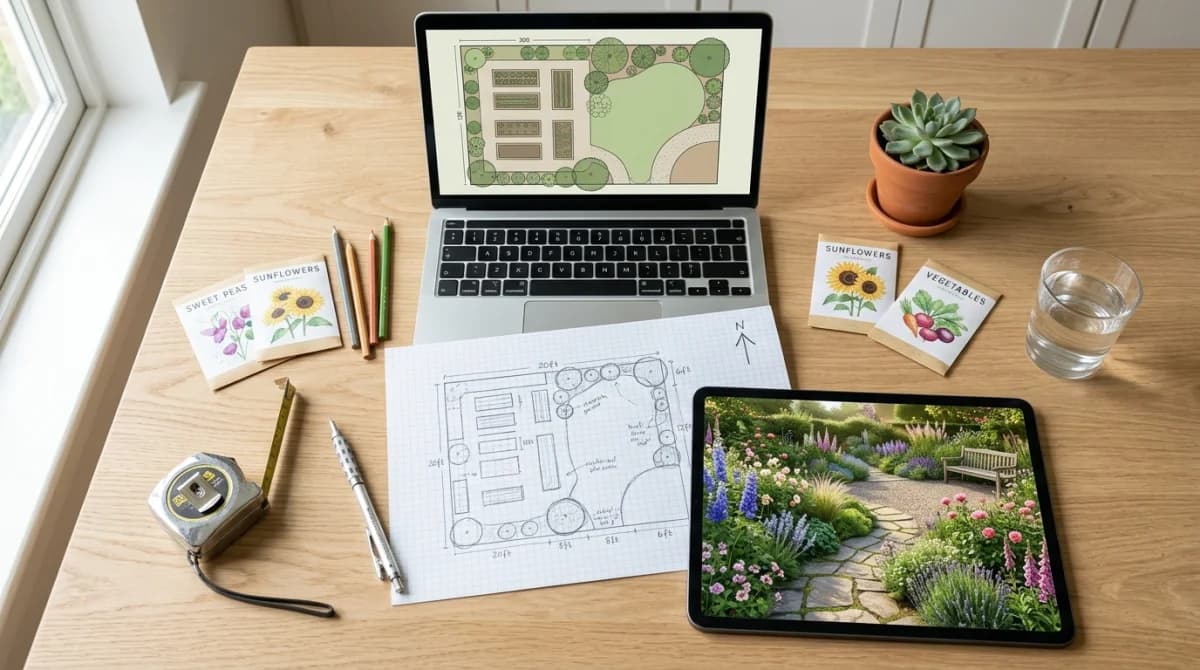
If you are working out where this kind of bed fits in the rest of the garden — and how it transitions to lawn, path, or the more permanent ornamental borders — Gardenly  can help you sketch the shape of the bed and the planting drifts before you start digging in May.

What to Resist

A few things to leave out, even though they are tempting.

Single specimens. One artichoke is structural. One rhubarb stuck in the corner of an otherwise unrelated bed is a leftover.

Too many heights at once. A vegetable border should have a clear back, middle, and front. If a six-foot pole bean ends up in the middle of the bed, the planting in front of it disappears.

One of everything. A row of mixed lettuces is a salad. A drift of one variety of red lettuce, repeated three times along the bed, is a planting.

Bare soil between plants. Mulch heavily, plant generously, and let the foliage of one drift just touch the next. A border reads as a single thing, not as a collection of plants.

A vegetable bed designed this way takes the same hour to plant as a row-cropped one, and produces the same harvest. It just earns its place in the front yard, instead of being hidden behind the garage.

Sources

Related Articles