How to Force Bulbs Indoors for Winter Color
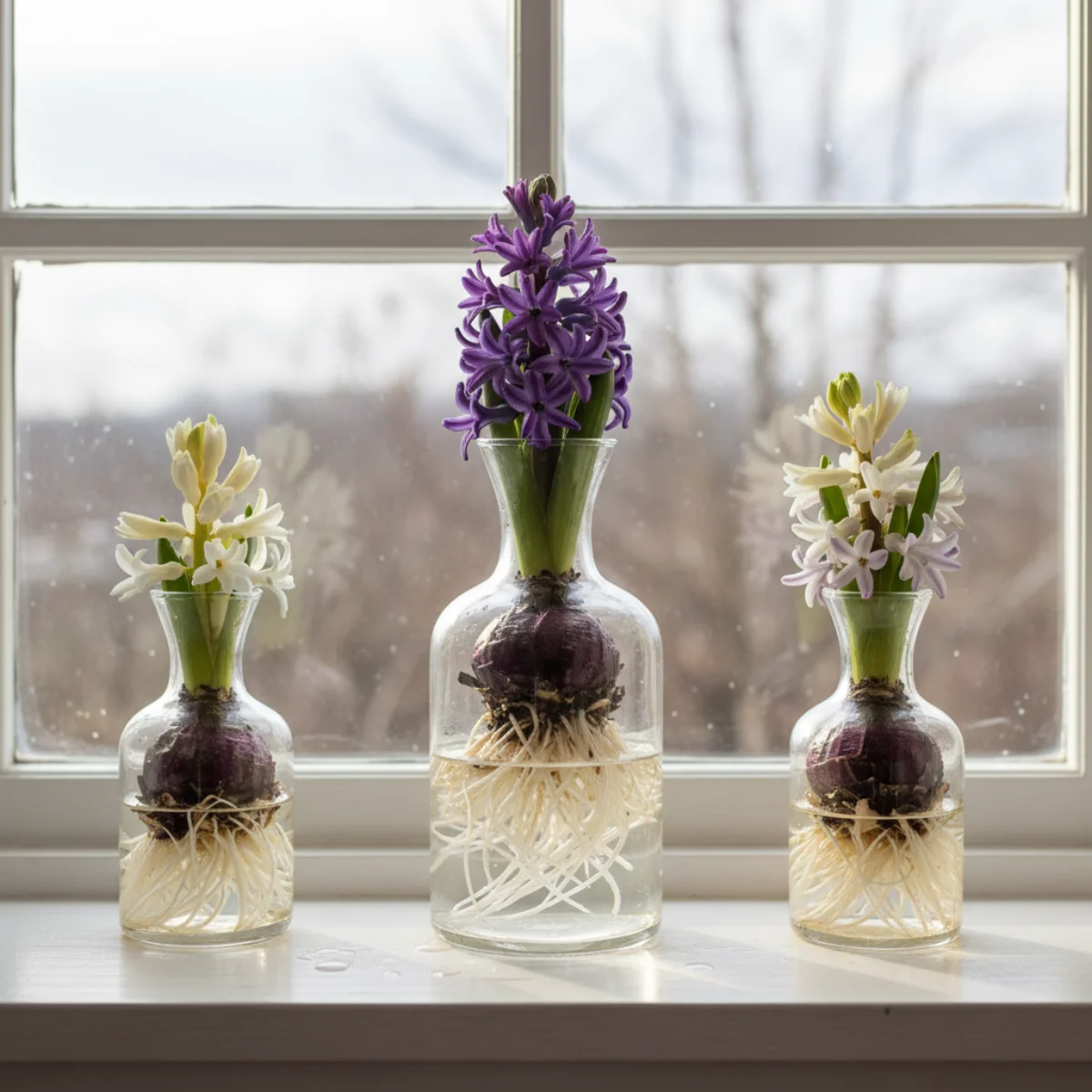
Spring bulbs—hyacinths, tulips, daffodils, crocuses—are programmed to bloom after a cold period followed by warmth. In nature, winter provides the cold. You can mimic this cycle intentionally, a process called forcing, to have blooms inside your home weeks or months before they’d appear in the garden.
January is an excellent time to force bulbs for late winter color, or to start a succession that carries you through to true spring.
Why Forcing Works
All spring bulbs contain a complete flower embryo inside them when you purchase them in autumn. The flower is already formed—it’s just waiting for the right signals to emerge. Cold temperature (around 35-48°F) for a set number of weeks mimics winter, then warmth and light trigger the bloom.
The bulb doesn’t know whether it’s in your refrigerator or in frozen ground. It just responds to temperature and, eventually, light. This is what you’re manipulating when you force bulbs.
Which Bulbs Force Best
Hyacinths (Best for Beginners)
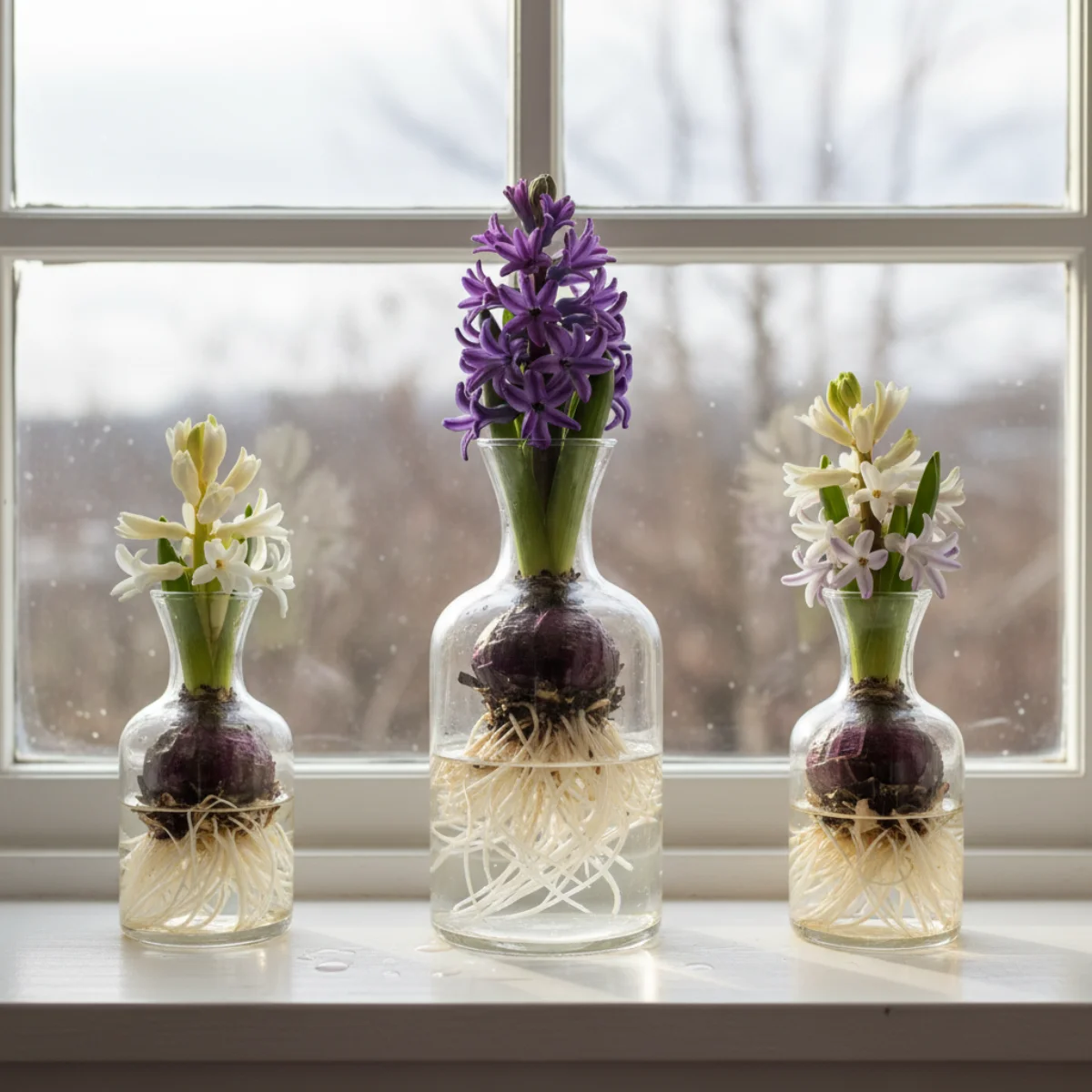
Hyacinths are the easiest and most reliable forcing bulbs, and the fragrance in a winter room is extraordinary. They’re also the only common bulb that can be forced in water alone, using a special hyacinth glass that holds the bulb just above the waterline.
Choose pre-chilled bulbs (labeled “prepared” or “forcing hyacinths”) for the fastest results—these have been pre-chilled by the grower and will bloom in as little as 3-4 weeks after potting.
Without pre-chilling, hyacinths need 10-14 weeks of cold before they’ll bloom.
Good varieties for forcing: ‘Delft Blue’, ‘Carnegie’ (white), ‘Pink Pearl’, ‘Jan Bos’ (deep red).
Narcissus / Daffodils
Standard garden daffodils need 16 weeks of cold—a long commitment. Paper white narcissus (Narcissus papyraceus) are the exception: they require no cold period at all and bloom 4-6 weeks after potting. They’re the quintessential apartment or indoor forcing bulb.
Paper whites are strongly fragrant (some find the scent too intense—sample before committing to a large bunch). Plant them in bulb fiber, pebbles, or water, and keep in a cool room until the shoots are several inches tall, then move to warmth and light.
Other narcissus that force well without extensive chilling: ‘Avalanche’, ‘Ziva’, ‘Grand Soleil d’Or’.
Tulips
Tulips take more patience—they need 12-16 weeks of cold—but the results are beautiful. Single early varieties like ‘Christmas Dream’ (pink), ‘Apeldoorn’ (red), and ‘Ballad’ (purple with white edges) are good choices.
For tulips planted in January, expect blooms in April-May, which is roughly when outdoor tulips bloom in many climates. To get January or February blooms from tulips, you’d need to have potted and chilled them back in September or October.
Crocuses, Muscari, and Small Bulbs
These force beautifully in shallow pots. Crocus need 15 weeks of cold and bloom in late winter. Muscari (grape hyacinth) needs 8-10 weeks. Plant them densely—a 6-inch pot can hold 15-20 crocus corms or a dozen muscari bulbs—for the most impact.
How to Pot Bulbs for Forcing
Materials Needed
- Bulbs (sized appropriate for forcing—go for the largest grade)
- Pots with drainage holes (clay or plastic both work; clay is better for bulbs prone to rot)
- Bulb fiber, gritty potting mix, or standard potting mix with added perlite
- Cool storage location: refrigerator, unheated garage, cold basement (35-48°F)
Potting Method
- Fill the pot about halfway with moist potting mix
- Set bulbs closely—tulip bulbs can almost touch; hyacinths should be just barely not touching
- Fill in around bulbs, leaving the tips just at or slightly above the soil surface
- Water thoroughly
- Label with variety and date potted
- Move to cold storage
During the cold period, water occasionally to prevent complete drying out, but don’t keep the soil wet. The goal is cool and slightly moist.
Chilling Times
| Bulb | Weeks of Cold Needed |
|---|---|
| Hyacinth (pre-chilled) | 0 (bloom in 3-4 weeks) |
| Hyacinth (not pre-chilled) | 10-14 weeks |
| Muscari / Grape Hyacinth | 8-10 weeks |
| Crocus | 14-15 weeks |
| Daffodil (standard varieties) | 16 weeks |
| Paper Whites | 0 (no cold needed) |
| Tulip | 12-16 weeks |
Forcing in Water
For hyacinths and some narcissus, water forcing is beautiful to watch—you can see the root development in a clear glass vase.
Hyacinth glasses: Fill so the water level just touches the base of the bulb. Keep in a cool, dark location for 8-10 weeks (or shorter if using pre-chilled bulbs). Roots will grow down into the water; change the water weekly or when it looks murky. When roots are well-developed and the shoot is several inches tall, move to light.
Pebble/water method (paper whites, some hyacinths): Fill a watertight container 2-3 inches deep with decorative pebbles, gravel, or glass stones. Nestle bulbs into the pebbles so they’re held upright. Add water until it just touches the base of the bulbs—not higher, or the bulbs will rot. Keep topped up.
Transitioning to Bloom
After the cold period, shoots should be 2-4 inches tall. Move pots to a cool room (55-60°F) with indirect light first—this prevents the stems from shooting up too fast and flopping. Once they’re established in this intermediate stage, move to a warmer spot with bright light for the final push to bloom.
Avoid putting forced bulbs in direct hot sun or near a heat source—this shortens the bloom period. Cool room temperature (60-65°F) extends flowers significantly. A window that gets morning light but not hot afternoon sun is ideal.
After Flowering
Forced bulbs in pots can sometimes be transplanted to the garden after flowering, where they may recover over a season or two—though they rarely bloom as well as fresh bulbs for a year or two afterward. Standard practice is to treat them as single-use and compost after the leaves die back.
Paper whites are frost-tender and cannot be planted outside in most of North America and northern Europe.
Making the Most of Forcing
The most satisfying approach is staging: pot up batches at 2-3 week intervals through fall and early winter, then bring them in from cold storage in succession through winter. With good planning, you can have bulbs blooming indoors from January through March.
If you missed the fall planting window, pre-chilled hyacinth bulbs (available from some suppliers in late fall or early winter) and paper white narcissus can be started any time for quick indoor color.
A bowl of blooming hyacinths on the kitchen table in January is one of winter’s better compensations.
Sources & Further Reading
- Growing Bulbs Indoors — University of Minnesota Extension
- Forcing Bulbs — Wisconsin Horticulture, UW-Madison Extension
- Forcing Flowering Bulbs for Indoor Beauty — Penn State Extension
- Forcing Bulbs for Winter Blooms — National Gardening Association