Net Your Strawberries This Week Before the Blackbirds Find Them
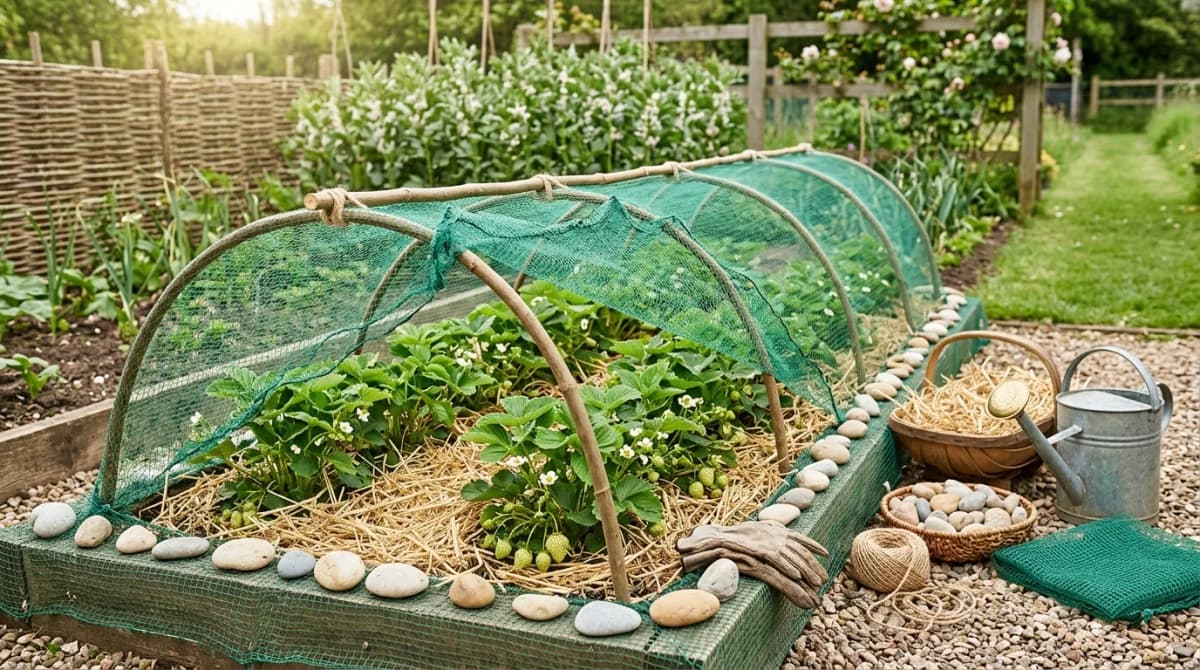
A strawberry bed in the middle of May is a deceptively peaceful sight. The white flowers have mostly finished, the bees are off elsewhere on the borage and the comfrey, and the first hard green pinhead fruits are sitting on their stems looking entirely uninteresting to anything except the gardener counting them. For about ten days nothing seems to be happening. Then a fruit picks up the faintest blush of pink, then another, and somewhere over the back hedge a blackbird notices. From that point a strawberry bed without bird protection is on a clock that the gardener does not own. Within seventy-two hours of the first colour, an unguarded row can lose a third of its crop to a single pair of blackbirds working it methodically from one end to the other, taking a neat triangular bite out of every fruit that has begun to ripen and leaving the rest to rot on the stem. There is no recovering from that. The week to act is the week the fruits are still uniformly pale and the birds have not yet developed the route.
Mid-May is the right week for almost every temperate-zone strawberry bed planted from runners the previous summer or autumn. The plants have flowered, the first fruits have set and swollen to the size of a small grape, and the colour change is roughly seven to ten days away. Putting up the netting now — before the colour appears — means the birds never form the habit of feeding in that spot. Putting it up after the first ripe fruit is taken means the birds already know the bed exists, and they will spend the rest of the season probing the netting for weaknesses.
Why a Frame Beats a Sheet of Netting
The single most common bird-protection failure in domestic strawberry beds is draping netting directly over the plants. It looks reasonable from a distance and it is what most gardening guides illustrate, but in practice it fails in two ways at once. The netting rests on the foliage and on the developing fruits, which means a blackbird standing on top of the net can reach straight through the mesh and eat the fruit underneath without ever needing to find a gap. And the flowers and emerging fruits get caught in the netting, so that when the gardener lifts it to pick, fruit is pulled off the plants by the mesh. Both problems disappear if the netting sits on a low frame at least six inches above the highest point of the foliage.
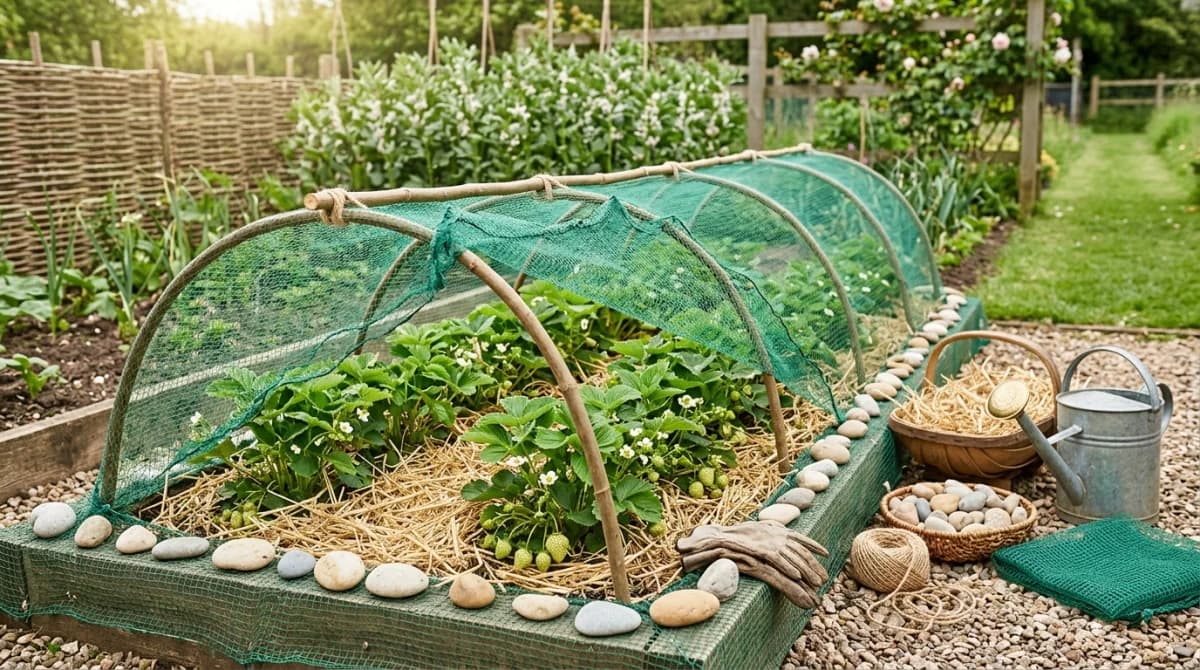
The frame does not have to be elaborate. A row of slim hazel rods or four-foot lengths of flexible plastic conduit, pushed into the soil at intervals of two to three feet down each long side of the bed and bent into a half-hoop over the row, gives a perfectly adequate skeleton. A single long ridge pole running along the apex of the hoops, tied at each crossing with garden twine, stiffens the structure against wind and stops the netting from sagging into the centre of the bed. Over this drape fine bird netting — five-eighths-inch mesh is the standard and is what most fruit-cage suppliers stock — letting it hang to the soil on all four sides with at least six inches of overhang.
The weighting at the edges is the part that most home setups skimp on, and the part that decides whether the system actually works. A net that sits loosely on the soil can be lifted by any blackbird with twenty seconds of patience, and once one bird has found the route, the rest of the local population learns it within a day. Weight the edges down all the way around with smooth river pebbles, lengths of old timber, or the long iron pegs sold for ground-sheet anchoring, spaced no more than two feet apart. The aim is that a determined bird trying to push under the net at any single point finds no slack to exploit.
Mesh Size and the Trade-Offs
Five-eighths-inch (15mm) mesh is the size to ask for. It is small enough to exclude blackbirds, thrushes, starlings, and sparrows reliably, and large enough that pollinators can still reach any late flowers if the netting is in place during the tail end of the bloom. It is also large enough not to entangle small birds catastrophically, which is the real concern with the very fine 5mm mesh sometimes sold for the purpose. A finer mesh sounds safer in principle but is worse in practice: small birds get tangled by their feet or by their primary feathers and cannot extract themselves, and the gardener arrives to a distressing problem on a Saturday morning.
Avoid using old curtain netting, agricultural fleece, or the kind of fine nylon mesh sold for protecting brassicas from cabbage white. None of it is rated for bird exclusion at the appropriate strength, and all of it tears or sags under the weight of a single overnight rain. Buy proper green or black UV-stabilised bird netting from a fruit-cage supplier; a roll twelve feet wide and thirty feet long covers a standard ten-foot strawberry row and lasts five seasons or more if it is taken down and stored dry over the winter.
Mulch Underneath, Before the Net Goes On
The week the netting goes up is also the week to mulch the soil underneath. A strawberry bed without a mulch layer at fruit-set is asking for two avoidable problems: soil splashing onto the fruit during heavy rain, which creates the grey-mould lesions that ruin half-ripe berries, and slugs that climb the stems at night and rasp the fruit at the contact point with the soil. A two-inch layer of clean barley straw, tucked carefully under each crown and spread between the rows, lifts the fruit clear of the soil and largely eliminates both problems for the rest of the season. The straw also keeps the soil cool and moist underneath, which helps the second flush of fruit set in June.
Do the mulching before the netting goes on. It is possible to mulch through the side of a low cloche frame, but it is fiddly and almost always less even than mulching with the bed open. Spread the straw, settle it around the crowns, then lift the netting over the frame and weight it down. The order makes a noticeable difference to the cleanliness of the harvest.
Lifting the Net to Pick
The one operational detail that determines whether the netting feels like an asset or a chore is how easily it lifts for picking. Build the frame so that one entire long side can be lifted as a single flap, hinged at the back, weighted only along the front edge. To pick, walk to the path side, lift the front pebbles off, fold the netting back over the apex of the hoops, and pick the row from a standing-stoop position. Replace the pebbles when finished. The whole operation should take less than a minute per visit. A net that has to be unpinned at every corner and dragged off entirely will get left off after the third pick, and the birds will move in within a day.
The Mistakes That Lose the Crop
Three patterns account for most strawberry-bed bird losses in their first protected season:
- Netting too late. A bed netted after the first fruit has been taken is a bed the birds already know about. They spend the rest of the season testing the perimeter, and a single gap on a single afternoon costs the entire crop in that area. Net before the first colour appears.
- Netting resting on the fruit. Drape-style netting lets birds feed through the mesh from above, and the percentage of crop lost is barely lower than an unprotected bed. Build a frame that holds the net at least six inches above the highest leaf.
- Loose edges. A net that is not weighted continuously around the entire perimeter is, to a hungry blackbird, an open door with a slight inconvenience attached. Pebble the entire perimeter every two feet, every time the net is replaced after picking.
Get the frame up and the netting weighted in the week of the 14th of May, mulch underneath while you are at it, and the bed becomes a reliable producer of clean, intact fruit from the first ripe berry in early June through the end of the main flush in early July. The work takes a Saturday morning, costs less than a single supermarket punnet over the lifetime of the netting, and is the difference between picking strawberries and watching birds pick them.
If you are unsure whether a low net frame will read acceptably in a bed that has to look reasonable from the kitchen window — a green-netted cloche running the length of a strawberry row is not the prettiest feature in a small garden — Gardenly can preview the bed at full June fruit, with the netting in place and the rest of the border planted to draw the eye elsewhere. Useful for deciding whether the strawberry row belongs at the back of the kitchen garden or in the more visible front beds where the netting will be on view for six weeks of the year.
Sources
- Royal Horticultural Society — Strawberries: Growing Guide
- Cornell Cooperative Extension — Strawberry Production for the Home Garden
- Penn State Extension — Home Garden Strawberries
- University of Minnesota Extension — Growing Strawberries in the Home Garden