Plant Out Your Leeks Now — The Trench-and-Puddle Method for Long White Stems All Winter
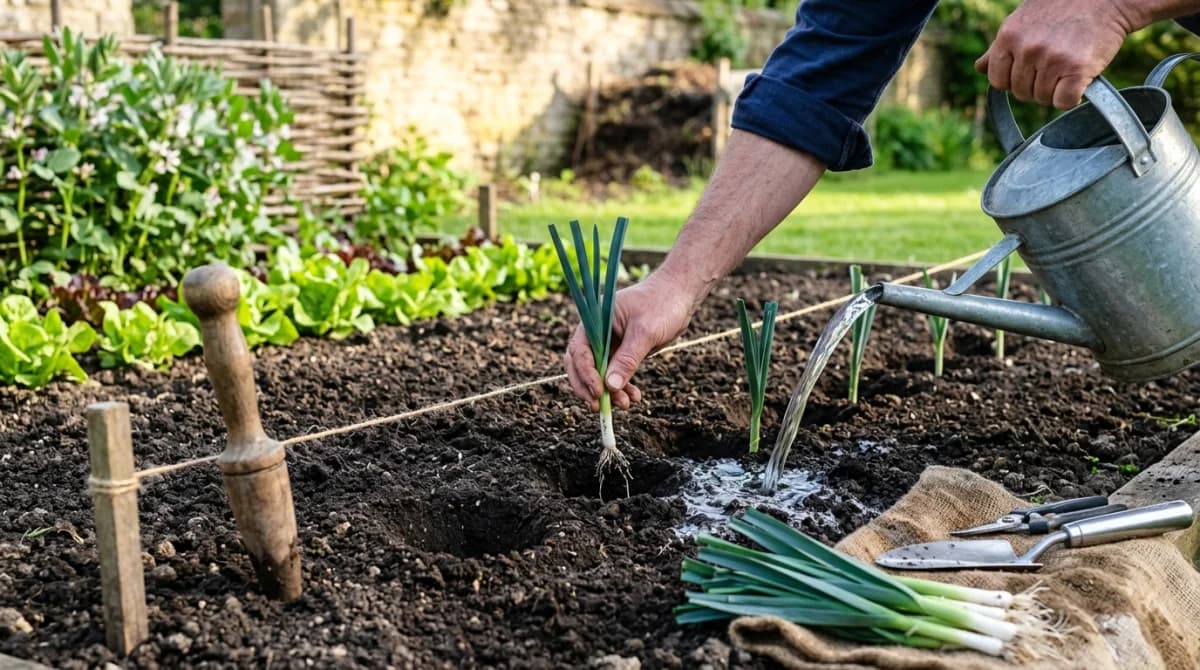
There is a very particular kind of gardener who plants leeks in late May, and it is the kind of gardener who already knows what they will be eating in February. A leek sown in January and planted out now will be ready to start lifting in October, and will then sit in the ground, perfectly happy, through every frost the winter throws at it, for you to pull as you need it until the following March. Five months of fresh vegetables from a single row, harvested one at a time, requiring no storage, no freezing, no fuss. There is nothing else in the kitchen garden that quite repays a single afternoon’s work like a row of properly planted leeks.
The trick — and it is genuinely a trick, not a technique that has been refined into mush by modern advice — is the trench-and-puddle method that allotment gardeners have used in Britain for at least a hundred years. You drop a pencil-thin seedling into a hole six inches deep, you fill the hole with water, and you walk away. You do not backfill. The soil collapses gently around the plant on its own over the next few weeks, and the depth of the hole forces the leek to develop the long blanched white shank that is the entire point of growing leeks at home rather than buying them.
When and What to Plant
Late May into the first half of June is the standard window across most of the UK and the cooler parts of northern Europe and North America, by which point leek seedlings sown in January or February under cover, or in March in a cold frame, will be roughly the thickness of a pencil and six to eight inches long. That is the size you want. Smaller than a pencil and they are too fragile to plant out well; thicker than a finger and they will run to seed instead of bulking up.
If you did not sow your own back in winter, all is not lost: garden centres and mail-order suppliers sell bundles of bare-root leek seedlings in late May and early June at very reasonable prices, often forty or fifty plants for the cost of a single restaurant side dish. A short row of fifteen plants will feed a couple comfortably through the cold months; thirty plants is a generous family supply.
The varieties worth knowing fall into two groups. The early-season leeks — ‘Musselburgh’, ‘Bandit’, ‘Lyon - Prizetaker’ — bulk up quickly and are ready to lift from October. The hardy late-season ones — ‘Apollo’, ‘Bleu de Solaise’, ‘Saint Victor’ — sit through the worst of the winter without flinching and carry you right through to March, often turning a beautiful slate-blue in cold weather. A good row plants half and half: a few earlies for autumn soups, the rest for the long winter.
Preparing the Ground
Leeks are not fussy, but they reward a single morning of proper preparation. They want an open, sunny spot in soil that has not just had manure dug into it (fresh manure makes them rot at the base), but that was manured for a previous crop, typically the potatoes or beans from the previous year. If your soil is heavy clay, fork in a bucket or two of coarse grit or old compost to open it up. If it is light and sandy, work in a bucket of well-rotted compost to hold moisture, because leeks will not bulk up properly if they go dry in summer.
Rake the surface to a fine, level tilth and remove any large stones. The row spacing is twelve inches between rows, and the plants themselves go six inches apart in the row — close enough to give you a proper row of leeks but far enough apart that each one has the soil and water it needs to fatten up.
The Trench-and-Puddle Method, Step by Step
This is the part that looks too simple to work and then works perfectly.
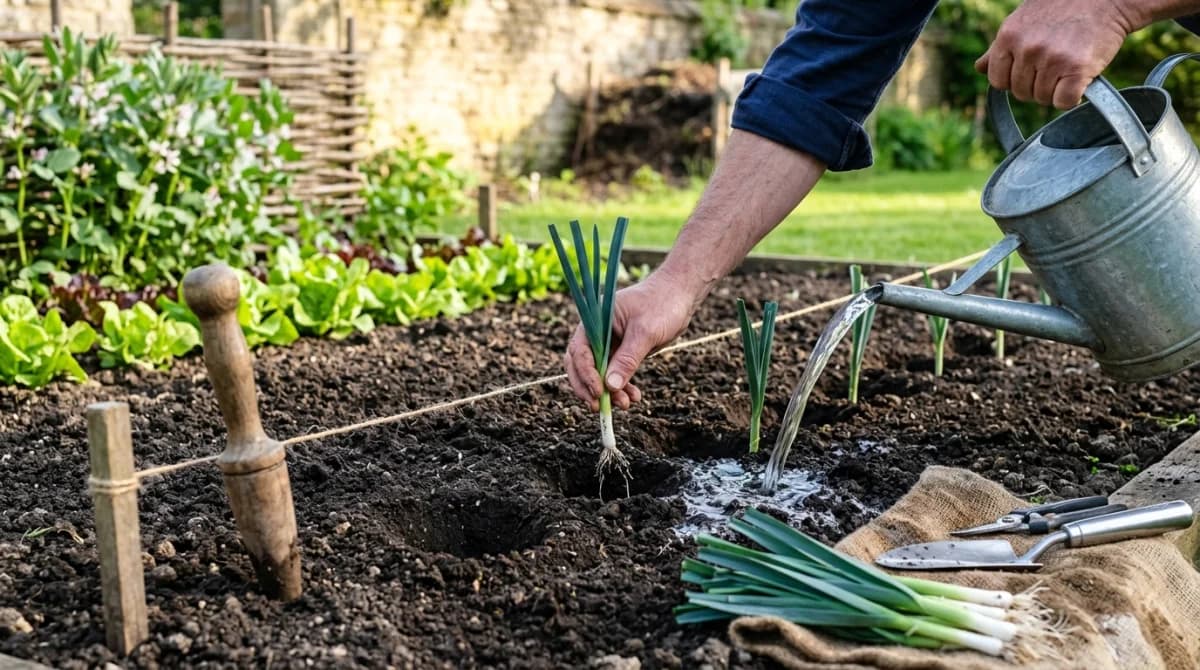
Take a stout wooden dibber — a broken spade handle sharpened to a point is the traditional tool, but any thick blunt stick will do — and push it straight down into the prepared soil to a depth of six inches. Pull it out cleanly, leaving a narrow vertical hole the diameter of a thumb. Move six inches along the row and make the next hole. Work along the row first; you can plant the whole row faster than you can plant one at a time, because the rhythm is everything.
Now take your leek seedlings out of the pot or seed bed where they have been growing. They will come up in a tangled clump — gently tease them apart, washing the soil off the roots in a bowl of water if they are reluctant. With a sharp pair of scissors, trim the roots back to about an inch long, and trim the very tops of the leaves back by about a third. This sounds brutal and is in fact essential: it reduces the leaf area the plant has to support while its trimmed roots are re-establishing, and it stops the long leaves drooping into the soil and rotting. The plant looks like a sad green pencil when you have finished, which is exactly right.
Drop each trimmed seedling into a dibbed hole. Do not push it down — just let it slide in until the leaves rest on the surface of the soil. The bottom of the leek should sit at or near the bottom of the hole, with most of the hole left as an air-gap around the plant. This is the key. You are not backfilling.
When the whole row is planted, take a watering can with the rose removed — you want a steady stream, not a sprinkle — and pour water generously into each hole until it brims. This is the puddle. The water carries just enough loose soil with it to settle around the base of the leek and seal it in. Over the next two or three weeks, gentle rain and your own watering will collapse more soil into the hole at its own pace, and the leek will quietly grow upward through the deepening soil column, blanching its lower stem white as it goes.
That is the whole job. You do not need to firm the soil with your boot, you do not need to backfill, and you do not need to mulch immediately. The leeks will look fragile and absurd for a fortnight and then visibly take hold.
Through the Summer
For the first month, water the row weekly if there is no rain — leeks will not establish into dry holes. Once they have clearly taken and started to put on new leaf growth, they are remarkably self-sufficient. Keep the row weed-free, because leeks compete poorly against weeds, and hoe shallowly to avoid disturbing the developing bulbs.
In late summer, if you want even longer blanched stems for show-quality leeks, you can earth them up the same way you would potatoes — drawing soil up around the stems with a hoe — or slip a cardboard tube over each plant. This is optional. For ordinary kitchen leeks, the original six-inch hole gives you all the white shank you need.
Leek moth and allium leaf miner are the two pests worth knowing about in the UK and parts of Europe, and the simplest defence is a length of fine insect-proof mesh draped loosely over the row from June onwards, removed only briefly to weed. It is the single thing that turns a clean row of leeks into a clean row of harvested leeks.
Harvesting Through Winter
Leeks are ready to lift when the stems are an inch or two thick and the plants stand a foot or more tall. The earliest varieties make this size by October; the later ones bulk up steadily through November and into the new year. You harvest one at a time, as needed — push a fork in alongside the plant and lever it gently upwards, because leeks are surprisingly deeply rooted and snap off at the base if you simply pull.
Cold does not hurt them. A row of leeks under a coating of frost on a January morning is one of the most reassuring sights in the gardening year, because you know that whatever else has failed or finished, there is dinner. Even in the harshest winter weeks, a leek pulled at lunchtime is on the table by evening, with no storage and no quality loss.
The last few stragglers, lifted in late February or early March, will be starting to think about flowering — you can spot it by the hard central stem developing in the heart of the leek — and these are the moment to call the season closed and clear the row for the next crop.
Why It Is Worth the Afternoon
A supermarket leek is a pale, hollow imitation of the real thing. The white shanks are short because the plants were grown in shallow soil at speed; the flavour is thin because they were harvested young; and they are, by the time they reach you, often a week old. A homegrown leek pulled in November has a deep, sweet, almost nutty flavour, a dense weight in the hand, and a six- or eight-inch white shank that makes the difference between an honest leek and onion soup and the watery imitation that most people grew up with.
The row also asks for almost nothing once it is in. There is no further sowing, no thinning, no successional planning, no fussy harvest window. You plant it once, in an afternoon, in late May. You weed it occasionally through the summer. And then, for five months of cold weather, you walk down the path and pull dinner out of the ground.
If you are working out where the leek row should sit in next year’s vegetable plot — what should follow your potatoes, where the brassicas would do best, how to rotate to keep the soil in good heart — Gardenly can render a proper plan of your kitchen garden from a photo of the space, so you can see how the rows and seasons fit together before you commit to the layout. Useful for the kind of long-season crops that occupy a bed for nine months and need their place planned ahead.
Sources
- Royal Horticultural Society — Leeks: Growing Guide
- Garden Organic — Growing Leeks
- National Allotment Society — Crop Rotation and the Allium Family