Plant Your Sweetcorn in a Block This Weekend — Not a Row — for Cobs That Actually Fill
There is one piece of advice about sweetcorn that does more for the eventual harvest than any amount of feeding or watering, and it has nothing to do with how you grow the plant and everything to do with how you arrange it. Sweetcorn is wind-pollinated, and that single fact should reshape the way you plant it. The instinct of most vegetable gardeners is to plant in tidy single rows — it is how we sow carrots, set out leeks, train beans — and for almost every crop that instinct is sound. For sweetcorn it is the one thing that quietly ruins the harvest, producing tall, healthy, leafy plants in late summer that yield cobs only half-filled with kernels, with bare gaps and blunt, undeveloped tips. The plants did everything right. The gardener planted them in the wrong shape.
Late May is the moment to put this right, because it is also the moment sweetcorn finally goes out. Corn is a tender, warm-season crop with no frost tolerance, and like courgettes it waits on the back of the last frost before it can leave the cold frame. By the last week of May most temperate gardens are clear, the soil has warmed, and plants raised under cover through April are ready to go into open ground. Plant them out this weekend — but plant them in a block, and you change the whole outcome.
Why a Block and Not a Row
Most of the vegetables we grow are pollinated by insects, which find the flowers wherever they happen to be. Sweetcorn is different. It carries its male and female flowers separately on the same plant: the tassel at the very top of the stem sheds clouds of fine yellow pollen, and the female flowers are the silks — those soft threads emerging from each developing cob lower down. Every single kernel on a cob is one silk that must catch one grain of pollen. Miss the pollination and that kernel never forms, which is exactly what a gap-toothed, half-empty cob is: a cob whose silks never got dusted.
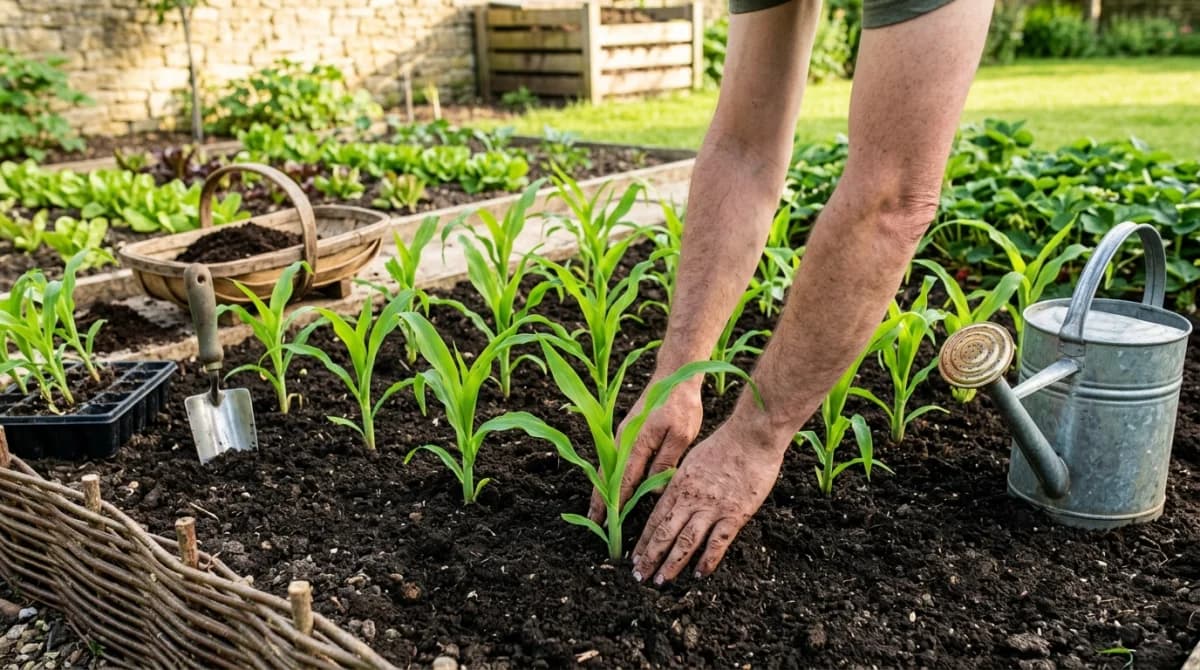
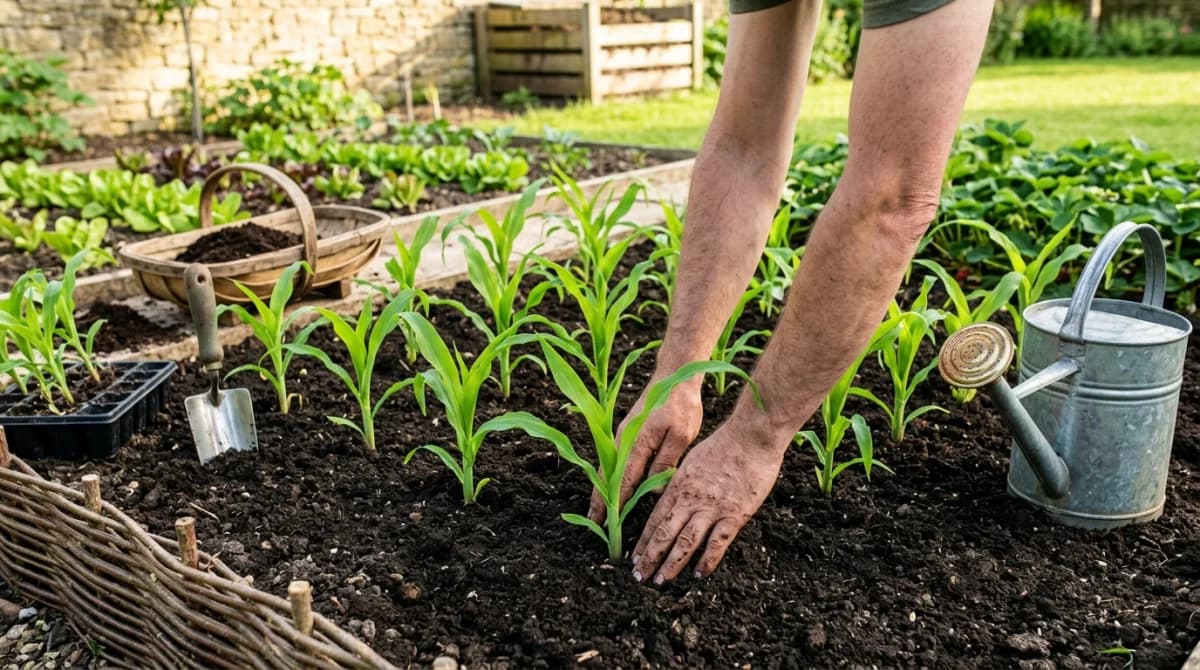
And the pollen does not travel by insect. It falls and drifts on the wind, downward and sideways, in a shower from the tassels above. In a single long row, most of that pollen blows clean off the end of the row and lands on bare ground, never reaching the silks of a neighbour. In a solid block, the pollen released by every plant rains down across all the plants around it, from every direction the breeze happens to come, and the silks are saturated. The arithmetic is simple and unforgiving: a block of sixteen plants in a four-by-four grid will pollinate far more completely than the same sixteen plants strung out in one long line. This is the whole reason the block matters, and it is why even a small patch of corn should be at least four plants wide and four deep — never a single file.
Getting the Plants Out Safely
Before any of that, the plants have to survive the move. Sweetcorn raised under glass or on a windowsill has lived a sheltered life, and it needs hardening off just as much as a courgette does. For seven to ten days before planting, move the plants outside into a sheltered spot during the day and bring them back under cover at night, gradually increasing their exposure to sun and breeze so that by the end they are standing out overnight and taking full conditions in their stride. A plant moved straight from warmth into open wind will check badly and sulk for weeks.
Corn is greedy for warmth and sun, so choose the most open, sunniest part of the garden you have — and one not too exposed to fierce wind, since tall corn in flower can be rocked and even flattened by a summer gale. The soil wants to be rich and free-draining; corn is a hungry feeder, and a bed dug over with plenty of well-rotted manure or garden compost before planting pays back through the season. Space the plants generously within the block — around eighteen inches apart in each direction is a good rule, giving each plant room to build a strong root system and a heavy stem without crowding its neighbours into a thin, leggy stand.
Plant on an overcast day or in the evening if you can, set each plant at the same depth it sat in its pot, firm it in gently, and water it in thoroughly to settle the soil around the roots. For the first couple of weeks, while the small root system catches up with the top growth, keep the plants well watered until they are visibly growing away. A surface mulch of compost spread around the block once it is planted locks in moisture and keeps the weeds down through the summer.
Through the Season to the Harvest
Once established, sweetcorn is an easy crop that mostly looks after itself. It will appreciate a deep soak in dry spells, and the critical moment for water is when the plants are flowering and the cobs are swelling — a drought at that stage means poorly filled cobs even in a well-arranged block. As the plants grow tall, they sometimes throw out a second set of roots, called brace roots, low on the stem; drawing a little soil up around the base of each plant helps anchor them against the wind. Resist the temptation to remove the side shoots, or tillers, that sometimes appear at the base — they do no harm and may even add a little to the plant’s strength.
When the tassels shed their pollen in mid to late summer, you can give nature a hand on a still, dry day by tapping the stems gently so the pollen falls, or even cutting a tassel and brushing it lightly over the silks — a small touch that nudges a block toward complete pollination. After that, it is patience. The cobs are ready when the silks have withered to brown and a kernel, pressed with a thumbnail, releases a milky rather than watery or doughy sap. That moment is the whole point of growing your own: sweetcorn begins converting its sugars to starch the instant it is picked, which is why a cob eaten within an hour of cutting tastes of a sweetness no supermarket cob ever reaches.
Planning the Block Before You Plant
Because the block shape is doing real work, it is worth deciding where it goes before you start planting rather than fitting the corn around everything else. A block of corn is a tall, dense feature by August — five or six feet high — and it will throw shade across whatever sits to its north, which can be a problem for sun-loving neighbours or a gift to a crop that resents midsummer heat. Worth thinking about, too, is shelter from wind, and leaving the open south side clear of anything taller.
If you are trying to picture how a square block of tall summer corn will sit in the plot — what it shades, where it shelters, how much room it really takes once it reaches full height — Gardenly can render your vegetable garden in full summer growth from a photo of the space, so you can place the corn block where it works rather than discovering in August that it has plunged the salad bed into shade. A small thing to check before committing the plants, and a useful one for a crop whose shape on the ground matters as much as this one’s does.
Plant the corn out this weekend, set it in a block, and you have already done the one thing that decides whether the cobs fill. The rest is sun, water, and a few weeks of waiting.
Sources
- Royal Horticultural Society — Sweetcorn: Growing Guide
- University of Minnesota Extension — Growing Sweet Corn in Home Gardens
- Cornell University — Sweet Corn Growing Guide
- Garden Organic — Sweetcorn Growing Advice