Soil Testing 101: What Your Garden Soil Is Trying to Tell You
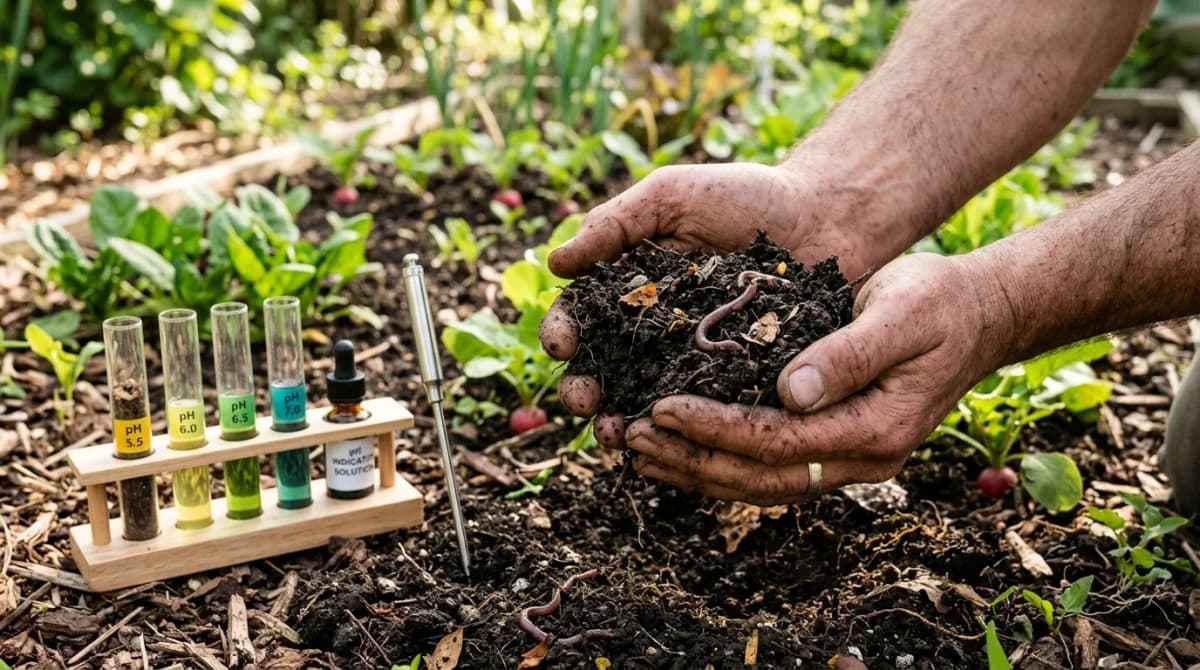
Every year, gardeners spend hundreds of dollars on plants, amendments, and fertilizers based on guesses. They add lime because someone on the internet said to. They dump fertilizer on everything because the bag said “feeds for three months.” They watch plants struggle and assume the variety was wrong or the weather was bad.
Most of the time, the answer is in the soil. And the only way to know what your soil actually needs is to test it.
A soil test costs less than a bag of fertilizer and tells you exactly what to add, what to skip, and what’s already working. It’s the single most cost-effective thing you can do in the garden, and almost nobody bothers.
What a Soil Test Tells You
A standard soil test from a cooperative extension lab measures several things that directly affect plant growth.
pH (Acidity or Alkalinity)
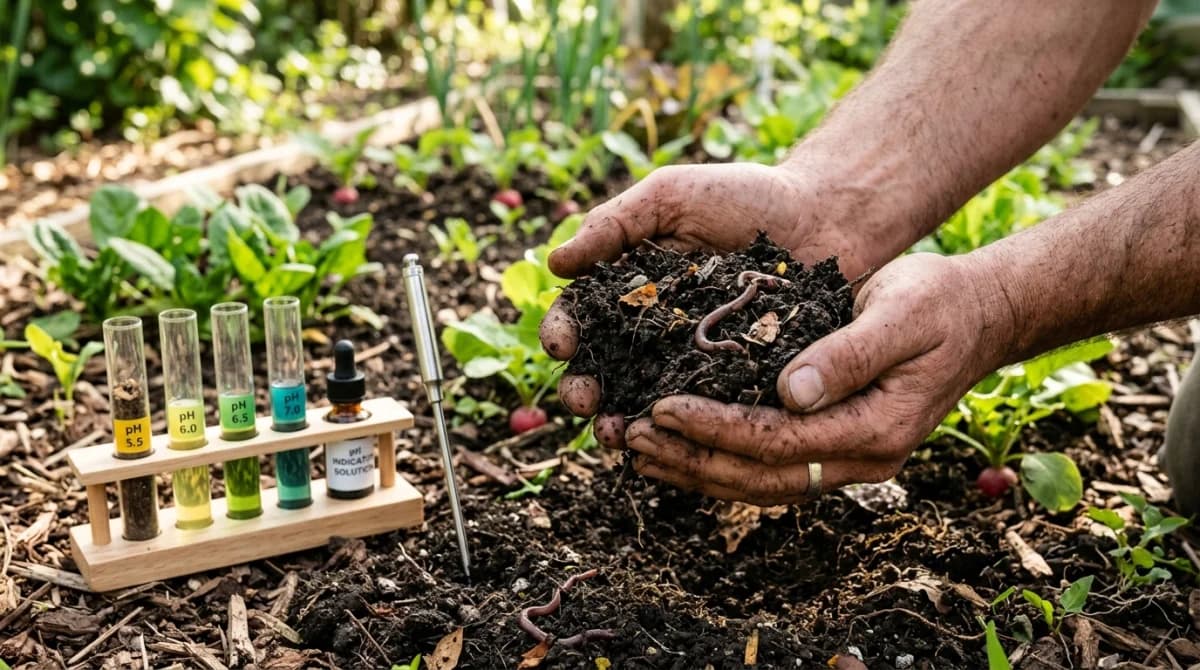
Soil pH is measured on a scale from 0 to 14, with 7.0 being neutral. Most vegetables and ornamental plants grow best in the 6.0 to 7.0 range. Outside that window, nutrients get locked up in chemical forms that plant roots can’t absorb, even if those nutrients are physically present in the soil.
A plant growing in soil with a pH of 5.0 can sit in nutrient-rich earth and still show deficiency symptoms. The nutrients are there, but the chemistry prevents uptake. Adjusting pH is often more effective than adding more fertilizer.
Macronutrients (N-P-K)
- Nitrogen (N): Drives leaf and stem growth. Deficiency shows as pale, yellowing lower leaves.
- Phosphorus (P): Supports root development, flowering, and fruiting. Deficiency shows as purplish tints on leaf undersides.
- Potassium (K): Strengthens overall plant health, disease resistance, and cold tolerance. Deficiency shows as brown, scorched leaf edges.
Most soil tests report these in parts per million (ppm) with a rating of low, medium, or high. If a nutrient tests high, you don’t need to add more. If it tests low, the report will recommend specific amounts of specific amendments.
Organic Matter
Organic matter is the percentage of your soil that comes from decomposed plant and animal material. It feeds soil organisms, improves structure, and increases both drainage and water retention, two things that seem contradictory but organic matter accomplishes both.
Most garden soils benefit from 3 to 5 percent organic matter. If your test shows less than 2 percent, adding compost regularly is the highest-priority improvement you can make.
The DIY Texture Test
Before you send a sample to a lab, you can learn a lot about your soil’s physical structure with a mason jar and some water.
The Jar Test
- Fill a quart jar one-third full with soil from your garden. Remove rocks, roots, and debris.
- Fill the rest with water, leaving an inch of air space.
- Add a teaspoon of dish soap (it helps particles separate).
- Shake vigorously for two minutes, then set the jar on a flat surface.
- Wait 24 hours.
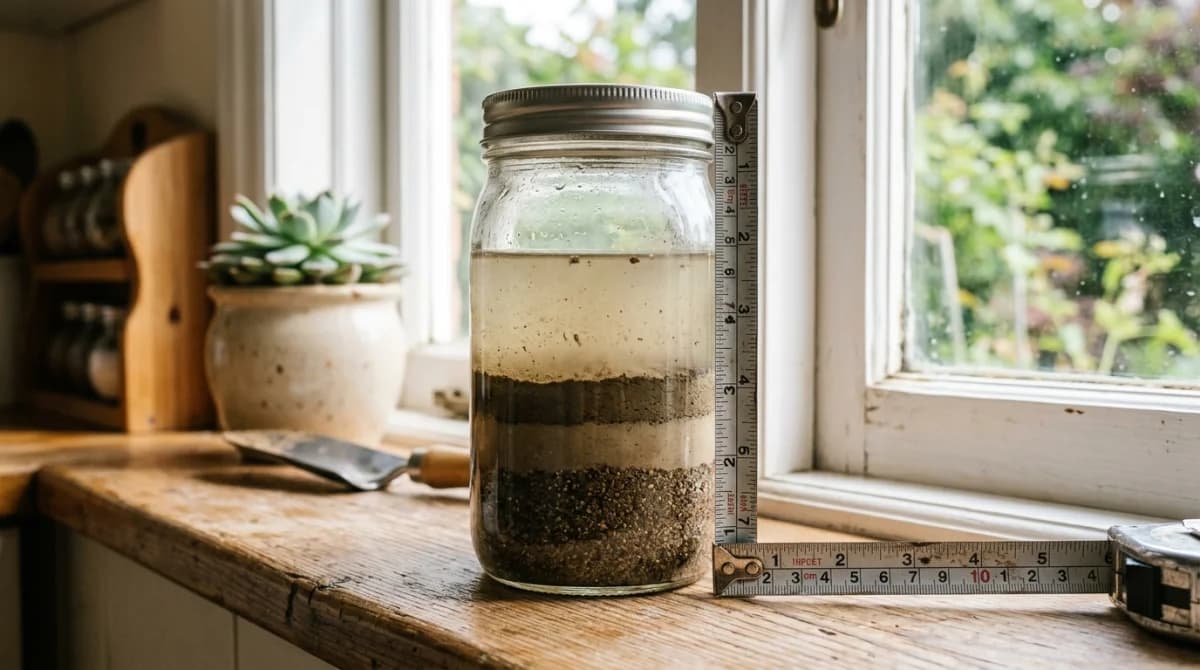
The soil settles into visible layers. Sand sinks to the bottom within a minute. Silt settles on top of the sand over the next few hours. Clay stays suspended longest and forms the top layer. Water above may stay cloudy for a day or more if you have high clay content.
Measure each layer’s thickness and divide by the total settled soil height to get approximate percentages. Ideal garden soil (loam) is roughly 40 percent sand, 40 percent silt, and 20 percent clay.
The Ribbon Test
Grab a handful of moist soil and squeeze it in your fist. If it forms a tight, sticky ball that you can press into a ribbon between your thumb and forefinger, you have clay. If it crumbles and won’t hold shape, you have sand. If it holds together loosely but breaks apart when pressed, you have loam.
This takes ten seconds and tells you more about your soil’s behavior than most gardeners learn in years of trial and error.
How to Take a Proper Soil Sample
A test is only as good as the sample you send. A scoop from one random spot doesn’t represent your garden.
Take multiple samples. Use a trowel or soil probe to collect six to eight small samples from different spots across the area you want to test. Go 6 to 8 inches deep, which is the root zone for most garden plants.
Mix them together. Combine all the sub-samples in a clean bucket and mix thoroughly. This composite sample averages out the natural variation across the area.
Dry the sample. Spread a cup of the mixed soil on newspaper and let it air-dry for a day. Don’t oven-dry it, as heat changes the chemistry.
Test different areas separately. Your front lawn, vegetable garden, and perennial border may have completely different soil conditions. Send separate samples for each area you manage differently.
Timing matters. Fall is the ideal time to test because you can amend over winter. But spring testing works fine; you just need to apply amendments and give them a few weeks to integrate before planting.
Reading Your Results
When your test comes back, you’ll see numbers, ratings, and recommendations. Here’s how to make sense of them.
pH Results
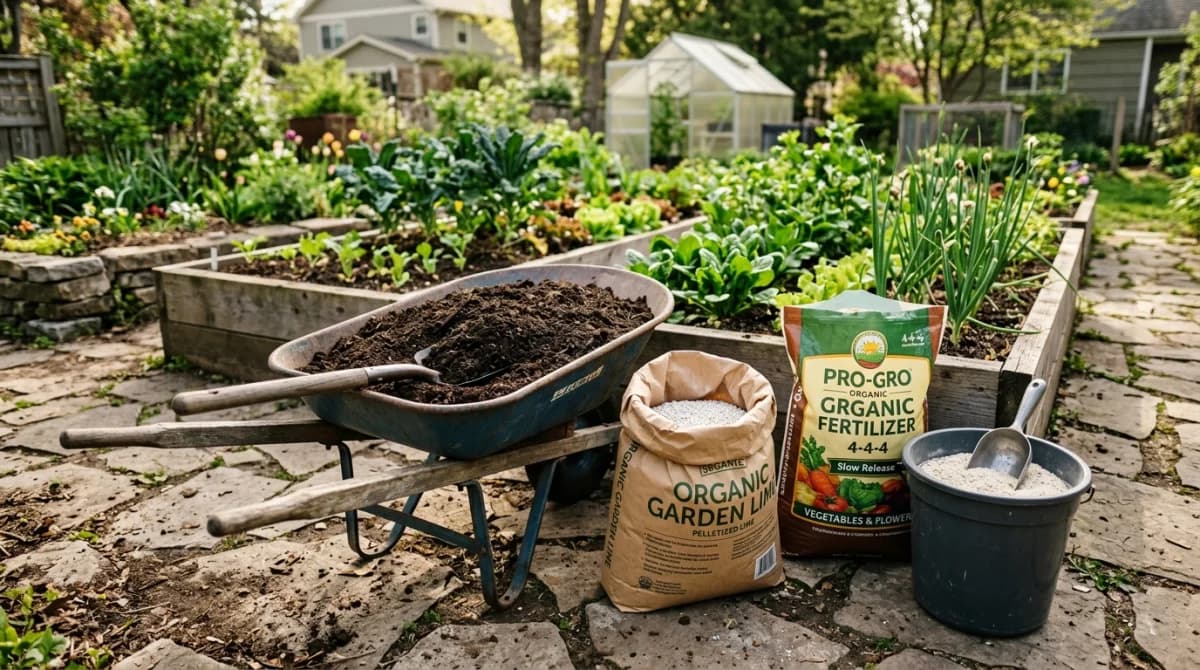
- Below 6.0: Soil is too acidic for most plants. Add pelletized limestone at the rate recommended by the test. Lime works slowly: it takes three to six months to fully adjust pH, which is why fall testing and winter application is ideal.
- 6.0 to 7.0: Optimal range for most vegetables and ornamentals. No adjustment needed.
- Above 7.0: Soil is alkaline. Elemental sulfur or iron sulfate can lower pH, but this is harder to correct than acidity. Growing in raised beds with amended soil is often the practical solution for very alkaline native soil.
Nutrient Levels
Labs rate each nutrient as low, medium, high, or excessive. Focus on anything rated low: those are your priorities. Ignore anything rated high or excessive. Adding more of a nutrient that’s already abundant wastes money and can create toxicity problems or nutrient imbalances.
The most common result for home garden soil: nitrogen is low (it always is, since nitrogen is mobile and leaches easily), phosphorus is medium to high (it accumulates over years of fertilizing), and potassium is variable.
If phosphorus tests high, avoid fertilizers with a high middle number (the P in N-P-K). Many gardeners apply “complete” fertilizers year after year and end up with excessive phosphorus, which can interfere with micronutrient uptake and run off into waterways.
Organic Matter
If your organic matter percentage is below 3 percent, compost is your best friend. Add 2 to 3 inches of finished compost to the soil surface and work it in annually. Within two to three years, you’ll see measurable improvement in organic matter content and dramatic improvement in how the soil behaves.
What to Do With the Results
The test report includes specific recommendations; follow them. Extension lab recommendations are calibrated for your region’s soil types and climate. They’re more reliable than generic advice from fertilizer bag labels.
Common Amendments
- Lime (calcium carbonate): Raises pH. Apply in fall or early spring and water in. Takes months to work fully.
- Sulfur (elemental sulfur): Lowers pH. Also slow-acting. Apply well before planting.
- Compost: Improves everything. Adds organic matter, nutrients, and soil biology. Apply 2 to 3 inches annually.
- Balanced organic fertilizer (e.g., 5-5-5): Addresses general nutrient deficiency without overdoing any single element.
- Bone meal: Adds phosphorus. Only apply if your test shows a phosphorus deficiency.
- Greensand or kelp meal: Adds potassium slowly. Good for long-term soil building.
What NOT to Do
Don’t add everything at once. If your pH needs adjusting and your nutrients are low, fix the pH first. Many nutrient deficiency symptoms disappear once pH is corrected because the nutrients were there all along, just chemically unavailable.
Don’t add sand to clay. This is the most persistent bad advice in gardening. Sand mixed with clay creates something close to concrete. Add organic matter to clay soil instead. It opens up the structure without the cement-making chemistry.
Don’t trust cheap home test kits for nutrient levels. The pH readings from home kits are reasonably accurate. The N-P-K readings are not. Spend the $15 to $20 on a lab test for nutrient analysis.
When to Retest
Retest every two to three years for established gardens. If you’ve made significant amendments (large lime application, major compost additions), retest the following year to see how the soil responded.
For new gardens, testing annually for the first three years helps you track improvement and fine-tune your approach. After that, the soil stabilizes and biennial testing is enough.
Your soil is the foundation of everything that grows in your garden. A $15 test and an afternoon of reading results will save you far more than that in wasted fertilizer, failed plantings, and frustration. Test first, amend based on evidence, and let the soil tell you what it needs instead of guessing.