Pruning Roses in Spring: When, How, and How Much
Roses have a reputation for being fussy, and pruning is where that reputation gets weaponized. New gardeners either don’t prune at all (and get leggy, unproductive bushes) or panic about cutting the wrong thing and end up leaving the plant in a worse state than before.
Here’s the reassuring truth: roses are hard to kill with pruning. You can hack a rose to stumps in spring and it will grow back vigorously. The question isn’t whether to prune. It’s how to prune for the shape, health, and flower production you want.
Different types of roses need different approaches, but the underlying principles are the same for all of them.
When to Prune
The timing marker is forsythia. When forsythia bushes in your neighborhood start blooming (those bursts of bright yellow on bare branches in early spring), it’s time to prune your roses.
This typically falls in late March to mid-April in zones 6 and 7, earlier in warmer zones, later in colder ones. The idea is to prune just as the plant is breaking dormancy and new growth buds are beginning to swell, but before significant new growth has emerged.
Pruning too early exposes fresh cuts to late freeze damage. Pruning too late removes new growth the plant already invested energy in, which sets it back.
If you miss the ideal window, prune anyway. Late pruning is better than no pruning.
What You Need
Bypass pruners: For canes up to half an inch thick. Bypass pruners make clean cuts (like scissors). Anvil pruners crush stems, so don’t use them on living wood.
Loppers: For canes over half an inch thick. Long handles give you leverage and reach into the center of the bush.
Pruning saw: For thick old canes at the base that loppers can’t handle.
Heavy gloves: Gauntlet-style leather gloves that protect your forearms. Rose thorns are serious.
Rubbing alcohol or disinfectant wipes: Clean your tools between plants, especially if you’ve cut out diseased wood.
The Basic Cuts
Every rose pruning cut follows the same technique:
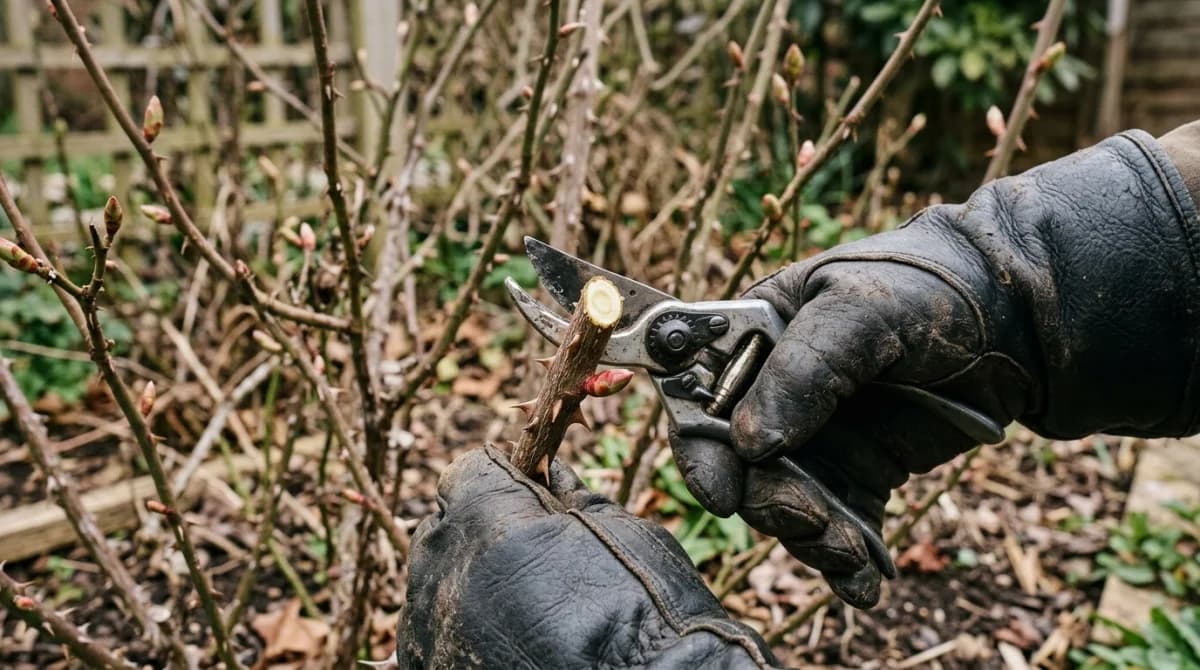
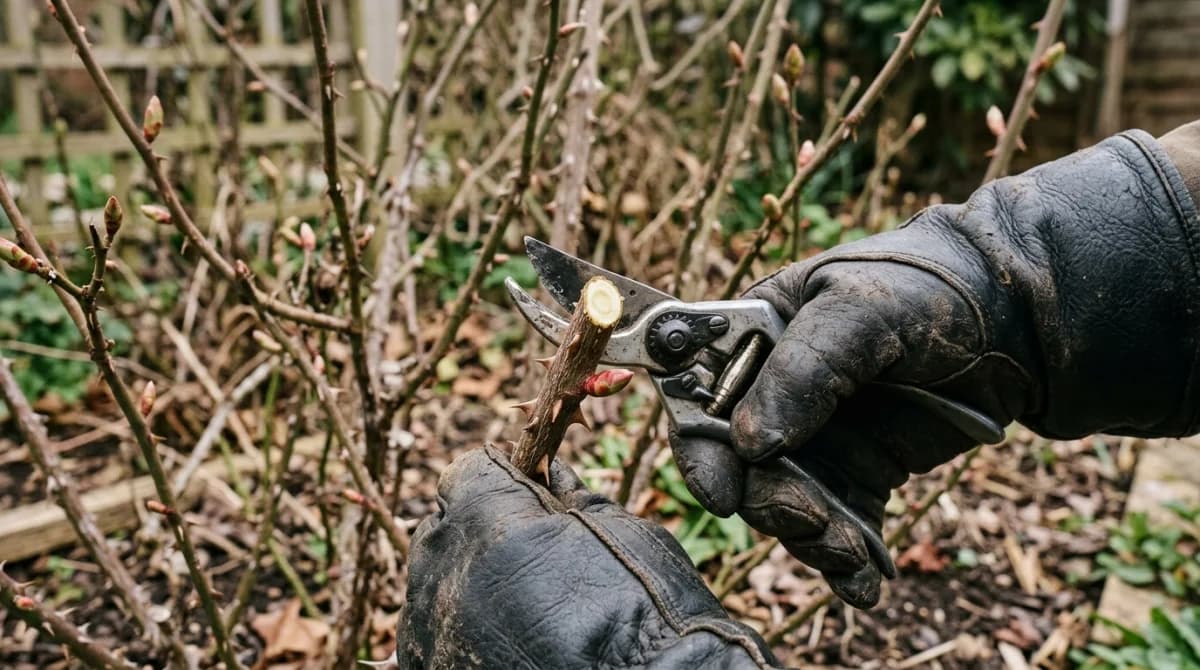
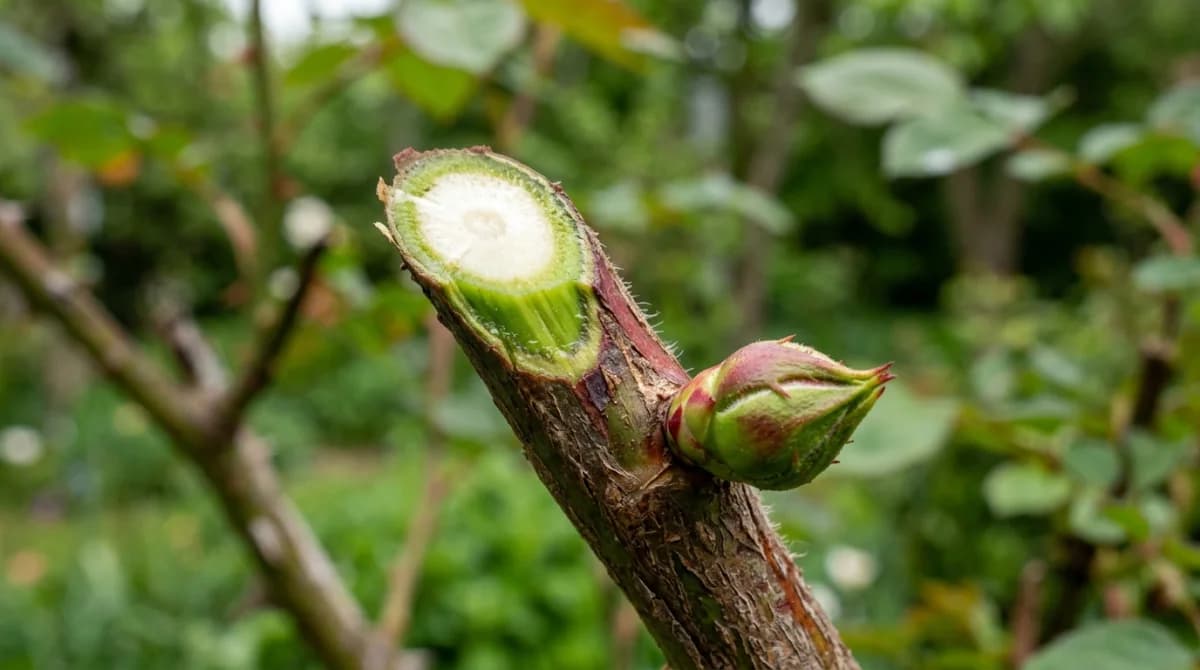
Cut at a 45-degree angle, about a quarter inch above an outward-facing bud. The angle should slope away from the bud so water runs off the cut surface. Cutting too close damages the bud. Cutting too far above leaves a stub that dies back and invites disease.
Always cut to an outward-facing bud. This directs new growth outward, opening the center of the bush for air circulation and light. Growth from inward-facing buds crosses into the center, creating a congested mess.
Remove the four D’s first: Dead, Damaged, Diseased, and Disoriented (crossing) canes. This is the foundation of all rose pruning, regardless of rose type. Remove these before making any shaping cuts.
Pruning by Rose Type
Hybrid Tea and Grandiflora Roses
These are the classic long-stemmed roses that produce one large flower per stem. They bloom on new wood (current season’s growth), so spring pruning stimulates the flowering wood.
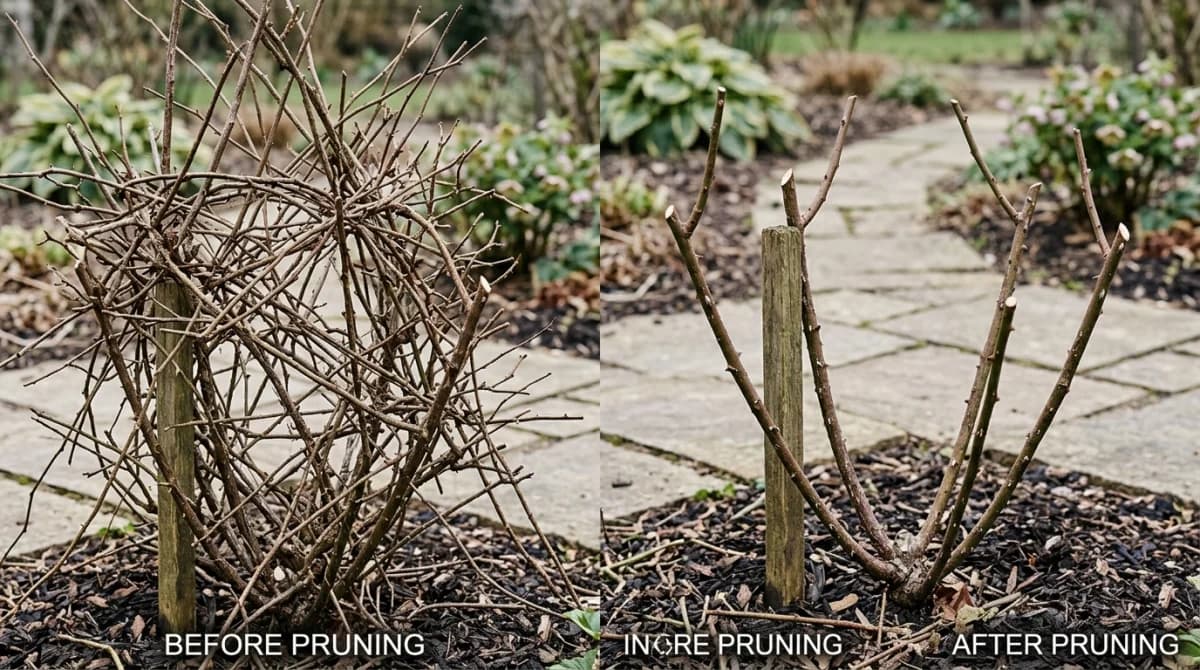
How much to cut: Reduce the bush to 12 to 18 inches tall, leaving three to five strong, healthy canes growing outward. Remove all other canes at the base.
Steps:
- Remove all dead, damaged, and diseased canes first.
- Remove any canes thinner than a pencil.
- Remove canes that cross through the center.
- Select three to five of the strongest remaining canes, ideally spaced evenly around the base.
- Cut each selected cane to 12 to 18 inches, just above an outward-facing bud.
- Remove all remaining canes at the base.
The result should be an open vase shape: canes growing upward and outward with an empty center.
Floribunda and Polyantha Roses
These produce clusters of smaller flowers and generally have a bushier growth habit. Pruning is similar to hybrid teas but less aggressive.
How much to cut: Reduce to 18 to 24 inches. Leave five to eight canes for a fuller look. The goal is a rounded mound rather than the open vase of a hybrid tea.
Shrub and Landscape Roses
This includes Knock Out roses, David Austin English roses, and other modern shrub types. They’re generally low-maintenance and forgiving.
How much to cut: Remove about one-third of the total height. Remove the four D’s, thin out any congested areas in the center, and shape the overall form. Don’t overthink it; these roses respond well to straightforward pruning.
For Knock Out roses specifically, you can cut them back to 12 to 18 inches in spring for a complete refresh. They bloom on new growth and will be covered in flowers by early summer regardless of how aggressively you prune.
Climbing Roses
Climbers require a different approach because they produce flowers on lateral branches that grow from the main structural canes.
What to prune:
- Remove dead or damaged canes.
- Remove the oldest main canes (more than four to five years old) at the base to make room for younger, more productive canes.
- Shorten lateral (side) branches to two to three buds. These laterals are where flowers will appear.
- Train main canes horizontally along a trellis, fence, or wall. Horizontal canes produce more lateral branches and more flowers than vertical ones.
What NOT to prune:
- Don’t cut back healthy main canes unless they’re old or unproductive. These are the framework that produces your flowering laterals.
Ramblers and Once-Blooming Roses
Do not prune these in spring. Ramblers and once-blooming old garden roses (gallicas, damasks, albas) bloom on wood produced the previous year. Pruning them in spring removes the flower buds.
Instead, prune these immediately after they finish blooming in early summer. Remove about one-third of the oldest canes at the base and shorten remaining canes by about one-third.
After Pruning
Clean Up
Rake up all pruning debris and remove it from the garden. Don’t compost rose clippings if there were signs of disease (black spot, canker, rust); bag and dispose of them. Disease spores can survive in compost and reinfect plants.
Feed
Spring pruning is the signal to start feeding. Apply a balanced rose fertilizer or a generous handful of compost around the base of each bush. Roses are heavy feeders that benefit from monthly fertilizing through the growing season, stopping in late summer to allow the plant to harden off before winter.
Mulch
Apply 2 to 3 inches of organic mulch around the base, keeping it a few inches away from the trunk. Mulch retains moisture, suppresses weeds, and moderates soil temperature. Refresh it annually.
Water
If spring is dry, water deeply after pruning. The plant is about to put significant energy into new growth and needs consistent moisture.
Common Pruning Mistakes
Pruning too timidly. This is the most common mistake. Gardeners leave too many canes and don’t cut back hard enough. The result is a tall, leggy bush with small flowers only at the top. Roses respond to hard pruning with vigorous new growth and bigger, better flowers.
Not removing the four D’s. Dead and diseased wood wastes the plant’s energy and harbors problems. Always remove it, even if you do nothing else.
Cutting to inward-facing buds. This sends new growth into the center of the bush, creating congestion, poor air circulation, and ideal conditions for fungal disease.
Using dull tools. Dull pruners crush stems instead of cutting them cleanly. Crushed cuts heal slowly and invite infection. Sharpen your pruners at the start of each season.
Pruning once-bloomers in spring. This removes the entire year’s flower display. If you’re unsure whether your rose blooms once or repeats, skip spring pruning and observe the bloom pattern this year, then prune appropriately next year.
Pruning roses is one of those tasks that seems intimidating until you do it once. The first year you cut a rose back hard and watch it explode with healthy new growth and abundant flowers, you’ll wonder why you ever hesitated. Pick up the pruners, follow the four D’s, cut to outward-facing buds, and let the rose do the rest.