Stake Your Peonies This Week Before the First Rain Flattens Them
There is a particular sound that herbaceous peonies make in early June, and a gardener who has heard it once never forgets it. It is the soft, almost apologetic flop of a fully open double peony stem giving way at the base of the flower, after a single heavy June downpour, and laying its eight-inch saucer of pink petals face-down in the mud at the front of the border. Half the flowers on a mature plant can go in one afternoon. The stems do not snap so much as bow slowly until the flower head touches the ground, where the petals stain brown within hours and the whole display is over for another year. There is exactly one week in the gardening calendar where this is preventable without effort, and that week is now.
Mid-May is the precise moment because the foliage of a mature herbaceous peony is at the height where a grow-through support can be lowered straight down over the crown from above and settled at the right level in a single movement. A week earlier the stems are too short and the support sits too high, with a clear gap of bare metal showing all summer. A week later the foliage has grown up through and around any frame placed on top, and getting the support down to the soil involves bending stems sideways, threading leaves through the grid one at a time, and inevitably snapping two or three of the strongest flowering stems in the process. The window when the work is genuinely easy is about seven to ten days long, and for most temperate-zone gardens it falls in the second and third weeks of May.
Why Peonies Need Support at All
A herbaceous peony’s stems are evolved to hold a single, modest, single-petalled flower of the kind still visible on the original species (Paeonia lactiflora, P. officinalis, P. tenuifolia). Two centuries of breeding for the double and bomb forms — ‘Sarah Bernhardt’, ‘Bowl of Cream’, ‘Festiva Maxima’, ‘Karl Rosenfield’ — have produced flowers that weigh four or five times what the stem was designed to carry. In dry, calm weather the stems just about manage; under any combination of rain, wind, or both, they cannot. The flower head fills with water, the stem leverages downward, and the whole thing folds at the weakest point, which is usually about six inches below the bud where the stem narrows to take the bend toward the sun.
Single-flowered and Japanese-form peonies (where the inner petals are reduced to narrow petaloids around a visible central boss of stamens) carry roughly half the weight of the doubles and are far less prone to flopping. If a long-standing peony has never needed support and reliably stands through every storm, it is almost certainly a single or Japanese form, and there is no need to start staking it now. The plants that need help are the heavy doubles, and they need it without fail every year.
The Three Support Options, Ranked
There are three workable approaches to peony support, and they are not equally good.
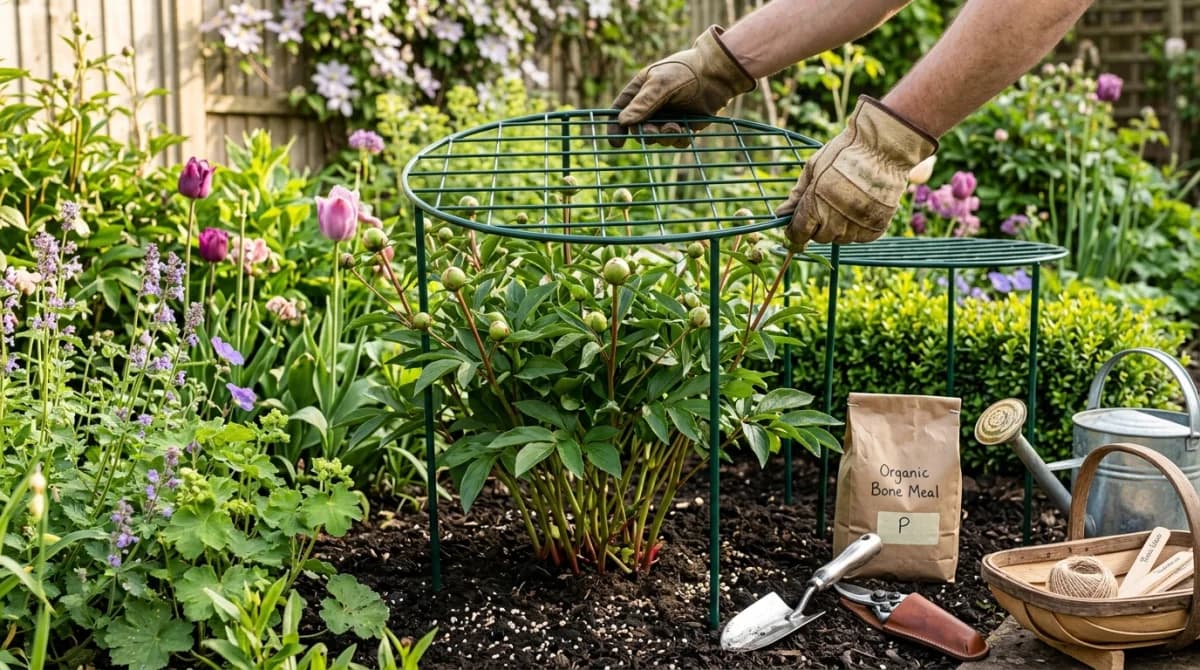
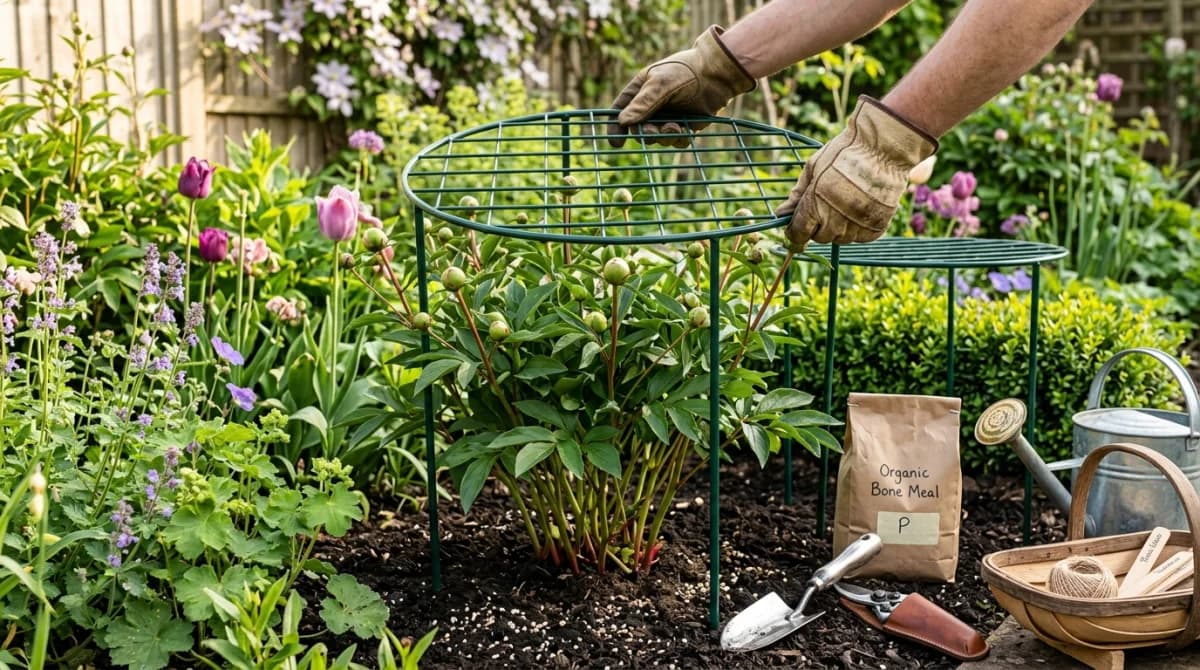
Grow-through grids are the right answer for almost every garden situation. These are circular metal frames — typically eighteen to twenty-four inches across — with three or four legs that push into the soil and a horizontal grid of squares at the top through which the stems grow. Set the support over the crown in mid-May with the grid about ten to twelve inches above the soil, so that the stems push up through the squares as they extend, and by the time the flowers open in early June the grid is invisible inside the foliage and the stems are held individually at the point where they would otherwise bow. A grow-through is the only support that, properly installed at the right week, becomes invisible in summer and is doing its work without any ongoing intervention from the gardener. The powder-coated dark green versions sold by every decent garden tool supplier last fifteen years and disappear into the planting completely.
Hoop supports, sometimes called link stakes or Y-stakes, are sections of metal hoop with vertical legs that interlink around the crown. They are useful for an established clump that has already been allowed to grow taller than the grow-through-grid window — say, the foliage is already two feet high and threading a grid down over it is impossible — but they are a second-best solution. The hoops sit at the perimeter of the clump and corral the stems inward, which works but tends to push the flowering stems into the centre rather than holding them where they naturally want to be. A hoop-supported peony can still look slightly bunched, like a flower arrangement compressed by an invisible vase.
Individual stakes with twine — driving a bamboo cane or hardwood stake next to each flowering stem and tying the stem to the cane with a figure-of-eight knot — is what most older gardening books illustrate. It works in the sense that the flowers stay upright, but the result looks like a peony attending a job interview, with every stem laced to a visible cane and the natural sweep of the clump replaced by a regimented vertical bundle. Unless an individual exhibition bloom is being grown for a flower show, this is the wrong approach for an ornamental border.
Installing the Grow-Through, Step by Step
The whole job, for a mature clump of three to five stems, takes about ninety seconds once the support is in hand. Stand directly over the clump, hold the grid horizontally above it, and lower it straight down over the foliage in one smooth movement until the legs touch the soil. Press each leg into the soil with the heel of one hand or, for stiffer ground, the sole of a boot, until the grid sits about ten to twelve inches above the soil surface and the foliage is poking up through the squares with the leaves spread freely. Lift any leaves that have folded under the grid back up through the squares with a finger. That is the entire installation.
The two details that matter are leg depth and grid height. Push the legs in at least six inches — a grow-through that has been only lightly pressed into soft May soil will sit fine until the first wet wind in late May and then list sideways under the weight of a leaning clump. And set the grid height so that the stems will extend through it well before the flower buds reach the level of the grid. If the buds are already at or above the grid when it is installed, lower it another two inches before the buds start to swell, because once a fat bud has formed at the tip of a stem it cannot be coaxed back down through a square without snapping.
For a young clump of one or two stems, a grow-through grid is overkill and a single short cane with a soft twine collar around the whole clump works equally well. The grid becomes the right answer at three or more flowering stems, which is roughly when a peony reaches the size where flopping becomes a problem worth solving.
What Else This Week Asks of the Peony Bed
While the support is in hand, two other small tasks belong in the same fifteen-minute visit. The first is a check for botrytis, which shows on peony foliage in mid-May as dark brown or blackish lesions at the base of stems or on the lower leaves, sometimes with a fuzzy grey mould visible in damp weather. Any stem with a visible lesion at the base should be cut out at ground level with clean secateurs and removed from the garden — not composted, because the spores carry through a cold compost heap and reinfect the bed next spring. A clean clump with no visible blackening at this stage will almost always come through to flower without further trouble.
The second task is a light feed. A handful of bone meal or a balanced general-purpose granular feed scattered around the crown (not on the crown itself) and lightly raked into the top inch of soil supports the bud development for the rest of May and the petal fill in early June. Peonies are not greedy feeders and they resent rich nitrogen, which pushes soft floppy growth at the expense of flowers, but a single modest spring feed at the moment the buds are forming makes a measurable difference to the size and substance of the flowers. Avoid blood meal, which is too high in nitrogen, and avoid mulching directly over the crown, which can suppress next year’s eyes and is the single most common cause of peonies that stop flowering after several good years.
The Sequence That Saves the Flower
Set the support in the week of the 15th of May. Cut out any stem showing botrytis at the base. Scatter bone meal in a ring around the crown and rake it in. Water if the soil is dry. The whole sequence is the work of a quiet half hour with a cup of coffee, and the difference it makes is the difference between a peony clump that flowers magnificently for two to three weeks and then carries seed heads cleanly into July, and a peony clump that opens spectacularly on a Friday and is face-down in the mud by Sunday afternoon.
If a peony clump has been in the same spot for many years and the staking question is starting to feel academic — the flowers were beautiful the first three seasons but have been gradually diminishing since — the issue is almost never the staking. It is almost always that the crown has been mulched too deeply, that a tree has grown to shade the spot for the critical morning hours, or that a neighbouring plant has crept in over the years and started competing for water at exactly the wrong six weeks. If you are uncertain whether the peony’s slot in the border is still the right slot for it, Gardenly can render the border at full June flower with and without the peony in its current position, and with the alternative of moving it to a sunnier corner in autumn. Useful for deciding whether the staking work is worth doing this year, or whether the better answer is a relocation in September when the foliage has died back and the crown can be lifted without losing a year of bloom.
Sources
- Royal Horticultural Society — Peonies: Growing Guide
- American Peony Society — Peony Care and Culture
- Missouri Botanical Garden — Paeonia Lactiflora Plant Finder
- University of Illinois Extension — Herbaceous Peonies