Stake Your Tall Perennials Now, Before the First Big Rain Flattens Them

The first heavy rain in May is what separates gardeners who staked their perennials in time from gardeners who spend an afternoon trying to lift muddy peony stems off the lawn with twine and prayer. By the time a delphinium has snapped at the base or a dahlia is folded sideways across the path, there is no fix that does not look like a fix. The stems hold the bend. The flowers face the ground. The whole clump looks broken even after you tie it back up.
Staking is one of those jobs that feels premature in late April and impossible by mid-June. The window is now — when emerging shoots are six to twelve inches tall and you can still get a support around them without snapping anything. A morning of work this week will save the look of a border for the entire summer.
Why Tall Perennials Flop
Plants that grow over three feet in a single season are botanically unusual. Most need their stems woody to stand up that tall, and perennials that die back every winter and regrow each spring do not have time to make truly woody tissue. The stems are essentially overgrown herbaceous shoots holding up disproportionately heavy flowers. They cope until something tips the balance: a windstorm, a soaking rain, a cold night that softens the cell walls.
The plants most likely to flop fall into a few predictable groups:
- Heavy-headed bloomers like peonies, double dahlias, and large-flowered chrysanthemums. The stems are fine until the flowers open and double in weight.
- Tall, narrow spikes like delphiniums, foxgloves, and lupines. Top-heavy by design, and the spikes catch wind like a sail.
- Lax, naturally sprawling growers like asters, sedums, baptisia, and tall phlox. These do not snap so much as lean — slowly, then all at once.
- Anything overfed or in too much shade. Soft, fast growth is weak growth. A plant in 50% sun gets twice as leggy as the same plant in full sun.
If the plant lives through a windy week or a soaking rain in May without support, you got lucky. The fix is not to hope for the same luck again.
The Rule: Stake Before You Need To
Almost every staking failure comes from waiting too long. The right time to stake is when the plant is somewhere between six and twelve inches tall — early enough that you can ease a support around the emerging stems, late enough that you can see exactly where the clump is.
If you stake earlier than that, you are guessing where the stems will come up and the support will look conspicuous and empty for weeks. If you stake later, the foliage is already too dense to thread anything through cleanly, and you will damage stems trying.
For most of zones 5 through 7, the last week of April and the first week of May is the sweet spot. Walk the borders with a basket of stakes and supports and treat it as a dedicated half-day job — not a thing to do whenever you happen to be passing.
Match the Support to the Plant
A peony does not need the same support as a delphinium does. Using the wrong support is almost as bad as using none, because the plant grows around the wrong shape and the supports become visible all summer.
Peony rings (grow-through supports) for round, bushy clumps
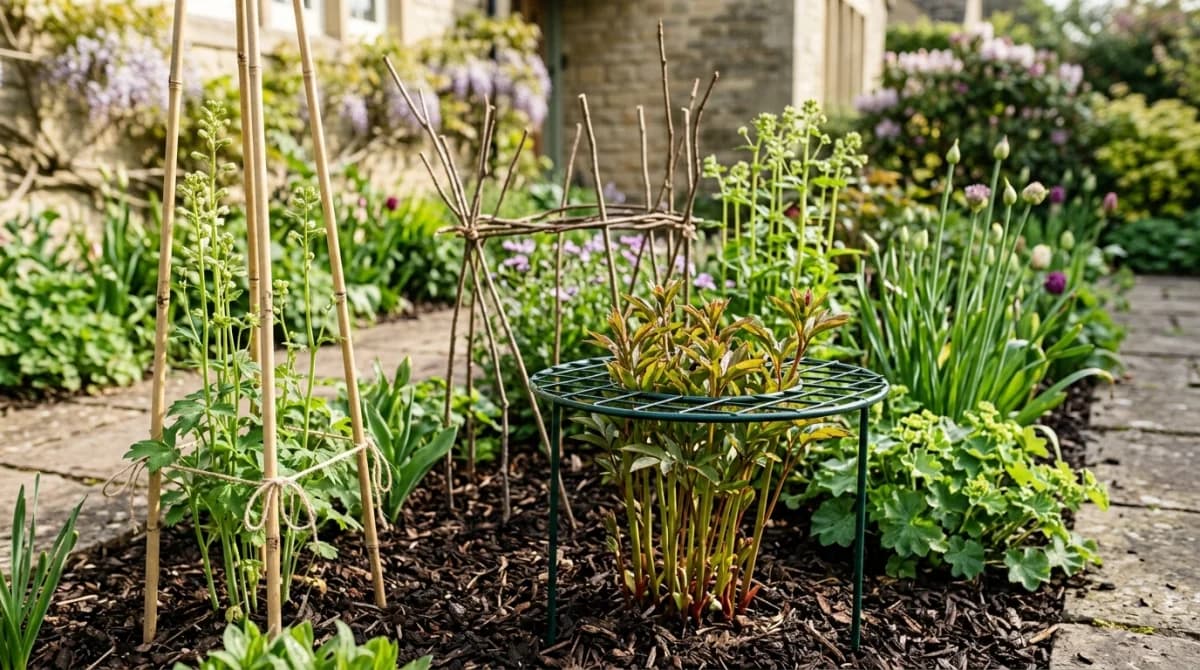
The classic galvanized peony ring — a metal hoop on three or four legs with a loose grid across the top — is the right tool for peonies, baptisia, sedum ‘Autumn Joy’, and any clump that grows up through itself. The legs go into the ground around the emerging shoots, the grid sits about a foot above the soil, and the stems grow up through the grid. By the time the foliage is full, the support is invisible.
The grow-through height matters. A grid that ends up at six inches above the foliage looks like scaffolding; one that ends up two-thirds of the way up the stem disappears. For a four-foot peony, set the grid at about thirty inches off the soil. Most rings have legs you can adjust by pushing them deeper or shallower into the soil.
Stakes and twine for individual spikes
Delphiniums, lilies, and gladiolus need a support per stem, not per clump. The simplest method is a sturdy bamboo cane or thin metal stake placed three or four inches behind the stem (so it is hidden by the leaves), tall enough to reach a hand below the lowest flower. As the stem grows, tie it to the stake at intervals of about a foot, using soft jute twine or strips of old t-shirt fabric in a loose figure-eight knot. The figure-eight allows the stem to move slightly without rubbing on the stake — a tight loop will snap a hollow delphinium stem in a windstorm.
For lilies, set the stake well clear of the bulb. Driving a thick cane straight down can split a bulb that has been quietly multiplying for years. Push the stake in at an angle if the bulb feels close.
Twiggy pea-stick supports for sprawlers
For asters, tall phlox, baptisia, and any plant that wants to lean rather than stand, the most invisible support is a piece of brushy pruning from a deciduous tree or shrub. Cut a forking branch about two-thirds the eventual height of the plant, push the cut end into the soil among the emerging stems, and let the foliage grow up through the twigs. Hazel and birch traditionally make the best pea-sticks because they branch finely. A few of these set casually around a clump can hold up plants that would otherwise need much more visible hardware.
The trick is to start with sticks that are too short rather than too tall. Anything more than two-thirds of the eventual height looks like a thicket. The plant will grow above the sticks and hide them entirely.
Caging for dahlias and tomatoes
Dahlias are technically tubers, not perennials in cold climates, but they are commonly grown alongside perennials and they flop spectacularly. The strongest support is a heavy-gauge wire cage or two stout stakes with horizontal twine grids — the same approach that works for indeterminate tomatoes. Set this when the dahlia shoots are six inches tall, before the foliage closes in.
A double-stake-and-twine setup works well for tall dahlias: drive two stakes a foot apart, one in front and one behind the clump, then run twine between them at increasing heights as the plant grows. By August, when each plant is throwing five-pound flowers, the twine cage will be the only thing standing between you and a sad, splayed-out mess.
Hidden Is Better Than Decorative
A support’s job is to disappear. Every visible inch of metal or stake is a small failure of design. A few decisions that help:
- Choose dark green or rust-colored hardware, not silver or galvanized bright. Even peony rings come in green, and they vanish into the foliage from any distance.
- Place stakes behind stems, not in front, so the leaves cover them from the main viewing angle of the bed.
- Use natural materials when you can. Bamboo, hazel, and oak weather to gray and read as part of the planting. Aluminum and powder-coated steel always read as hardware.
- Cut stakes to length. A six-foot bamboo cane sticking three feet out of the ground above a four-foot delphinium ruins the line of the entire spike. Cut canes so the top sits below the lowest open flower.
The supports you cannot see are the ones that work.
What to Stake This Week
A practical short list for late April, in the order most gardens need them:
- Peonies. The buds are still small but the foliage is shooting up fast. Get peony rings on before the leaves are large enough to need threading through.
- Delphiniums. Each new stem gets one cane. Set them now and tie loosely; tie again every couple of weeks as the stems extend.
- Tall phlox and asters. Pea-sticks or a low ring around the clump.
- Dahlias. If your tubers are up six inches, the cage or twin-stake setup goes in this week.
- Lilies. Stake the tall Oriental and trumpet varieties; species and Asiatic types under three feet are usually fine.
- Baptisia and tall sedums. A low peony-style ring works perfectly. Without one, both sprawl open from the center after the first heavy rain.
When You Already Missed the Window
If you are reading this in mid-June and the rain has already done its work, do not yank the bent stems upright in one go — they will snap. Lift them gradually over a week, easing each one with a stake and loose tie, and write yourself a note for next April.
It also helps to take photos in late spring of any plant that flopped, with notes on which direction it leaned and how big the clump got. A clump that fell to the south will probably do it again, and knowing that lets you put a stake there a year before you need it. If you are planning a redesign anyway, Gardenly can help you visualize how a border will look at full height before you plant — including how to space heavy bloomers so they have room to be supported without the structures crowding into adjacent plants.
A staked border in May is a quiet kind of preparation. Nothing about the work is showy. But the difference shows up six weeks later, when the rain comes through hard and the peonies are still standing.
Sources
- Royal Horticultural Society — Staking Plants
- University of Minnesota Extension — Staking Perennial Flowers
- Penn State Extension — Supporting Top-Heavy Perennials
- Cornell Cooperative Extension — Care of Herbaceous Perennials