Mediterranean Garden Design in Canada | Okanagan to BC Coast

Only one region of Canada genuinely replicates Mediterranean growing conditions: the Okanagan Valley of British Columbia. With 2,000+ hours of annual sunshine, summer rainfall under 300mm, and mild winters that rarely exceed -15°C, the Okanagan supports lavender farms, olive trees overwintered outdoors against south walls, and a wine industry that produces award-winning Syrah and Viognier — the same varietals grown in France's Rhône Valley. This is Canada's Mediterranean, and gardeners in Kelowna, Penticton, and Oliver enjoy a genuine version of the style, not an approximation. Coastal BC (Zone 8b) is the second-best option: Vancouver and Victoria gardeners can grow rosemary, cistus, phormium, and many Mediterranean perennials outdoors year-round with mild, wet winters replacing the dry Mediterranean dormancy season. For the rest of Canada — Ontario, Quebec, the Prairies, and the Maritimes — Mediterranean gardening is best understood as drought-tolerant xeriscape with Mediterranean aesthetics: the visual language of warm stone, silver-leaved plants, lavender, and terracotta is entirely achievable, but it must be combined with honest choices about cold-hardiness and container growing.

Mediterranean Garden in Canada

Why Choose This Style for Canada?

The Okanagan Valley is legitimately Mediterranean: hot, dry summers, 300mm annual rainfall, loamy benchland soils, and Zone 6b–7a temperatures that allow outdoor lavender farms, winery herb gardens, and semi-hardy olive trees against south walls

🌱

Coastal BC (Zone 8b) offers mild, wet winters that allow year-round outdoor growing of most Mediterranean perennials — the climate is Atlantic rather than Mediterranean but supports the same plant palette

💚

Canadian Prairie summers are intensely hot and dry — perfect for established Mediterranean plants during the growing season, and the extreme cold paradoxically kills many garden pests over winter

Climate Adaptation for Canada

Seasonal management varies dramatically by region. In the Okanagan, the Mediterranean rhythm is nearly authentic: plants are dormant in summer drought, spring is the peak growth period, and winters are cold but manageable for Zone 6b-hardy varieties. In coastal BC, the rhythm inverts to a Pacific Northwest pattern: growth continues through mild wet winters, and the driest (and sometimes warmest) period is July–September, which suits Mediterranean drought-tolerance perfectly. In Ontario and Quebec, the growing season for containerized Mediterranean plants runs from mid-May (post-frost) to mid-October (pre-freeze), with plants spending November–April in a cool, bright frost-free space at 5–10°C — an unheated garage with a south window, or a cool basement under grow lights, works well. On the Prairies, Mediterranean planting is primarily a summer container display supplemented by in-ground ultra-hardy substitutes (Russian sage, creeping thyme, sea buckthorn) that provide the silver-foliaged, drought-tolerant Mediterranean aesthetic permanently.

Key Challenges
  • Only the Okanagan Valley (Zone 6b–7a) and coastal BC (Zone 8b) can support genuine Mediterranean planting outdoors year-round — everywhere else requires container growing or zone-appropriate substitutes
  • The continental Prairie climate (Zone 2b–4a) is the opposite of Mediterranean: cold, dry winters (-35°C), hot-humid summers, and spring-autumn freeze-thaw cycles that kill Mediterranean plants outright
  • Ontario and Quebec winters (Zone 5b–6a, down to -25°C) eliminate most true Mediterranean shrubs; rosemary, cistus, and lavandula stoechas die without frost-free indoor overwintering
  • Heavy Prairie clay soils are waterlogged during spring snowmelt — the worst possible condition for Mediterranean plants that demand perfect drainage year-round
  • The Mediterranean concept requires dry summers; much of Canada's rain falls in summer, creating the conditions Mediterranean plants evolved to avoid
Regional Advantages
  • The Okanagan Valley is legitimately Mediterranean: hot, dry summers, 300mm annual rainfall, loamy benchland soils, and Zone 6b–7a temperatures that allow outdoor lavender farms, winery herb gardens, and semi-hardy olive trees against south walls
  • Coastal BC (Zone 8b) offers mild, wet winters that allow year-round outdoor growing of most Mediterranean perennials — the climate is Atlantic rather than Mediterranean but supports the same plant palette
  • Canadian Prairie summers are intensely hot and dry — perfect for established Mediterranean plants during the growing season, and the extreme cold paradoxically kills many garden pests over winter
  • UBC Botanical Garden's research program has extensively trialled Mediterranean species in Pacific Northwest conditions, providing a locally tested performance record available through their published plant lists
  • Canadian long summer days provide 16+ hours of sunlight in June — more than any Mediterranean location — driving vigorous growth in sun-loving Mediterranean species during the growing season

Key Design Principles

Match Your Region to Your Ambition

Okanagan gardeners can design authentic Mediterranean gardens with outdoor lavender hedges, rosemary topiaries, and south-wall fig trees. Coastal BC gardeners can grow the full Mediterranean shrub palette year-round with some winter protection. Ontario and Quebec gardeners should build around ultra-hardy in-ground plants supplemented by containerized seasonal specimens. Prairie gardeners should embrace "drought-tolerant xeriscape with Mediterranean aesthetics" — the visual language works without the plant species. Being honest about your climate produces a better, lower-maintenance garden than forcing inappropriate plants into unfriendly conditions.

The Okanagan Model: Canada's Authentic Mediterranean

The Okanagan Valley has supported Mediterranean-style winery gardens since the 1970s. Visit the estate gardens at Mission Hill Family Estate Winery (Westbank) or Burrowing Owl Estate Winery (Oliver) to see lavender borders, silver-foliaged planting, and warm stone terracing executed at a professional level in this climate. The benchland soils — well-drained, mineral-rich, and low in organic matter — are essentially Mediterranean. Replicate the soil conditions first; the plants follow naturally.

South-Wall Microclimates Extend Hardiness by One Zone

A south-facing masonry wall absorbs daytime heat and re-radiates it overnight, raising effective hardiness by 1–2 zones in the immediately adjacent planting zone. In Ontario and Quebec, a rosemary plant that would die in an open border (Zone 7 minimum) can survive several years against a brick south wall (creates effective Zone 6b–7a conditions). This is how Okanagan gardeners grow semi-hardy olives, and it is the same technique British gardeners use to extend tender plant cultivation northward. Use this principle for all borderline-hardy Mediterranean plants: lavandula stoechas, rosmarinus, ceanothus, and cistus.

Mediterranean Drainage as a Design Element

The Mediterranean garden's characteristic look of warm stone, gravel mulch, and terraced levels is not just aesthetic — it is functional drainage engineering. On Canadian sites with heavy clay or high water tables, replicating this drainage through raised beds, deep gravel mulch (50–75mm of coarse angular granite chip over landscape fabric), and terraced stone walls is the difference between plants that thrive and plants that die of root rot during spring snowmelt. Build your drainage system first; the Mediterranean aesthetic comes with it as a natural consequence.

Container Growing as a Legitimate Strategy

In Zone 2b–5b Canada, growing Mediterranean trees (olive, citrus, bay laurel) in containers is not a compromise — it is the correct approach. A well-grown container olive tree in a large fibreglass planter can be a spectacular focal point outdoors from May to October, then spend winter at 5–10°C in a bright frost-free space. This two-season strategy produces plants that are often larger and healthier than marginally hardy in-ground specimens in cold climates, because overwintered container plants avoid the desiccation damage from cold, dry Canadian winds that kills borderline-hardy in-ground specimens.

Fragrant Herbs as the Mediterranean Heart

Lavender, thyme, rosemary, oregano, and sage are the sensory core of the Mediterranean garden — and most are surprisingly cold-hardy. Lavandula angustifolia (true lavender) is reliably hardy to Zone 4b with excellent drainage and snow cover. Thymus serpyllum (creeping thyme) survives to Zone 3. Oregano and sage (Salvia officinalis) are Zone 4–5. Build a central herb section — a formal arrangement of these plants around a stone urn or gravel path — as the olfactory heart of any Canadian Mediterranean garden, regardless of zone.

Recommended Plants for Canada

These plants are specifically selected to thrive in your region's climate and complement this garden style perfectly.

True Lavender
True Lavender

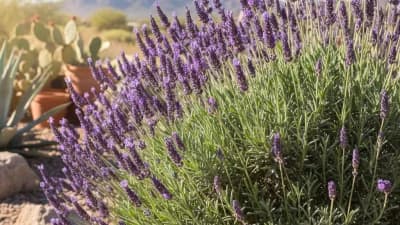
Lavandula angustifolia

The cornerstone Mediterranean plant for Canadian gardens. Hardy to Zone 4b with excellent drainage — it is the primary crop of Okanagan lavender farms (Okanagan Lavender & Herb Farm, Kelowna) and grows reliably in BC, Ontario, and sheltered prairie microclimates. 'Hidcote' and 'Munstead' are the most cold-tolerant cultivars. Perfect drainage is non-negotiable: plant on a slope or in raised beds with 50% coarse sand amendment.

Sun: Full sun — minimum 6 hours; reduced flowering in part shade

Water: Low; drought-tolerant once established; never waterlogged

Blooms: June–August; shear after flowering to promote compact form

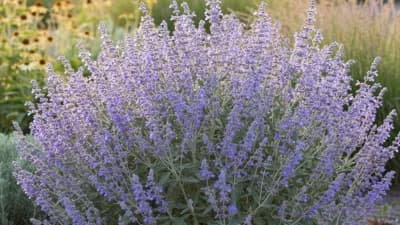
Russian Sage
Russian Sage

Perovskia atriplicifolia

The most Mediterranean-looking plant reliably hardy to Zone 3b — its silver-white stems, grey-green aromatic foliage, and haze of lavender-blue flowers from July to September are indistinguishable in effect from Perovskia or Vitex in a French garden. Cut to 150mm in spring; it grows to 1.2m by July. The best all-Canada Mediterranean substitute for gardeners in any zone.

Sun: Full sun

Water: Very low; excellent drought tolerance — one of the most xeric plants for Canadian gardens

Blooms: July–September

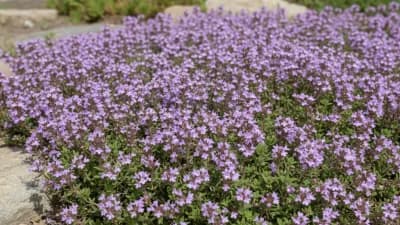
Creeping Thyme
Creeping Thyme

Thymus serpyllum

Native to the eastern Mediterranean but hardy to Zone 3 across Canada. Forms a dense, fragrant mat between stepping stones or over gravel surfaces — a defining Mediterranean garden groundcover. Pink-purple flowers in June–July. The textural effect of thyme-covered gravel is one of the most effective Mediterranean garden motifs achievable in all Canadian zones.

Sun: Full sun

Water: Low; very drought-tolerant

Blooms: June–July

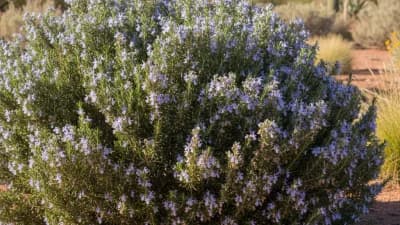
Rosemary (Coastal BC and Okanagan)

Salvia rosmarinus

Genuinely hardy to Zone 7b outdoors, but surviving to Zone 6b in exceptional south-wall microclimates. In coastal BC (Vancouver, Victoria) and the Okanagan, rosemary grows as a reliable outdoor shrub. Elsewhere in Canada, overwinter in a cool, bright frost-free space (5–10°C). Upright cultivar 'Tuscan Blue' is the best choice for standard or hedge form; 'Prostratus' is a trailing form for wall plantings in mild BC climates.

Sun: Full sun; requires excellent drainage year-round

Water: Low once established; drought-tolerant

Blooms: Blue-lavender flowers January–April in coastal BC; early spring elsewhere

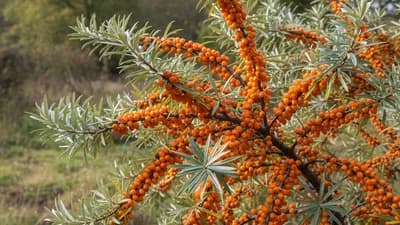
Sea Buckthorn
Sea Buckthorn

Hippophae rhamnoides

Hardy to Zone 2 with a silver Mediterranean-style leaf that reads as olive-like from a distance. Orange berries in August–October provide brilliant autumn colour. Fixes nitrogen in poor sandy soils — the ideal Mediterranean-aesthetic plant for Prairie xeriscapes where actual Mediterranean shrubs cannot survive. Requires both male and female plants for berry production.

Sun: Full sun

Water: Low; very drought-tolerant — naturally a dune and dry slope plant

Blooms: Orange berries August–October

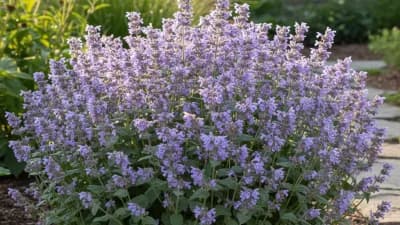
Catmint
Catmint

Nepeta x faassenii

Hardy to Zone 3 and one of the most Mediterranean-looking perennials for Canadian gardens. Grey-green aromatic foliage, lavender-blue flowers from June through September, and drought tolerance that suits both prairie and Okanagan conditions. 'Walker's Low' reaches 600mm and is the most widely available cultivar in Canadian nurseries. Shear by half after first bloom flush for rebloom.

Sun: Full sun to part shade

Water: Low; drought-tolerant once established

Blooms: June–September with rebloom if sheared mid-season

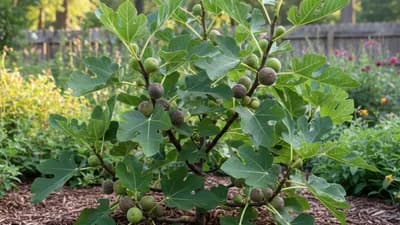
Hardy Fig (Okanagan and south-wall BC)

Ficus carica 'Brown Turkey'

The most cold-hardy commonly available fig, surviving to -15°C at the root (canes may die but the plant resprouts). In the Okanagan (Zone 6b–7a), 'Brown Turkey' and 'Chicago Hardy' produce fruit reliably when planted against a south wall. In coastal BC (Zone 8b), figs fruit without protection. Elsewhere in Canada, grow in large containers overwintered frost-free.

Sun: Full sun; south-facing wall essential for outdoor overwintering

Water: Moderate in summer; reduce watering in September to harden canes

Blooms: Fruit ripens August–October

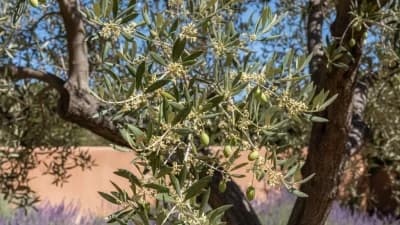
Olive Tree (container)

Olea europaea

Classic Mediterranean focal plant grown as a container specimen across all Canadian regions. Place outdoors in the sunniest position from late May to mid-October, then overwinter in a bright, cool (5–10°C) frost-free space. Use a well-draining Mediterranean potting mix (50% potting soil, 50% coarse perlite). In the warmest Okanagan microclimates (Oliver, Osoyoos), some gardeners successfully overwinter in the ground against a south wall — this remains exceptional rather than reliable.

Sun: Full sun — minimum 8 hours outdoors

Water: Low; avoid waterlogging; drought-tolerant once established

Ready to Bring This Style to Life?

Upload a photo of your yard and get AI-powered mediterranean garden designs with plants perfectly suited to Canada's climate.

Start Designing Now

Essential Design Features

Paving and Hard Surfaces
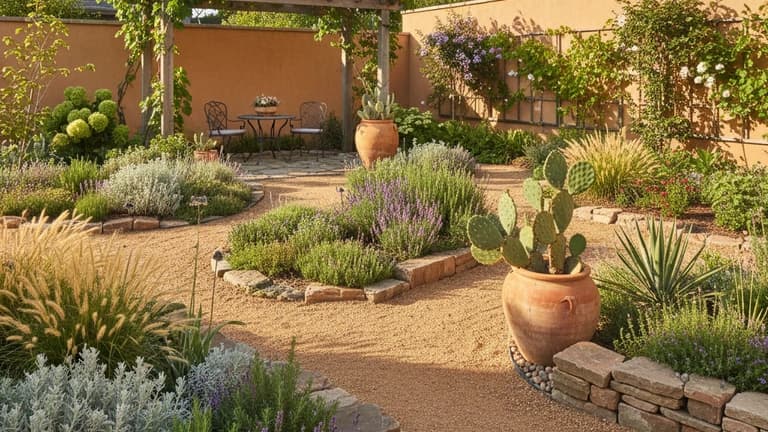
  • Warm-toned natural stone: Okanagan sandstone, Ontario limestone, or Manitoba Tyndall stone in buff-yellow tones that visually evoke Mediterranean warmth
  • Terracotta-effect concrete pavers rated for Canadian freeze-thaw cycles (minimum 3% absorption rate) — real terracotta shatters in Zone 5 and colder
  • Coarse angular granite gravel (20–40mm) as the primary surface treatment under and around Mediterranean plants — provides drainage, reflects heat, and suppresses weeds
  • Dry-stacked stone retaining walls creating terraced levels — both a Mediterranean aesthetic and a structural drainage solution for sloped Canadian properties
  • Flagstone path set in stabilised decomposed granite rather than mortar, allowing drainage between stones and accommodating frost movement without cracking
  • Poured concrete with exposed aggregate or broom finish in warm grey or buff tones — more freeze-thaw durable than laid masonry in severe Canadian winters
Water Features
  • Wall-mounted stone or cast-iron lion-head fountain with recirculating pump and winterizable shut-off valve — drain in October, restart in May
  • Courtyard-style stone basin fountain; the pump and all water must be drained before -5°C for three consecutive nights
  • Terracotta-style fibreglass urn as a dry focal point in winter — fill with a simple plantings of rosemary or seasonal herbs in summer
  • Millstone fountain in natural stone: the recirculating pump is protected in the underground reservoir and the whole feature can be drained for winter
  • Rain garden planted with drought-tolerant native grasses and sedges to capture spring snowmelt on Okanagan and Prairie sites with clay underlayers
Structures and Overhead
  • Cedar pergola with open rafters draped with hardy grape 'Himrod' (Zone 5) or 'Marquette' (Zone 4) for Okanagan-inspired wine garden aesthetic
  • Stucco or lime-rendered garden wall in white or warm ochre — the most effective single element for creating Mediterranean character anywhere in Canada
  • Retractable canvas awning in terracotta or sand tone for shade and rain protection extending the outdoor season at either end
  • Outdoor fireplace or chiminea for extending evenings into September–October: essential for a usable Mediterranean outdoor living space in most of Canada
  • Built-in seat walls of dry-stacked local stone providing thermal mass that stays warm after sunset
  • Wrought-iron or powder-coated steel gate in a stucco wall — the definitive Mediterranean entrance element reproducible in any Canadian climate
Containers and Seasonal Display
  • Large fibreglass planters (minimum 60L) for olive, citrus, and bay laurel — fibreglass does not crack in -30°C and is far lighter than stone for moving indoors in autumn
  • Rolling plant caddies under large containers for efficient October move-indoors — a non-negotiable investment for any gardener growing container Mediterranean trees
  • Glazed ceramic containers rated for outdoor use only in Zone 8+ — use frost-proof fibreglass or resin replicas in colder zones
  • Terracotta-look concrete troughs for lavender, thyme, and dwarf rosemary in Zone 5–7 gardens — the concrete weathers to an authentic patina within two to three seasons
  • Groupings of containers in decreasing sizes around an olive or fig focal specimen — creates the piazza fountain effect of Mediterranean plazas without permanent installation

Seasonal Maintenance Guide

Spring (mid-April in BC and Okanagan; late May in Ontario/Quebec; early June on Prairies)
  • Move container Mediterranean plants outdoors only after the last frost date and once overnight lows are reliably above 5°C — hardened plants can handle 2°C but a surprise -4°C night will kill an olive that has broken dormancy
  • Prune lavender to 50–75mm above the woody base before new growth emerges (March in coastal BC, mid-April in Okanagan, late April in Ontario) — never cut into old wood, which does not regenerate
  • Remove winter mulch from Mediterranean bed sections only when soil temperature reaches 8°C — too early in March exposes roots to freeze-thaw damage
  • Test soil drainage in planting areas as snowmelt saturates the ground — any area that holds standing water for more than 48 hours after snow melts needs raised-bed construction or deep drainage improvement before planting
  • Apply a top-dressing of coarse grit (20mm angular granite or pea gravel) to the surface of Mediterranean beds to maintain the drainage layer and the visual aesthetic simultaneously
  • Divide and transplant established clumps of catmint, Russian sage, and ornamental thyme before growth reaches 100mm — this is the optimal division window
Summer (June–August)
  • Water container Mediterranean plants daily in hot weather (above 28°C) — containers dry out quickly; allow the top 25mm of compost to dry between waterings for in-ground plants
  • Fertilize container olives and citrus monthly with a balanced liquid fertiliser from June through August — potted plants cannot access soil nutrients and exhaust container compost within two seasons
  • Deadhead lavender after the first flush in early July to encourage a second flush in late August — shear the flowering stems to just above the foliage layer, not into bare wood
  • Harvest herbs (thyme, rosemary, oregano) regularly through summer — frequent cutting encourages bushy growth and prevents leggy, woody stems from developing
  • In the Okanagan, apply deep irrigation (25–30mm) every 10 days in July–August during the driest period — Mediterranean plants tolerate drought but benefit from deep, infrequent watering rather than shallow daily watering
  • Monitor container plants for red spider mite in hot, dry conditions — Mediterranean plants in dry microclimates are particularly susceptible; treat with an insecticidal soap spray at first sign
Autumn (September–October)
  • Move container Mediterranean trees indoors when overnight temperatures first reach 3°C for three consecutive nights — typically mid-October in Zone 6, late October in Zone 8
  • Apply a 100–150mm layer of coarse gravel mulch (not bark mulch) around in-ground lavender, thyme, and sage before the first hard frost — gravel mulch prevents crown-rot from wet autumn conditions far better than organic mulch
  • Drain all recirculating water features before the first hard freeze (-5°C overnight): blow out lines with compressed air, remove pump for indoor storage, cover basins to prevent leaf accumulation and ice damage
  • Plant spring-flowering bulbs (allium, iris reticulata, crocus) in gravel Mediterranean beds in October for April–May colour that complements the Mediterranean planting palette
  • Wrap marginally hardy rosemary and cistus against south walls with a single layer of horticultural fleece in November (Zone 6b–7a) — this adds approximately 2–3°C of frost protection
  • Reduce watering of container olive and fig trees to once every 10 days from September onwards to harden growth and prepare the plants for dormancy
Winter (November–March)
  • Maintain overwintering container Mediterranean plants at 5–10°C in a bright frost-free space — most will drop some leaves and appear semi-dormant, which is correct; only water every 2–3 weeks to prevent complete desiccation
  • Check outdoor lavender after heavy snowfall — the weight of ice-bonded snow can split established plants; gently shake snow off before it refreezes
  • Monitor outdoor stone and paving for frost-heave damage: immediately re-level any heaved stepping stones or paving after the ground begins to thaw in February to prevent trip hazards
  • Research Okanagan lavender, winery garden, and Mediterranean plant suppliers in January for spring ordering — local Okanagan nurseries (including those attached to lavender farms) carry climate-tested varieties not available nationally
  • Plan irrigation improvements for Mediterranean beds: an inline drip system with an autumn blow-out provision is the ideal summer irrigation method for established Mediterranean plantings across all Canadian regions
  • Inspect stucco or rendered walls for frost damage — hairline cracks from freeze-thaw cycles are normal but should be sealed in spring before water infiltrates and enlarges them
Investment Guide

Estimated costs for creating your mediterranean garden in Canada

Small Garden
  • Plants
    CAD $550 – $1,200
    Lavender (3–5 plants), Russian sage, creeping thyme, catmint, and container olive for 20–35m² — Okanagan nurseries typically 10–15% cheaper than Lower Mainland BC for Mediterranean species
  • Hardscaping
    CAD $1,100 – $2,500
    Coarse gravel mulch, warm-tone flagstone path, dry-stacked stone raised bed surround
  • Containers
    CAD $350 – $750
    Two large fibreglass planters with rolling caddies for olive and fig; frost-proof urns
  • Winter Protection
    CAD $150 – $350
    Horticultural fleece, coarse gravel mulch, plant caddies, compressed-air pump for water feature drain-down
  • Total
    CAD $2,150 – $4,800
    Compact Mediterranean herb and lavender garden; Okanagan and Prairie at lower end, coastal BC at higher end due to labour costs
Medium Garden
  • Plants
    CAD $1,600 – $3,500
    Lavender hedge (8–10 plants), rosemary standards (BC/Okanagan), container olive and citrus, catmint borders, Russian sage for 50–80m²
  • Hardscaping
    CAD $4,500 – $9,500
    Warm-tone natural stone patio, dry-stacked stone retaining walls, gravel garden section, courtyard paving
  • Water Features
    CAD $1,200 – $3,000
    Wall fountain or millstone water feature with winterizable recirculating pump system
  • Outdoor Living
    CAD $2,500 – $5,500
    Cedar pergola with climbing grape, outdoor fireplace or chiminea, cast-iron furniture, Mediterranean lighting
  • Winter Protection
    CAD $450 – $900
    Frost-free indoor storage setup (shelving, grow light, hygrometer) for container collection
  • Total
    CAD $10,250 – $22,400
    Full Mediterranean courtyard garden; BC lower mainland labour premium adds 20–25% over Prairie equivalents
Large Garden
  • Plants
    CAD $4,000 – $8,500
    Mature lavender hedge, standard rosemary (BC/Okanagan), multiple container trees, extensive herb and perennial planting for 120–250m²
  • Hardscaping
    CAD $10,000 – $22,000
    Expansive natural stone patio with terraced levels, rendered stucco walls, decorative wrought-iron gate, extensive gravel garden
  • Water Features
    CAD $3,000 – $7,000
    Multiple courtyard fountains or large stone water feature with heated recirculating system for extended-season operation
  • Outdoor Living
    CAD $6,000 – $14,000
    Large cedar or steel pergola, outdoor kitchen, fireplace, premium Mediterranean furniture and accessories
  • Winter Protection
    CAD $1,000 – $2,500
    Dedicated overwintering greenhouse or insulated garden room for large container collection
  • Total
    CAD $24,000 – $54,000
    Showcase Mediterranean garden; Okanagan winery-style estate gardens at the higher end with professional landscape design

Frequently Asked Questions

Transform Your Yard Today

Get personalized mediterranean garden designs created by AI, featuring plants that thrive in Canada. Upload your yard photo and see your dream garden come to life in minutes.

Start Your Design