Mediterranean Garden in India: Deccan, Rajasthan, and Hill Stations

The Mediterranean garden style has a stronger natural fit with India than most gardeners realise. The Deccan Plateau during its dry season (October-May) — particularly Maharashtra and Karnataka — closely mirrors the Mediterranean summer: hot, dry, and sunny with a concentrated rainy period followed by months of minimal rainfall. The Rajasthan and Kutch desert regions go further: olive cultivation has been established commercially in Jodhpur district, and the indigenous Rajasthani drought-garden tradition parallels Mediterranean xeriscaping philosophy with gravel mulching, aromatic plants, and drought-tolerant shrubs dating back centuries before the term 'Mediterranean garden' was coined. In Himachal Pradesh, the state horticulture department has documented successful lavender cultivation in the Bharmour region, and the hill stations of Shimla and Dharamshala genuinely support lavender, rosemary, and the broader Mediterranean palette. The shared foundation is a philosophy of using water wisely — a value that resonates deeply across water-scarce Indian regions.

Mediterranean Garden in India

Why Choose This Style for India?

Deccan Plateau dry season (October-May) mirrors the Mediterranean summer closely — 7-8 months of low rainfall suit drought-tolerant Mediterranean species perfectly once monsoon drainage is managed

🌱

Rajasthan commercial olive cultivation (Jodhpur, Udaipur) has proven that Olea europaea survives and produces fruit in Indian conditions — Mediterranean icon, Indian-proven

💚

Bougainvillea, widely used in Indian gardens, is a Mediterranean-climate plant native to South America — the visual vocabulary of Mediterranean gardens already exists across India

Climate Adaptation for India

The Indian Mediterranean garden has two distinct operational modes. From October to May, it enters its prime season: dry, sunny conditions allow Mediterranean aromatics to thrive, olives to ripen, and outdoor living spaces to be used constantly. This corresponds inversely to the Mediterranean region, where summer is the active garden season. From June to September, the garden enters monsoon management mode: drainage must handle 100+ mm rainfall events, all Mediterranean plants in containers must be moved under cover, and gravel mulches must be inspected and cleared of sediment weekly. In Rajasthan and Kutch, the monsoon is shorter and lighter (June-August, 300-500 mm) making Mediterranean garden management considerably more straightforward than in coastal Maharashtra or Kerala.

Key Challenges
  • Monsoon rains (June-September) deliver 600-1,500 mm in concentrated bursts that Mediterranean plants — adapted to dry summers — are not evolved to handle; drainage is the critical design challenge
  • Northern plains heat (45°C+ in May-June) exceeds the tolerance of many Mediterranean aromatics including English lavender, rosemary, and thyme, which prefer cool winters and warm rather than extreme summers
  • High monsoon humidity (85-95% RH) creates fungal conditions that Mediterranean plants adapted to dry Mediterranean summers have no resistance to — powdery mildew and root rot are the main risks
  • Alkaline irrigation water in Rajasthan (pH 8-8.5) and saline groundwater in coastal Gujarat require soil amendment for acid-preferring Mediterranean plants
Regional Advantages
  • Deccan Plateau dry season (October-May) mirrors the Mediterranean summer closely — 7-8 months of low rainfall suit drought-tolerant Mediterranean species perfectly once monsoon drainage is managed
  • Rajasthan commercial olive cultivation (Jodhpur, Udaipur) has proven that Olea europaea survives and produces fruit in Indian conditions — Mediterranean icon, Indian-proven
  • Bougainvillea, widely used in Indian gardens, is a Mediterranean-climate plant native to South America — the visual vocabulary of Mediterranean gardens already exists across India
  • India's strong courtyard and outdoor living tradition (the haveli, the verandah) aligns directly with the Mediterranean emphasis on outdoor rooms, shaded terraces, and al fresco entertaining

Key Design Principles

Monsoon Drainage as the Foundation

No Mediterranean garden in India succeeds without extraordinary drainage infrastructure. Build raised beds a minimum of 30 cm above finished grade with 40% coarse grit mixed into planting soil. Grade all surfaces at 1:50 minimum fall away from plant roots. Install perforated drainage pipes under all Mediterranean planting beds discharging to a soakaway or rain garden. In Rajasthan where monsoon is lighter, standard raised bed construction suffices; in Kerala or coastal Karnataka, Mediterranean plants are not appropriate.

Indo-Mediterranean Material Palette

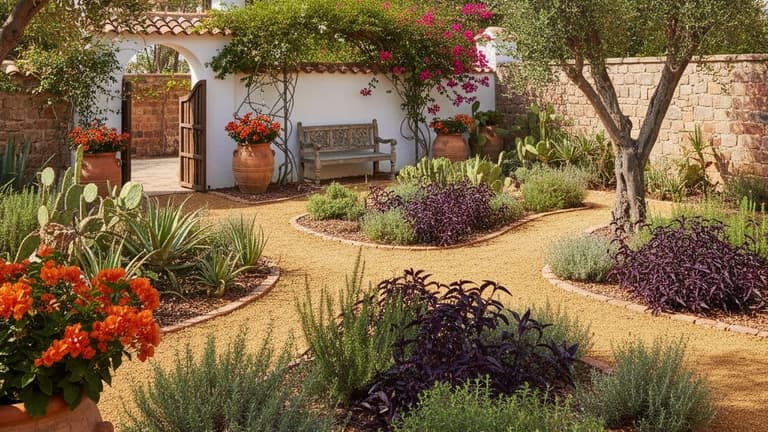
Jaisalmer sandstone in warm golden tones, Rajasthani blue pottery planters, Kota stone paving, and terracotta from Khurja create a material palette that is simultaneously Indian and Mediterranean in spirit. White-lime-washed walls (used in traditional Rajasthani architecture) directly echo Mediterranean whitewash. Combine with Mediterranean ceramic details, copper pots, and iron lanterns for a fusion that is genuinely rooted in Indian materials and craft.

Aromatic Herb Garden at the Core

Rosemary (Salvia rosmarinus), French lavender (Lavandula dentata), thyme, oregano, and sage form the aromatic heart of any Mediterranean garden. In India, these thrive during the dry season (October-May) across the Deccan and hill stations. Combine with native Indian aromatics — curry leaf, lemongrass, and tulsi — for a productive herb garden that bridges both traditions. In Himachal Pradesh, the Bharmour region has proven that lavender cultivation is commercially viable, removing any doubt about hill station feasibility.

The Rajasthani Parallel: Desert-Garden Wisdom

The traditional Rajasthani garden tradition — using gravel mulch, growing aromatic and medicinal shrubs, using stone walls to create microclimates — parallels Mediterranean principles of xeriscape design. Indigenous Rajasthani desert gardeners developed drought-garden techniques centuries before the Mediterranean aesthetic was formalised in European design. Acknowledge and draw on this parallel: use local plant knowledge, traditional stone craftsmanship, and the Indigenous practice of gravel mulching to create a garden that is deeply Indian and genuinely Mediterranean in philosophy.

Outdoor Rooms and Courtyard Living

The Mediterranean pergola draped with grapevine is functionally identical to the traditional Indian verandah or haveli courtyard. Design outdoor rooms as primary living spaces: a shaded dining terrace, a morning sun seating corner, a herb kitchen garden accessible from the cooking area. Stone-built benches with cushions, iron or brass lanterns, and clay pot displays are the furniture of both Mediterranean and Indian outdoor life.

Water Conservation Philosophy

Mediterranean gardens are fundamentally about water wisdom — using it minimally, harvesting it when it falls, and selecting plants that thrive without irrigation. This philosophy resonates deeply in water-scarce Indian regions: Bangalore's worsening groundwater crisis, Rajasthan's reliance on tanker water, Chennai's annual water shortages. Install drip irrigation on all planted beds, harvest monsoon water in underground cisterns for dry-season top-up, and mulch all planted areas with 5-8 cm of gravel to suppress evaporation.

Recommended Plants for India

These plants are specifically selected to thrive in your region's climate and complement this garden style perfectly.

Olive Tree
Olive Tree

Olea europaea

The Rajasthan government has successfully established commercial olive cultivation in Jodhpur and Udaipur districts, confirming that the variety "Arbequina" and other self-fertile cultivars survive Indian conditions. In home gardens, olives thrive in Rajasthan, Gujarat, and the Deccan Plateau as ornamental specimens with architectural form. Require excellent drainage and minimal monsoon irrigation. Will not succeed in Kerala or coastal Karnataka.

Sun: Full sun — minimum 8 hours

Water: Very low once established — drought tolerant

Blooms: Inconspicuous spring flowers; fruit in autumn

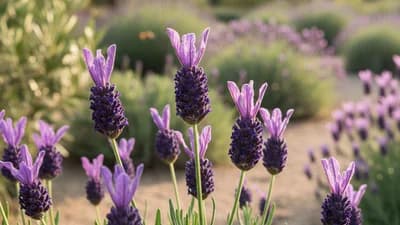
French Lavender
French Lavender

Lavandula dentata

The most heat-tolerant lavender, and the variety documented in successful Himachal Pradesh cultivation (Bharmour region trials by HP Horticulture Department). Performs well in Indian hill stations and the Deccan Plateau dry season. Must have perfect drainage and cannot tolerate monsoon waterlogging. Move containers under cover during peak monsoon. English lavender (L. angustifolia) only for Shimla and Dharamshala elevations above 1,500 m.

Sun: Full sun

Water: Very low — dies in waterlogged soil

Blooms: November-March (India)

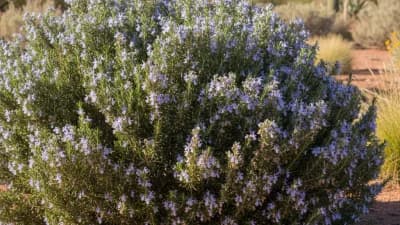
Rosemary
Rosemary

Salvia rosmarinus

Aromatic Mediterranean shrub that performs reliably through the Indian dry season and tolerates Deccan Plateau heat better than most aromatics. Thrives in poor, gritty soil with perfect drainage. In Rajasthan, grows as a hardy landscape shrub. During monsoon, ensure drainage channels are unblocked weekly — standing water at roots kills rosemary in 72 hours. Harvest regularly for culinary use.

Sun: Full sun

Water: Low — drought tolerant; zero tolerance for waterlogging

Blooms: November-February

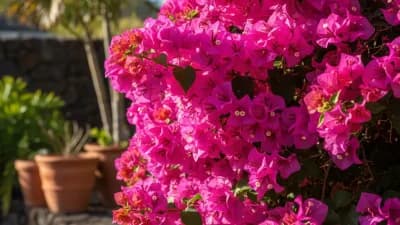
Bougainvillea
Bougainvillea

Bougainvillea spectabilis

The most Mediterranean-looking plant in the Indian garden vocabulary — and a climate-adapted Mediterranean plant. Used across India from Shimla to Kochi, it is the backbone of the Mediterranean aesthetic here. Train over terracotta-rendered walls and pergolas. The magenta and orange varieties evoke Amalfi coast villages; the white and cream cultivars give a more restrained Provence aesthetic. Blooms best when drought stressed in the dry season.

Sun: Full sun

Water: Low — stress-blooming: reduce water for best flower display

Blooms: October-May (plains dry season)

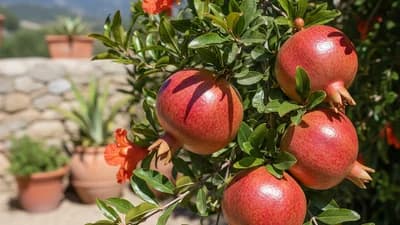
Pomegranate
Pomegranate

Punica granatum

Dual-heritage Mediterranean and Indian fruit tree — grown in Rajasthan and Gujarat for centuries, with commercial orchards in Solapur (Maharashtra) producing 70% of India's crop. For the garden, the ornamental dwarf variety is excellent in terracotta containers. Red flowers and decorative fruit extend the Mediterranean colour palette. Tolerates both Indian summer heat and light frosts in northern regions.

Sun: Full sun

Water: Low to moderate

Blooms: Flowers March-May; fruit October-January

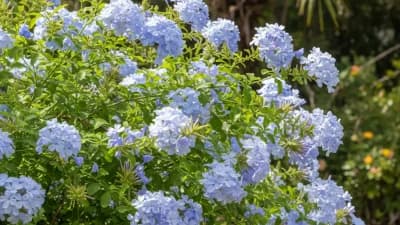
Plumbago
Plumbago

Plumbago auriculata

Sky-blue flowering shrub native to South Africa but now deeply naturalised across India — it provides the blue-lavender colour tones that characterise Mediterranean gardens where lavender struggles. Thrives in Deccan Plateau and Rajasthan conditions. Prune hard after monsoon to encourage a prolific winter flowering display that lasts until April.

Sun: Full sun to part shade

Water: Low to moderate

Blooms: October-May (with peak in dry season)

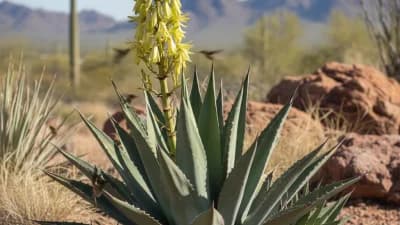
Agave
Agave

Agave americana

Architectural succulent used throughout Mediterranean landscapes for structural accent. In India thrives in Rajasthan, the Deccan Plateau, and Gujarat — regions that genuinely parallel Mediterranean climate. Place as a bold focal specimen in gravel beds or at path junctions. The blue-grey rosette is a year-round architectural statement requiring zero maintenance once established.

Sun: Full sun

Water: Very low — survives on rainfall alone in most Indian zones

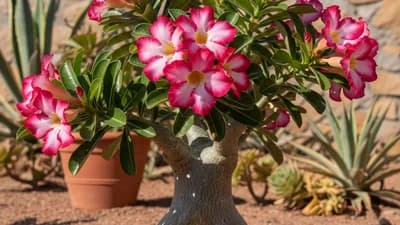
Adenium
Adenium

Adenium obesum

The "desert rose" of African origin but completely at home in Rajasthan and Gujarat's arid conditions. Its swollen caudex trunk and bright flowers provide the Mediterranean coastal garden quality of sculptural form combined with vivid colour. Excellent in large terracotta pots on terraces and patios. Complete drought tolerance in Indian winters.

Sun: Full sun

Water: Very low — water monthly in dry season

Blooms: March-June, with repeat flushes through autumn

Ready to Bring This Style to Life?

Upload a photo of your yard and get AI-powered mediterranean garden designs with plants perfectly suited to India's climate.

Start Designing Now

Essential Design Features

Paving and Surfaces
  • Jaisalmer sandstone in warm golden tones — the most authentically Mediterranean-looking Indian stone
  • Kota stone in brown finish for broad terrace areas — durable and heat-resistant
  • Terracotta tiles for courtyard and covered terrace surfaces — natural and climate-appropriate
  • Gravel areas in cream or buff river pebble — functional Mediterranean aesthetic, helps drainage
  • Dry-stacked local sandstone walls using Rajasthani stoneworking techniques — parallels dry-stone Mediterranean walls
  • Lime-washed render on boundary walls in white or warm ochre — direct echo of Mediterranean whitewash tradition
Water Features
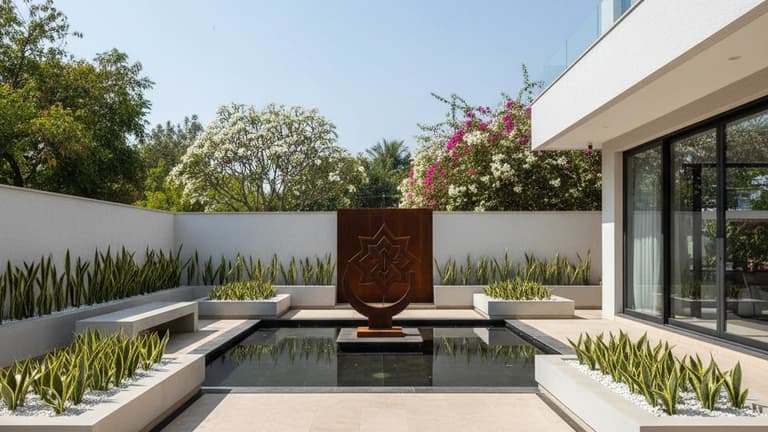
  • Wall-mounted sandstone or marble fountain — one of the most powerful Mediterranean signals in a garden
  • Small recirculating basin in terracotta or carved stone — provides sound and evaporative cooling
  • Rajasthani blue pottery water feature as focal point — beautiful fusion of Indian craft and Mediterranean scale
  • Underground monsoon harvest cistern feeding a gravity-fed dry-season fountain — sustainable water management
  • Shallow stone bird dish in the herb garden — wildlife feature with Mediterranean detail
Structures and Shade
  • Timber or steel pergola draped with Bougainvillea or jasmine — the Mediterranean outdoor room
  • Whitewashed boundary walls with recessed niches for terracotta pots — Andalusian courtyard reference
  • Outdoor dining terrace on Kota stone with built-in stone banquette seating
  • Jaali screen or laser-cut panel providing filtered light privacy — Indian craft, Mediterranean function
  • Tandoor or outdoor cooking station integrated into terrace design — authentic Indian outdoor living
  • Shade cloth or bamboo roller blind for summer protection of sensitive Mediterranean aromatics
Containers and Pots
  • Large terracotta urns (50-80 cm diameter) for olive and pomegranate specimens
  • Rajasthani blue pottery planters for lavender and rosemary — iconic Indian material, Mediterranean scale
  • Hand-thrown Khurja terracotta pots in groupings of 3, 5, 7 — use odd numbers for natural composition
  • Copper or brass degchi (cooking vessels) repurposed as planters — Indian material, Mediterranean container aesthetic
  • Glazed blue-and-white ceramic pots for featured herb display — universally Mediterranean in feel

Seasonal Maintenance Guide

Pre-Monsoon / Spring (February-May)
  • Prune lavender back by one-third by 28 February before summer heat accelerates growth — avoid cutting into old wood
  • Move all lavender and rosemary containers to covered position before first monsoon rain (typically 15 June in most zones)
  • Apply gravel mulch (5-8 cm, 10-20 mm particle size) to all Mediterranean beds before April — reduces evaporation by 60%
  • Increase drip irrigation frequency to daily on sandy-soil Mediterranean beds when temperatures exceed 38°C
  • Inspect and clear all drainage channels and soakaway beds before 1 June — blocked drainage is fatal to Mediterranean plants in monsoon
  • Harvest rosemary and thyme heavily before monsoon — plants need to be cut back to reduce fungal surface area
Monsoon (June-September)
  • Move all lavender, rosemary, and thyme containers under a covered roof immediately at monsoon onset — 3 days of standing water kills them
  • Inspect drainage channels after every rainfall event exceeding 25 mm — clear sediment within 48 hours to prevent soil waterlogging
  • Apply copper oxychloride fungicide to Bougainvillea and Plumbago every 14 days in high-humidity zones
  • Reduce irrigation to zero for Agave, Adenium, and Olive from June-September — monsoon rainfall is sufficient
  • Check gravel mulch areas for monsoon soil deposition — sediment fills voids and causes waterlogging if left
  • Rajasthan and Kutch: lighter monsoon (June-August) allows Mediterranean plants to remain in ground with drainage monitoring only
Post-Monsoon (October-November)
  • Return container lavender and rosemary to outdoor positions once last rain has passed — typically mid-October in Deccan, early November in Kerala
  • Plant new Mediterranean specimens — October-November is the optimal Indian planting window for drought-tolerant species
  • Harvest pomegranates when skin colour deepens and fruit sounds hollow when tapped — typically October-November
  • Refresh gravel mulch areas after monsoon deposition — top up to restore 5 cm depth
  • Prune Bougainvillea to tidy form — triggers the dry-season flowering flush that lasts through April
  • Divide and repot container aromatics that have become root-bound over the growing season
Winter (December-February)
  • Peak garden season for Mediterranean plants in India — enjoy the garden in its best condition
  • Prune lavender to shape after peak November-December flowering; do not cut below green growth
  • Hill stations and north India: protect frost-sensitive plants (Adenium, Bougainvillea) with horticultural fleece when night temperatures drop below 5°C
  • Harvest olives (if established in Rajasthan garden) when berries turn from green to yellow-green
  • Deep water olive and pomegranate trees twice monthly in December-January if rainfall is below 10 mm/week
  • Plan and source new plants for October planting — design improvements are best executed in January when the garden is most visible
Investment Guide

Estimated costs for creating your mediterranean garden in India

Small Garden
  • Plants
    ₹6,000 - ₹14,000
    Lavender, rosemary, Bougainvillea, Plumbago, pomegranate for 20-30 m²
  • Hardscaping
    ₹12,000 - ₹25,000
    Jaisalmer sandstone or Kota stone paving, gravel areas, dry-stone edging
  • Containers
    ₹4,000 - ₹9,000
    Terracotta urns, Rajasthani blue pottery planters
  • Drainage Infrastructure
    ₹5,000 - ₹12,000
    Raised bed construction and perimeter drainage; essential for all Mediterranean gardens in India
  • Total
    ₹27,000 - ₹60,000
    Compact Mediterranean herb and aromatic garden with drainage
Medium Garden
  • Plants
    ₹18,000 - ₹40,000
    Olive tree, lavender, rosemary, Bougainvillea, Agave, herbs for 50-80 m²
  • Hardscaping
    ₹45,000 - ₹95,000
    Stone terrace, gravel paths, dry-stone walls, lime-washed boundary render
  • Water Features
    ₹12,000 - ₹28,000
    Wall-mounted sandstone fountain or terracotta basin with recirculating pump
  • Outdoor Living
    ₹22,000 - ₹50,000
    Timber pergola, built-in seating, lanterns, outdoor cooking station
  • Drainage Infrastructure
    ₹10,000 - ₹22,000
    Multi-zone drainage system for monsoon protection of Mediterranean beds
  • Total
    ₹1,07,000 - ₹2,35,000
    Authentic Mediterranean courtyard garden with outdoor living space
Large Garden
  • Plants
    ₹45,000 - ₹90,000
    Mature olive grove, Agave specimens, extensive aromatic hedges for 100+ m²
  • Hardscaping
    ₹1,10,000 - ₹2,20,000
    Expansive Jaisalmer stone terrace, walls, steps, gravel gardens
  • Water Features
    ₹30,000 - ₹65,000
    Multiple fountain features, harvest cistern, main terrace water wall
  • Outdoor Living
    ₹65,000 - ₹1,40,000
    Large pergola, outdoor kitchen, fire pit, extensive lounge terrace
  • Drainage Infrastructure
    ₹18,000 - ₹35,000
    Professional drainage system with automated monitoring in high-rainfall zones
  • Total
    ₹2,68,000 - ₹5,50,000
    Expansive Indo-Mediterranean garden with full outdoor living infrastructure

Frequently Asked Questions

Transform Your Yard Today

Get personalized mediterranean garden designs created by AI, featuring plants that thrive in India. Upload your yard photo and see your dream garden come to life in minutes.

Start Your Design