
Japanese Garden Design in the UK | Expert British Guide

The UK's cool, moist maritime climate is arguably better suited to Japanese garden design than most of Europe — persistent dampness encourages moss carpets that take decades to establish in drier countries, and gentle temperature swings mean Japanese maples colour gradually rather than scorching. From the highly authentic Cowden Japanese Garden in Scotland (considered among the most historically faithful in Europe) to the formal Tatton Park Japanese Garden in Cheshire with its reconstructed Shinto shrine, the UK has a century-long tradition of taking this style seriously.

Japanese Garden in United Kingdom

Why Choose This Style for United Kingdom?

Annual rainfall of 800–2,500mm across most of the UK creates near-perfect conditions for moss establishment — the Somerset Levels and Scottish Highlands rival Japan for moss diversity

🌱

Mild winters (rarely below -10°C outside of Scotland) mean Fatsia japonica, Camellia japonica, and Nandina domestica overwinter reliably in the ground across the southern two-thirds of England and Wales

💚

Cool, cloudy summers reduce transpiration stress on shade-loving species — Hosta, Hakonechloa, and Kirengeshoma grow more vigorously here than in continental Europe

Climate Adaptation for United Kingdom

British Japanese gardens are structured around four genuinely distinct acts. March brings the first Camellia japonica blooms and unfurling Hakonechloa foliage. April and May deliver cherry blossom — Prunus 'Shirotae' and P. 'Kanzan' are the most reliable in UK conditions — alongside fresh growth on Acer palmatum. June through August is the green season: moss intensifies with summer rainfall, Iris ensata reaches peak flowering in June, and bamboo produces new culms. October and November are the Japanese garden's finest months in the UK; the combination of cool Atlantic nights and lingering warmth intensifies autumn colour on Japanese maples to a degree rarely matched in warmer European climates. December through February reveals skeletal structure — stone lanterns, the white bark of Betula utilis var. jacquemontii, and winter-flowering Hamamelis japonica provide interest through the darkest months.

Key Challenges
  • Southeast England receives under 600mm of rain annually — Japanese maples and moss gardens here need supplementary irrigation when rainfall drops below 25mm per week in June–August
  • Heavy clay soils across the Midlands and south require deep grit incorporation before planting, particularly for Acer palmatum and Pinus mugo, which resent waterlogged roots
  • Late spring frosts (April–early May) in Scotland and northern England can scorch emerging Acer foliage — site maples in east-facing positions sheltered from morning sun after frost
  • Persistent overcast winters in northern England reduce vigour in sun-demanding plants like Prunus serrulata; choose shade-tolerant understory alternatives in Zone 7b or north of the Pennines
Regional Advantages
  • Annual rainfall of 800–2,500mm across most of the UK creates near-perfect conditions for moss establishment — the Somerset Levels and Scottish Highlands rival Japan for moss diversity
  • Mild winters (rarely below -10°C outside of Scotland) mean Fatsia japonica, Camellia japonica, and Nandina domestica overwinter reliably in the ground across the southern two-thirds of England and Wales
  • Cool, cloudy summers reduce transpiration stress on shade-loving species — Hosta, Hakonechloa, and Kirengeshoma grow more vigorously here than in continental Europe
  • The UK has the most mature Japanese garden heritage of any non-Asian country, with specialist nurseries (Bluebell Nursery, Pan-Global Plants) stocking proven cultivars with an RHS Award of Garden Merit
  • The southwest peninsula (Zone 9a) from Cornwall to the Gower supports tender Japanese subjects — Cleyera japonica, Edgeworthia chrysantha, and bamboo species too borderline for inland gardens

Key Design Principles

Embrace the British Climate as an Asset

Rather than treating UK weather as a compromise, design around its strengths. The RHS Chelsea Flower Show has repeatedly showcased Japanese-inspired gardens — Kazuyuki Ishihara's multiple gold-medal winning exhibits demonstrate that moss, bamboo, and water look most compelling in Britain's soft light. Design for persistent dampness: use York stone and Scottish granite, which develop authentic moss patinas within two to three seasons without chemical intervention.

Borrowed Scenery (Shakkei) with British Landscape

Frame views of mature English oak, beech hedgerows, or brick garden walls as shakkei — borrowed scenery integral to the composition. Heale House in Wiltshire exemplifies this approach, where the Japanese teahouse bridges river overlooks a classic English water meadow. Screen modern development with Fargesia murielae screening while opening framed views to existing mature trees.

Water as the Garden's Soul

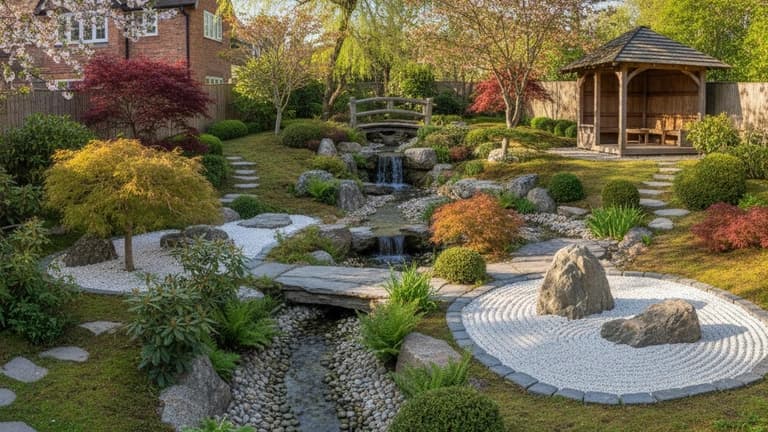
UK rainfall provides free water for features year-round. Install a recirculating pump-fed stream that captures visual drama in wet weather rather than fighting it. Traditional tsukubai water basins overflow naturally during heavy rain — design overflow routes as decorative rills rather than concealed drains. In dry southeast gardens, a gravelled karesansui (dry garden) provides low-maintenance alternative to standing water.

Moss as Foundation, Not Afterthought

Scotland and Wales provide conditions where moss gardens establish themselves without assistance. In drier southeastern gardens, establish moss by transplanting bryophyte mats from garden centres, maintaining soil pH between 5.5 and 6.5, and watering daily for the first three months. Once established, UK rainfall takes over. Tatton Park's Japanese Garden demonstrates that lush moss carpets are achievable as far north as Cheshire.

British Stone as Authentic Material

Japanese gardens traditionally use locally sourced stone — a principle that makes British materials entirely appropriate. York stone weathers to a grey-green patina indistinguishable from aged Japanese garden stone. Welsh slate splits into authentic-looking irregular planes. Scottish granite provides the density and character of volcanic stone used in Kyoto gardens. Avoid imported decorative stone that looks incongruous in a British setting.

Regional Plant Palette

Scotland: lean on Acer japonicum (more cold-hardy than A. palmatum), Rhododendron yakushimanum hybrids, and native mosses — Scotland's higher rainfall produces richer moss carpets than anywhere else in the UK. Midlands and north England: Fargesia murielae 'Simba' for screening, Mahonia japonica for winter scent. Southwest: extend the palette to Cleyera japonica, Schefflera taiwaniana, and Pittosporum tenuifolium.

Recommended Plants for United Kingdom

These plants are specifically selected to thrive in your region's climate and complement this garden style perfectly.

Japanese Maple
Japanese Maple

Acer palmatum

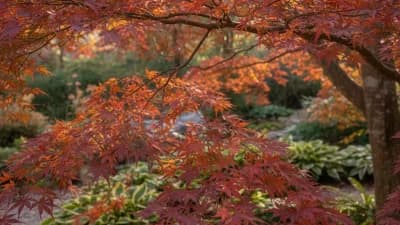
Fully hardy across the UK south of the Highlands (-15°C tolerance in most cultivars). 'Osakazuki' (RHS AGM) delivers the most intense scarlet autumn colour in British conditions. 'Sango-kaku' provides coral winter bark for interest from November to March. Shelter from easterly winds which cause leaf scorch; a northwest-facing wall is ideal in exposed gardens.

Sun: Dappled shade to partial sun; avoid full afternoon exposure in July–August

Water: Moderate — mulch 75mm deep with bark to retain moisture in dry spells

Blooms: April (emerging foliage), October–November (autumn colour)

Umbrella Bamboo
Umbrella Bamboo

Fargesia murielae

The most reliably hardy clumping bamboo for UK conditions — fully clump-forming (non-invasive) and hardy to -20°C. RHS AGM cultivar 'Simba' reaches 2.5m and provides dense screening without spreading. Essential for enclosure in Japanese garden design; will establish in Scotland and northern England where running bamboos fail.

Sun: Full sun to partial shade

Water: Moderate — drought-stressed plants show rolled leaves; water when rainfall under 20mm per week

Japanese Cherry
Japanese Cherry

Prunus 'Shirotae'

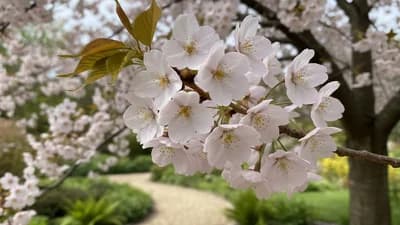
Called 'Mount Fuji cherry', this RHS AGM variety produces pure white semi-double blossoms on wide-spreading, almost horizontal branches in late April — two weeks later than P. 'Kanzan', extending the blossom season. Widely grown throughout UK including in the National Trust garden at Sissinghurst, it is more suitable for Japanese-style gardens than the more familiar upright pink forms.

Sun: Full sun

Water: Low to moderate once established

Blooms: Late April–early May

Japanese Water Iris
Japanese Water Iris

Iris ensata

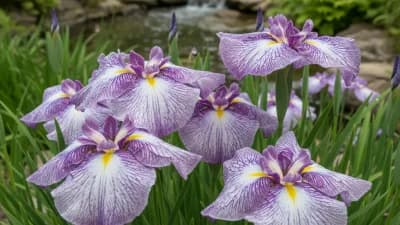
Thrives at UK pond margins where soil remains waterlogged. Produces spectacular flat-petalled flowers to 15cm across in June — later than Iris pseudacorus (yellow flag) so extends the pond flowering season. Requires acid soil conditions (pH 5.5–6.5); in alkaline gardens, grow in containers of ericaceous compost sunk in the pond edge.

Sun: Full sun

Water: High — requires saturated soil or shallow standing water

Blooms: June–July

Japanese Forest Grass

Hakonechloa macra

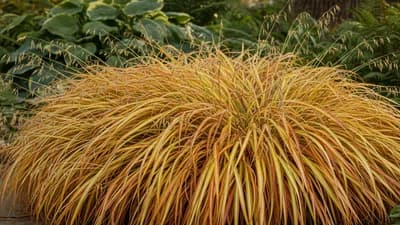
One of the most beautiful grasses for UK shade gardens. 'Aureola' (RHS AGM) forms golden-yellow cascading mounds that light up shaded areas and turn amber in autumn. Grows more vigorously in UK conditions than in continental Europe — the combination of shade and moisture suits it perfectly. Use to soften stone steps and path edges.

Sun: Partial to full shade — foliage scorches in full afternoon sun

Water: Moderate — appreciates consistent moisture, will tolerate UK winter wet

Blooms: Late summer (delicate flower panicles), autumn golden colour

Hosta (Plantain Lily)

Hosta sieboldiana

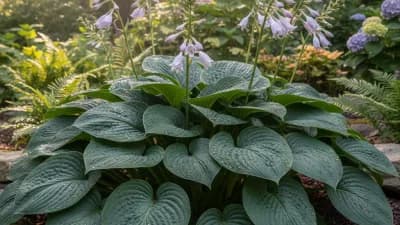
H. sieboldiana 'Elegans' (RHS AGM) produces the largest, most glaucous blue-grey leaves of any hosta — individual leaves reach 30cm across. In UK conditions, the cool summers allow hostas to maintain fresh-looking foliage well into September. Slug pressure is the primary challenge in damp UK gardens; sink copper tape rings into the soil around crowns from March.

Sun: Deep to partial shade

Water: Moderate to high — thrives in UK damp conditions

Blooms: July (pale lavender flowers, secondary to foliage)

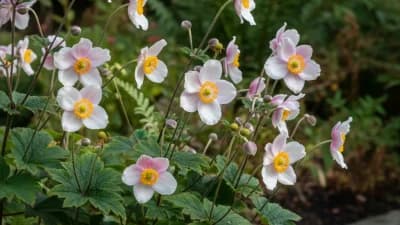
Japanese Anemone
Japanese Anemone

Anemone × hybrida

An indispensable late-season plant for UK Japanese gardens. 'Honorine Jobert' (RHS AGM) produces pure white single flowers from August through October, precisely when the garden needs renewal before autumn colour begins. Naturalises readily in UK conditions, spreading to form weed-suppressing colonies in light shade under deciduous trees.

Sun: Partial shade to sun

Water: Moderate — established plants are remarkably drought-tolerant

Blooms: August–October

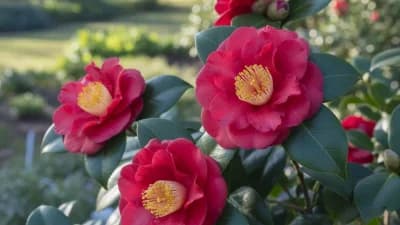
Camellia
Camellia

Camellia japonica

Hardy to -10°C and reliably evergreen across southern England, Wales, and Ireland. The National Collection of Camellias is held at Chiswick House, London, demonstrating their suitability for UK gardens. 'Adolphe Audusson' (RHS AGM) produces deep red semi-double flowers from February to April — crucial for winter/early spring interest in Japanese gardens. Requires acidic soil (pH 5.5–6.5); plant against a west-facing wall to avoid frozen buds thawing too rapidly in morning sun.

Sun: Partial shade — avoid east-facing positions where morning sun defrosts flower buds too quickly

Water: Moderate — requires consistent moisture; drought stress causes bud drop

Blooms: February–April

Ready to Bring This Style to Life?

Upload a photo of your yard and get AI-powered japanese garden designs with plants perfectly suited to United Kingdom's climate.

Start Designing Now

Essential Design Features

Water Features
  • Recirculating stream with York stone or Welsh slate bed, designed to cascade during heavy rain rather than flood
  • Koi pond with professional biological filtration — allow 500 litres per fish minimum; UK temperatures support koi year-round without heating
  • Tsukubai (stone water basin) fed by shishi-odoshi (bamboo deer-scarer) — the sound of water particularly effective in enclosed UK garden settings
  • Karesansui (dry garden) using locally sourced crushed granite or pale quartz gravel raked in wave patterns — ideal for smaller urban spaces
  • Rain chain (kusari-doi) directing roof water into a ground-level basin as a functional ornamental feature
  • Naturalistic bog garden planted with Iris ensata, Ligularia dentata, and native Caltha palustris adjacent to pond
Stone and Gravel
  • York stone stepping path with 150mm gaps filled with Soleirolia soleirolii (mind-your-own-business) for a moss-like effect in southeast gardens
  • Moss-encrusted natural boulders sourced from Scottish or Welsh quarries — authentic appearance within one to two seasons of establishment in damp conditions
  • Stone lanterns (toro) in granite or sandstone, positioned to illuminate paths without introducing anachronistic contemporary lighting
  • Scottish granite cobbles for transitional areas between planted zones and gravel
  • Gravel meditation courtyard using pale Cotswold or Jersey limestone chippings — avoid dark gravel which absorbs heat and cracks in frost
  • Natural stone bridges over water features using reclaimed sandstone or limestone
Plant Palette Strategy
  • Canopy layer: Acer palmatum specimens as focal points, Pinus mugo for evergreen silhouette in winter
  • Structural layer: Fargesia murielae screening, Camellia japonica as clipped evergreen hedge
  • Flowering interest: Rhododendron yakushimanum hybrids (April–May), Iris ensata (June), Anemone × hybrida (August–October)
  • Moss and groundcover: Bryophyte transplant mats in damp northern gardens; Soleirolia soleirolii in southeast where moss is harder to establish
  • Autumn focus: Acer palmatum 'Osakazuki' for maximum colour intensity in UK conditions
  • Winter structure: Hamamelis japonica, Mahonia japonica, Betula utilis var. jacquemontii bark
Architectural Elements
  • Timber gate using green oak or cedar with traditional Japanese joinery — green oak weathers to silver-grey within three years, matching the mature stone palette
  • Viewing pavilion or tea house in timber with overhanging eaves designed to shelter the occupant from UK rain while maintaining open sightlines
  • Woven bamboo fence panels (kenninji) or moso bamboo post screens for inner garden enclosure
  • Arched timber or stone bridge as focal point over water feature
  • Chozubachi (hand-washing basin) at garden entrance — functional as well as traditional
  • Low-level LED path lighting concealed in stone edges for winter evening use

Seasonal Maintenance Guide

Spring
  • Prune Acer palmatum in late March before bud break — pruning after leaf emergence causes excessive sap bleeding; remove crossing and inward-growing branches only
  • Apply ericaceous fertiliser to Camellia, Rhododendron, and Acer in early April once soil temperature exceeds 8°C — the Gardeners' World recommendation of sulphate of ammonia at 30g per square metre works well
  • Divide Hakonechloa and Hosta clumps in April, replanting divisions 300mm apart; cut back any winter-damaged Hakonechloa foliage to ground level
  • Clean pond filters and net pond surface in late April before blanket weed growth accelerates with warming water temperatures
  • Re-rake gravel meditation areas after winter frost heave disturbs patterns
  • Watch for vine weevil damage (crescent-notched leaves) on Hosta from May — apply nematode biological control when soil temperature exceeds 12°C
Summer
  • Irrigate southeast England gardens when rainfall drops below 25mm per week from June to August — Japanese maples show leaf curl before wilting, which is the trigger to water
  • Deadhead Iris ensata immediately after flowering to redirect energy to rhizome development for next year
  • Maintain water clarity in koi ponds during warm periods — UK heatwaves (over 25°C) reduce dissolved oxygen; use a pump or waterfall to aerate
  • Thin Fargesia bamboo in July by removing oldest canes at base — this opens the clump and promotes strong new culm production
  • Monitor for red spider mite on Acer in dry spells; increase humidity with overhead spraying in the evening
  • Top-dress moss areas with finely sieved leaf mould in July if dryness causes browning — moss recovers rapidly once moisture returns
Autumn
  • Plant new Acer palmatum specimens from mid-September to late October — autumn planting allows root establishment before the following year's dry spells
  • Remove fallen leaves from pond surface immediately — decomposing leaves release hydrogen sulphide toxic to fish; skim daily in October and early November
  • Collect Acer and Camellia seeds in October for propagation — stratify Acer seeds in damp vermiculite in the fridge for 12 weeks before spring sowing
  • Prune Camellia after flowering (October–November for late varieties) — avoid pruning Camellia in spring which reduces next year's flower bud set
  • Rake and refresh gravel areas after leaf fall; add fresh 20mm gravel topping if patterns have compacted over summer
  • Apply autumn balanced feed to Hakonechloa and Hosta before dormancy to build root reserves for spring
Winter
  • Appreciate the garden's bone structure — the most important season for evaluating design decisions, as plants in Japan are designed to look compelling without foliage
  • Protect newly planted or borderline-hardy subjects (Cleyera japonica, Edgeworthia) with horticultural fleece when temperatures drop below -5°C in January–February
  • Prune deciduous trees in January–February during the dormant period for clean shapes — avoid pruning cherry trees (Prunus) in winter due to silver leaf disease risk in wet conditions
  • Check and clear stone lanterns of moss that may obscure carved detail if that matters; alternatively allow natural patination to continue developing
  • Plan improvements during January quiet period — Tatton Park's Japanese Garden holds open days that are worth visiting for authentic design references
  • Clean water pump filters monthly through winter — UK winter rainfall can introduce silting in recirculating systems

Investment Guide

Estimated costs for creating your japanese garden in United Kingdom

Small Garden
  • Plants
    £600 - £1,400
    Acer palmatum 'Osakazuki' (specimen), Fargesia murielae, Hakonechloa, Hosta, Camellia for 20-40 sqm — add 20% in London/southeast for nursery delivery costs
  • Stone and Gravel
    £450 - £1,000
    York stone stepping path, Scottish granite boulders, pale limestone gravel — Scotland pricing approximately equal despite perceived remoteness
  • Water Feature
    £300 - £800
    Tsukubai basin with recirculating pump, or karesansui dry garden with raked gravel — pump installation by qualified electrician at £55–65/hour
  • Structures
    £400 - £900
    Bamboo fence section or stone lantern — handmade bamboo panels from specialist UK suppliers £85–120 per metre
  • Total
    £1,750 - £4,100
    Intimate Japanese meditation corner; add 20% for London/southeast labour and delivery
Medium Garden
  • Plants
    £2,000 - £4,000
    Multiple Acer specimens, mature Fargesia screening, Rhododendron yakushimanum, Camellia hedge for 50-80 sqm
  • Stone and Gravel
    £2,000 - £4,500
    Extensive York stone path, featured boulders, dry garden — stone supply from Yorkshire quarries reduces costs for Midlands and north gardens
  • Water Feature
    £2,500 - £6,000
    Naturalistic pond with biological filter and koi, or recirculating stream with stone cascade — includes pump, liner, and electrician labour
  • Structures
    £2,000 - £4,000
    Green oak entry gate, kenninji bamboo fence perimeter, timber viewing bench — labour at £50–60/hour for specialist joiner
  • Irrigation
    £700 - £1,400
    Supplementary drip irrigation for southeast England where summer drought is a genuine risk
  • Total
    £9,200 - £19,900
    Authentic British Japanese garden with water feature; London/southeast add 20%, Scotland subtract 10%
Large Garden
  • Plants
    £5,000 - £10,000
    Specimen maples (60-100cm girth), mature Camellia hedging, extensive bamboo screening, full moss establishment programme for 100+ sqm
  • Stone and Gravel
    £5,000 - £10,000
    Major stonework including natural stone bridges, large boulders with crane placement, extensive gravel areas — crane hire adds £400–700 per day
  • Water Feature
    £8,000 - £18,000
    Large koi pond (minimum 10,000 litres) with professional biological filtration, UV steriliser, and recirculating stream — pond specialist labour at £55–65/hour
  • Structures
    £5,000 - £10,000
    Custom green oak gate, substantial tea house or viewing pavilion, extensive bamboo fence — bespoke joinery from UK craftsman at day rates of £350–500
  • Irrigation
    £1,800 - £3,500
    Professional multi-zone drip irrigation with rainfall sensor — essential for southeast England gardens
  • Total
    £24,800 - £51,500
    Expansive traditional Japanese garden; showcase standard comparable to Tatton Park private sections

Frequently Asked Questions

Transform Your Yard Today

Get personalized japanese garden designs created by AI, featuring plants that thrive in United Kingdom. Upload your yard photo and see your dream garden come to life in minutes.

Start Your Design