




Modern Minimalist Garden Design UK | Chelsea-Standard Gardens

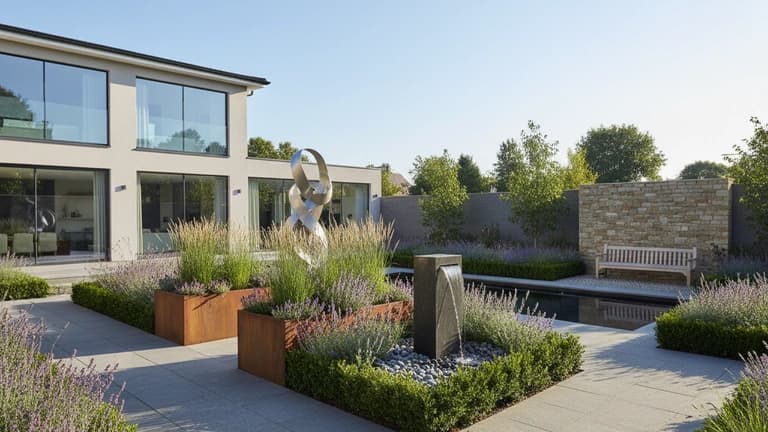
The UK has produced some of the world's most celebrated minimalist garden designers. Andy Sturgeon has won multiple RHS Chelsea Flower Show gold medals with gardens that combine severe geometry with rich planting — his 2019 'M&G Garden' used 45-tonne Portland stone columns with dense meadow planting to extraordinary effect. Dan Pearson, whose Tokachi Millennium Forest in Japan is a canonical work of contemporary landscape design, began his career in British gardens and brings a deeply ecological minimalism that is influential worldwide. The British climate is, counterintuitively, well-suited to this aesthetic: persistent rain keeps Corten steel perpetually oxidising to its signature amber patina, while overcast light flatters the textures of clipped yew and Yorkstone in a way that harsh sunlight never could.

Modern Minimalist in United Kingdom

Why Choose This Style for United Kingdom?

Overcast, diffuse UK light is the finest possible light for displaying textured materials — Yorkstone, Corten steel, and clipped yew read more clearly under British cloud than in Mediterranean sun, where harsh shadows disrupt surface detail

🌱

Persistent rain makes Corten steel's oxidation process continuous and complete — a Corten raised bed installed in the UK develops its full amber-brown patina within one to two years; in drier climates this takes five years or more

💚

The UK's mild temperatures support Stipa gigantea, Hakonechloa macra, Deschampsia cespitosa, and Molinia caerulea as structural planting grasses — all reliably perennial and at their most beautiful in UK conditions with gentle breeze and diffuse light

Climate Adaptation for United Kingdom

A well-executed UK minimalist garden is designed to be most revealing in winter, when the deciduous layer has fallen to expose the structural skeleton. October is the period of maximum drama — ornamental grasses at peak, any Betula bark gleaming, seedheads of Echinacea and Verbena catching low autumn light. November through January is the test of the design: only evergreen architecture, quality materials, and subtle lighting carry the garden through the fifteen shortest days of the year. Frost transforms clipped Taxus and Ilex into temporary sculpture; after a hard frost, even a simple Yorkstone path with Hakonechloa edging becomes extraordinary. March brings the first upward movement from ornamental grasses and the flush of any spring bulbs — Tulipa 'Spring Green' in white and green works precisely because it does not fight the minimalist colour palette. July and August deliver the full meadow and grass moment — the UK's long summer twilights (light until 10pm in the north in June) mean the garden is enjoyed at its most atmospheric.

Key Challenges
  • Persistent damp encourages algae and moss growth on horizontal paved surfaces — essential to specify non-slip finishes and a minimum 1:80 fall on all paving; Yorkstone and sandstone need annual pressure-washing or a dilute Castrol Clean Plus application to maintain clarity
  • UK winters can be long and grey from November to March — the minimalist garden must be designed to look compelling as a monochrome composition without colour or seasonal interest, relying entirely on form and structure
  • Box blight (Cylindrocladium buxicola) and box tree caterpillar (Cydalima perspectalis) have devastated Buxus sempervirens hedging across the UK since 2011 — any minimalist design that relies on box topiary must have a contingency or alternative from the outset
  • Increasingly frequent extreme weather — the 2022 UK heatwave (40.3°C recorded in Lincolnshire) followed by heavy winter rainfall — places unusual stress on minimalist planting palettes designed for narrow temperature ranges
Regional Advantages
  • Overcast, diffuse UK light is the finest possible light for displaying textured materials — Yorkstone, Corten steel, and clipped yew read more clearly under British cloud than in Mediterranean sun, where harsh shadows disrupt surface detail
  • Persistent rain makes Corten steel's oxidation process continuous and complete — a Corten raised bed installed in the UK develops its full amber-brown patina within one to two years; in drier climates this takes five years or more
  • The UK's mild temperatures support Stipa gigantea, Hakonechloa macra, Deschampsia cespitosa, and Molinia caerulea as structural planting grasses — all reliably perennial and at their most beautiful in UK conditions with gentle breeze and diffuse light
  • World-class material suppliers are concentrated in the UK: Marshalls (Yorkstone and Purbeck paving), Landscape Projects (Corten and steel products), Armourcoat (polished plaster finishes), and dozens of specialist stone masons serving the London and southeast design market

Key Design Principles

Andy Sturgeon's Material Restraint

Sturgeon's approach — limiting the hard landscape palette to two or three premium materials used in large format — is the most important principle for UK minimalist gardens. His 2019 Chelsea garden used Portland stone (light), Corten steel (warm), and water (reflective) as the only three material components. The rule is: choose one primary surface material, one accent material, and one contrasting element — and use them consistently at scale.

Dan Pearson's Ecological Minimalism

Pearson's approach argues that minimalism and ecological richness are not contradictory — a restricted plant palette of five species planted in large drifts of fifty or more plants each creates both visual simplicity and habitat value. His use of Molinia caerulea, Deschampsia, and Sesleria reflects his deep knowledge of plant communities. Applied to UK gardens, this means fewer species planted more densely and with more repetition than conventional practice.

Taxus baccata as Living Architecture

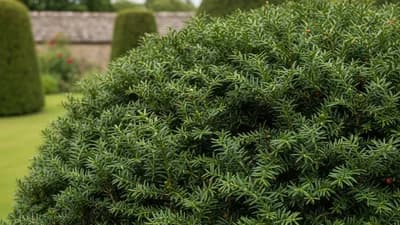
English yew (Taxus baccata) is the finest hedging material in the world for UK minimalist design — dark, dense, and completely responsive to clipping into any geometric form. It grows at 200–300mm per year once established, tolerates deep shade, and lives for centuries. Use it to create vertical walls of green that frame outdoor rooms, as clipped columns at 600mm spacing, or as a single flat-topped hedge providing a constant horizontal line. The alternatives — Prunus lusitanica and Ilex crenata — are equally reliable for box blight-resistant hedging.

Yorkstone and Corten as the British Minimalist Palette

Yorkstone (sawn sandstone from Yorkshire quarries) is the canonical British paving material — warm buff-grey, non-slip when wet, and improving with age. Large format (900mm × 600mm minimum, 900mm × 900mm preferred for contemporary work) is essential for a minimalist effect; small slabs read as suburban. Corten steel weathers gracefully in UK rain, developing its characteristic amber patina without maintenance. Combine Yorkstone horizontal planes with Corten vertical elements for a palette that is unmistakably British and contemporary simultaneously.

Negative Space as Primary Design Element

UK minimalist gardens, particularly in the urban context where most are built, require discipline in allowing empty space. A 20sqm London courtyard with Yorkstone paving, a single Betula utilis specimen, one Corten raised bed, and a simple reflecting pool has more visual power than a 60sqm garden filled with varied planting. The test: if you removed one element, would the garden be diminished? If removing an element makes no difference, that element should be removed.

Lighting for the British Winter

With sunset before 4pm in December, UK minimalist gardens must function as lit spaces for four to five months of the year. The RHS Chelsea Flower Show night previews consistently demonstrate that lighting transforms even modest gardens — LED uplights under Betula utilis illuminate the white bark to luminous effect; ground-level LED strips along Corten raised bed edges create a floating plane at night; recessed ground lights in paving create clean pools without visible fittings during daylight.

Recommended Plants for United Kingdom

These plants are specifically selected to thrive in your region's climate and complement this garden style perfectly.

English Yew
English Yew

Taxus baccata

Taxus baccata is native to the UK and the finest structural hedging material available for minimalist gardens. It tolerates shade (including the deep north-facing shade of London courtyard gardens), all UK soils, and clips to precise geometry. Hardy to -20°C, it requires one annual trim in August to maintain form. Use as flat-topped hedging from 600mm to 3m, as clipped columns, or as free-standing topiary. The National Trust's Hidcote Manor demonstrates the full architectural potential of Taxus in the UK.

Sun: Full sun to deep shade — unique versatility among evergreen hedging plants

Water: Low — extremely drought tolerant once established

Golden Oat Grass
Golden Oat Grass

Stipa gigantea

Andy Sturgeon used Stipa gigantea in multiple Chelsea show gardens as a semi-transparent structural element. It forms a dense evergreen basal clump from which stems reach 2.4m, producing golden oat-like flower heads that glow in low British light from June to October. Completely transparent — you see through it to what is behind — making it perfect for creating soft visual division without obscuring space. RHS AGM. Plant as isolated specimens or in geometric groups of three to five.

Sun: Full sun

Water: Low — exceptionally drought tolerant once established

Blooms: June–October, seedheads persist through winter

White-stemmed Himalayan Birch

Betula utilis var. jacquemontii

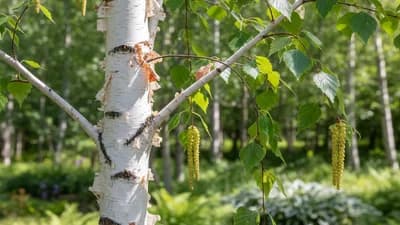
The single most architecturally compelling tree for UK minimalist gardens. 'Doorenbos' and 'Grayswood Ghost' (both RHS AGM) have the whitest bark of any Betula cultivar. In UK gardens, the persistent damp keeps the bark gleaming white; in drier climates it greys over. Plant as a multi-stem specimen (three or five stems from the base), underplanted with Hakonechloa macra or a single species of Carex. The National Arboretum at Westonbirt holds extensive plantings for cultivar comparison.

Sun: Full sun to dappled shade

Water: Moderate — grows vigorously in UK conditions with reliable rainfall

Japanese Forest Grass

Hakonechloa macra

'Aureola' (RHS AGM) produces cascading golden-yellow mounds that light up shade gardens and age to warm amber before dying back in December. The most versatile grass for UK minimalist design — use as a single repeated element beneath Betula specimens, as soft edging to Yorkstone paths, or as mass planting in large Corten raised beds. Dan Pearson uses it extensively for its combination of movement and luminosity in diffuse British light.

Sun: Partial to full shade — scorches in full afternoon sun

Water: Moderate — appreciates consistent UK moisture

Blooms: Foliage from April, golden autumn colour October–November

Feather Reed Grass
Feather Reed Grass

Calamagrostis × acutiflora 'Karl Foerster'

The most upright ornamental grass available — grows to 1.8m with a perfectly vertical habit that creates strong rhythmic repetition when planted in geometric rows. 'Karl Foerster' (RHS AGM) flowers in June with pinkish-bronze plumes that fade to golden-beige and hold their form through winter. The ideal grass for creating transparent screens or emphasising axes in a minimalist UK garden. Divide every three years in March to maintain vigour.

Sun: Full sun to light shade

Water: Low to moderate — adaptable to UK conditions

Blooms: June–winter (holds form)

Portuguese Laurel
Portuguese Laurel

Prunus lusitanica

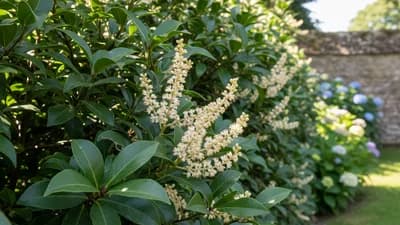
The best alternative to Buxus sempervirens for UK minimalist hedging following box blight devastation. Glossy dark green leaves with maroon stalks form a dense surface when clipped, and it tolerates shaping into any form including lollipop standards. Hardy to -15°C. Prune twice yearly (May and August) for the sharpest form. Ilex crenata 'Dark Green' is the closest box substitute for small balls and low hedging below 600mm; Prunus lusitanica excels for taller hedging and standards.

Sun: Full sun to shade

Water: Low to moderate

Purple Coneflower
Purple Coneflower

Echinacea purpurea

Echinacea provides the most architecturally persistent seedheads of any commonly available UK perennial — the spiky central cones remain standing through December in UK conditions and are excellent for birds. 'Magnus' (RHS AGM) produces large flat-petalled flowers of deep rose-purple from July to September. Plant in large groups of seven or more for minimalist impact; the individual plants are modest but a mass of twenty creates a genuinely structural statement.

Sun: Full sun

Water: Low — drought tolerant once established

Blooms: July–September, seedheads October–December

Tufted Hair Grass
Tufted Hair Grass

Deschampsia cespitosa

'Goldtau' (RHS AGM) produces airy clouds of golden-bronze flower panicles from June that persist in the UK's damp air well into autumn. Dan Pearson uses it extensively in naturalistic minimalist schemes where movement in the breeze creates the primary visual interest. More shade tolerant than most ornamental grasses — works effectively beneath deciduous trees where the grass palette is otherwise limited. Evergreen in mild UK winters.

Sun: Full sun to partial shade — one of the most shade-tolerant ornamental grasses

Water: Low to moderate

Blooms: June–October

Ready to Bring This Style to Life?

Upload a photo of your yard and get AI-powered modern minimalist designs with plants perfectly suited to United Kingdom's climate.

Start Designing Now

Essential Design Features

Surfaces and Paving
  • Sawn Yorkstone in large format (900mm × 600mm or 900mm × 900mm) — supply from Yorkshire quarries including Marshalls or Stoneheam; specify a minimum 50mm thickness for ground-level areas, 40mm for steps
  • Brushed or honed concrete in warm neutral tones as a less expensive alternative to stone — specify a minimum 150mm slab with reinforcement mesh; seal annually to prevent UK damp causing algae
  • Corten steel edging (5mm thickness) for the crispest boundary between paving and planted areas — pre-rusted Corten available from UK landscape suppliers or allow six to twelve months for natural patination
  • Pale limestone gravel (10–20mm) in planted areas to provide drainage, visual contrast with plant colour, and weed suppression simultaneously
  • Sustainably sourced hardwood decking (Accoya or Kebony modified timber) as a warm-toned contrast to stone — both materials are dimensionally stable in UK freeze-thaw conditions and require minimal maintenance
Water Features
  • Rectangular reflecting pool flush-mounted with paving — minimum 600mm depth for winter ice tolerance in UK conditions; specify a dark render (charcoal or graphite) for maximum reflectivity
  • Blade water feature: a horizontal slot in a Corten or stone wall delivers a laminar sheet of water — the standard detail in UK high-end contemporary gardens from the early 2000s, still highly effective
  • Linear rill running through the long axis of a garden — Yorkstone or Corten-edged with 150–200mm water width; creates movement and sound without dominating the space
  • Still water mirror in a polished stainless steel bowl — a simpler and more affordable version of the reflecting pool that works at courtyard scale
  • Overflow pool or raised basin with blade overflow — water falling over the edge of a flush-mounted raised pool creates perpetual movement without requiring a visible fountain
Structures and Boundaries
  • Powder-coated steel pergola in RAL 7016 (anthracite grey) or RAL 9005 (jet black) — sharp, contemporary contrast with Yorkstone and living planting; avoid brown or bronze which reads as dated
  • Corten steel raised beds — prefabricated from 3mm sheet steel in 600mm height for standard use, 1200mm for seated use; order bespoke sizes from London Corten Designs or similar UK fabricators
  • London stock brick wall — unrendered buff or red brick is a distinctly British material that complements contemporary planting palettes in an urban setting; Andy Sturgeon has used it to powerful effect
  • Slatted Iroko or Accoya privacy screens — 50mm × 25mm laths at 75mm spacing provide partial screening without complete closure; fix with concealed stainless steel fixings
  • Built-in stone or concrete bench seat — a 450mm-high Yorkstone seat with 400mm depth is the benchmark; a single long seat performs better than multiple pieces in a minimalist space
Outdoor Lighting
  • Recessed LED ground lights (IP67 rating minimum for UK use) in Yorkstone paving — specify a warm white (2700K) colour temperature to complement the warm stone tones
  • LED uplights to Betula multi-stem specimens — 10W warm white PAR38 LED at 45° angle illuminates the white bark to extraordinary effect in the long UK winter months
  • Corten raised bed LED strip lighting along the top interior edge — creates a floating planting plane at night with concealed light source
  • Step riser lighting recessed into Corten or stone risers — warm white LED, visible only from ground level, creates safety and atmosphere simultaneously
  • Indirect wall washing from low-level bollards or buried upward-facing slots — illuminates rendered or brick walls without casting hard shadows

Seasonal Maintenance Guide

Spring
  • Cut back Hakonechloa and Deschampsia to 50mm above ground level in late February to early March — wait until new growth is clearly visible before cutting; cutting too early in January risks damaging emergent shoots in late frosts
  • Trim Taxus baccata hedges for first cut in late April, after the risk of hard frosts has passed — the new growth is soft and clips cleanly; target the precise geometric profile established in the previous year
  • Clean Yorkstone and concrete surfaces of algae growth in late March using a pressure washer at 120 bar — lower pressure is insufficient, higher pressure can damage stone surface finish; a dilute Patio Magic solution applied two weeks earlier makes cleaning faster
  • Check drainage falls on paving and channel drains — UK winter frost and settling can disrupt 1:80 falls; rectify immediately before summer use begins
  • Plant new grass and perennial additions in April when soil temperature exceeds 8°C — spring planting in the UK requires weekly watering for six weeks; autumn planting (September) requires significantly less intervention
  • Replenish gravel in planted areas — winter rain and footfall compact gravel to 30–50mm; restore to 75–100mm for effective weed suppression
Summer
  • Second Taxus trim in late July or early August — this is the most important cut for maintaining sharp geometric precision; the August trim defines the silhouette that will carry the garden through winter
  • Water newly planted grasses and perennials during extended dry periods (below 25mm rainfall over two weeks) in their first summer — established plants require no supplementary irrigation in UK conditions
  • Deadhead Echinacea partially — remove spent flowers from July to August to extend the blooming period, but allow final September flowers to go to seed for winter seedhead effect and bird food
  • Weed gravel areas monthly from May to August — a single pass with a long-handled wire brush takes ten minutes per 10 sqm and prevents weed establishment before roots anchor
  • Check water feature pump filters monthly and clear debris — UK summer brings significant organic material into outdoor water features; blocked pumps cause overflow and staining
  • Trim Prunus lusitanica hedges in July for a single annual cut — unlike Taxus, Portuguese laurel needs only one cut per year if maintained consistently
Autumn
  • Clear fallen leaves from paving and water features immediately in October and November — wet leaves on Yorkstone and concrete become dangerously slippery and stain the surface; Betula drops leaves in three weeks and requires daily attention
  • Apply Barrettine hardwood oil to Iroko or Accoya timber structures in October before first frosts — two coats, with 24 hours drying time between; this maintains the honey-brown colour and prevents grey weathering
  • Plant spring bulbs in geometric drifts in October — Tulipa 'Spring Green' (white with green feathering) and T. 'Purissima' (pure white) are the minimalist palette choices; plant at 150mm depth in groups of 15–25
  • Divide Calamagrostis and Deschampsia clumps in September every three years — use a sharp spade to cut the clump into four sections; replant immediately at original spacing
  • Assess the garden's winter composition from the house in late October — this is the moment to identify structural deficiencies; gaps in evergreen planting are most obvious when deciduous material has dropped
  • Service outdoor lighting system before winter — replace failed LEDs, clean lenses, and check waterproofing seals on ground lights before sustained wet weather begins
Winter
  • Keep Yorkstone and concrete surfaces clear of moss and algae from November onwards — UK persistent damp encourages rapid growth; a monthly spray with dilute Jeyes Fluid prevents accumulation without damaging plants
  • Prune Betula multi-stem specimens in January when fully dormant — remove dead wood and any crossing branches; the sparse winter silhouette reveals structural issues invisible in summer
  • Protect the steel fixings of timber structures from corrosion — apply WD-40 or similar to exposed stainless steel bolt heads and any mild steel components; UK winter salt from road treatment corrodes steel hardware quickly in coastal or roadside gardens
  • Check Corten steel raised beds for any rust staining on adjacent Yorkstone — place a gravel sacrificial border between Corten and stone to catch rust runoff; clean stained stone with oxalic acid solution if required
  • Commission new lighting design if winter darkness reveals inadequate illumination — experienced UK garden lighting designers (ELDA members) provide survey and specification services from £500
  • Order plants for spring delivery in January from specialist UK nurseries — Knoll Gardens for ornamental grasses, Marchants Hardy Plants for late-season perennials, Architectural Plants for structural specimens
Investment Guide

Estimated costs for creating your modern minimalist in United Kingdom

Small Garden
  • Plants
    £500 - £1,100
    Taxus baccata hedging (3–4 metres), Betula multi-stem specimen, grasses and perennials for 15-25 sqm — London southeast pricing; subtract 15% for Midlands and north
  • Hard Landscaping
    £1,800 - £3,500
    Sawn Yorkstone (90mm format) or brushed concrete paving with Corten edging — Yorkstone supply approximately £65–90/sqm, laying at £55–65/hour
  • Corten Planters
    £400 - £900
    Corten steel raised bed (1200mm × 600mm × 600mm) from UK fabricator; bespoke sizing available — standard sizes from architectural metal suppliers at £250–600 each
  • Lighting
    £500 - £1,000
    Basic LED scheme — 4–6 ground lights and 2 tree uplights; electrician installation at £60–70/hour
  • Total
    £3,200 - £6,500
    Compact minimalist courtyard — London/southeast prices; Midlands subtract 15%
Medium Garden
  • Plants
    £1,500 - £3,500
    Taxus hedging walls, two to three Betula specimens, mass grasses, Echinacea drifts for 40-70 sqm
  • Hard Landscaping
    £4,500 - £9,000
    Large-format Yorkstone throughout, Corten edging, gravel planted areas with drainage membrane
  • Water Feature
    £1,500 - £3,500
    Rectangular reflecting pool in dark render or blade water feature in Corten/stone wall — including pump, pipework, and electrician
  • Structures
    £2,500 - £5,500
    Powder-coated steel pergola, built-in stone bench, Corten raised beds, timber privacy screen
  • Lighting
    £1,000 - £2,200
    Integrated LED lighting system — recessed paving lights, tree uplights, Corten bed strips
  • Total
    £11,000 - £23,700
    Complete minimalist garden with water feature and professional lighting — Midlands baseline
Large Garden
  • Plants
    £4,000 - £9,000
    Mature Taxus hedging walls (2.5m height), multiple Betula specimens, extensive grass and perennial mass planting for 100+ sqm
  • Hard Landscaping
    £10,000 - £20,000
    Premium Yorkstone or Portland stone throughout, multiple Corten edged beds, detailed drainage — structural engineer consultation may be required for retaining walls at £1,000–2,000
  • Water Features
    £4,000 - £8,000
    Large reflecting pool (20+ sqm) or multiple integrated water elements — specialist water feature contractor at £65–80/hour
  • Structures
    £6,000 - £12,000
    Designer steel pergola with integrated lighting, screen walls, outdoor kitchen area — bespoke steel fabricator day rate £500–700
  • Lighting
    £2,500 - £5,500
    Professional architectural lighting scheme — ELDA-member lighting designer specification plus installation
  • Total
    £26,500 - £54,500
    Large-scale Chelsea-quality minimalist garden; London/southeast add 20% for labour, Scotland subtract 10%

Frequently Asked Questions

Transform Your Yard Today

Get personalized modern minimalist designs created by AI, featuring plants that thrive in United Kingdom. Upload your yard photo and see your dream garden come to life in minutes.

Start Your Design